With Greenwich Schools heading into budget planning season, the Oct 23 Board of Education business meeting and Oct 9 retreat were held under the cloud of budget cuts.
Impacts of last spring’s $4.1M reduction to the district’s operating budget are being felt, and possible cuts in FY27 are anticipated.
At the 4-1/2 hour retreat, superintendent Dr. Toni Jones talked about replacing Greenwich High School’s five house structure –Bella, Cantor, Clark, Folsom and Sheldon – to a structure based on the four grades – 9, 10, 11 and 12.
Last spring, when the BOE struggled to find ways to reduce their operating budget Jones floated the idea of reducing five GHS houses to four, for a reduction in 5.0 FTEs: a house administrator, dean, assistant dean, counselor(s) and administrative assistant.
That struggle to quickly reduce the budget by $4.1 million was triggered by a vote of the Greenwich finance board. Republican chair, Harry Fisher used his tie-breaking vote in April to break a party-line tie and force the $4+ million reduction.
Ultimately the board reduced FTEs, including media assistants, and saved almost $2 million by changing school start times to eliminate bus routes.
Unfortunately that left a hangover in the form of lack of bus parking.
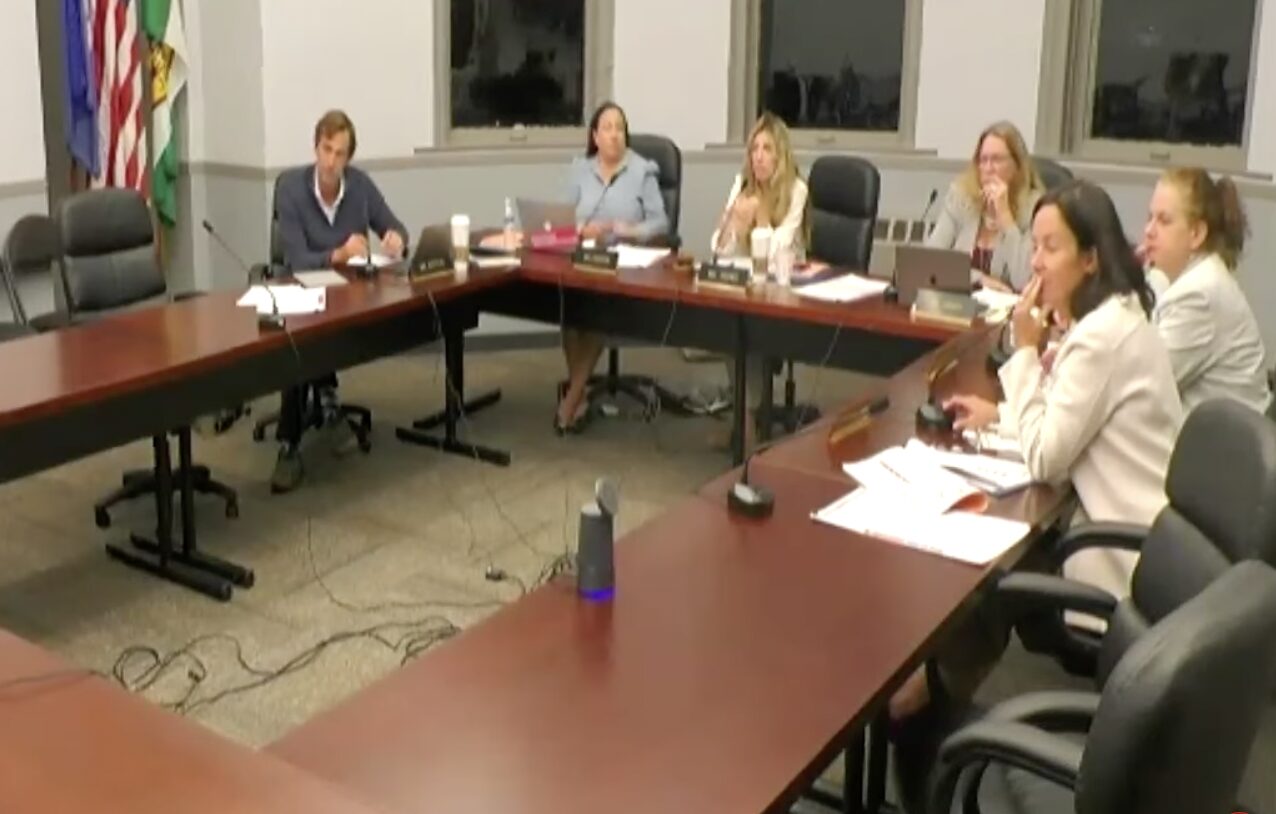
Oct 9, 2025 BOE retreat.
At the Oct 9 retreat, Jones suggested structuring GHS students by their class.
“When you’re grouped by 9, 10, 11, 12, one of the benefits is you have a team of people bringing in those freshmen and they really get to know the kids.”
She said organizing students by grade might also improve school spirit. She said she’d heard from parents that their children don’t feel attached to their houses.
BOE member Cody Kittle pressed GHS Principal Ralph Mayo and vice principal Dana Tulotta on their defense of the existing house system.
“Do you believe in it without an comparative basis?” Kittle asked.
“The house system works. Our scores are up,” Mayo said. “There’s a reason for that.”
“As a math teacher are you sure that statement holds up?” Kittle asked Ms Tulotta, who started her career at GHS as a math teacher.
Mayo said the five-house system was an efficient way to deliver services. He said students today require far more services than they did in the 1970s when the school was created with four houses.
“If you need support – and a lot of kids need support – there’s no better way than the house system,” Mayo said, adding that each house has a secretary, school counselors, psychologist, social worker and house administrator.
“They get to know their kids,” Mayo said. “It breaks that big school into five tiny schools. Lots of schools try to emulate GHS and put in a house plan, but they can’t because they’re not built that way.”
He said back in 1964 the town started a debate whether to replace the high school (now repurposed as Town Hall) with two new schools.
Instead, the current high school, which opened in 1970, was designed with four houses. A fifth house was added in the 1990 in conjunction with the construction of the science wing. At the time, a wave of an additional thousand students was anticipated.
“Our numbers for our guidance counselors are about 180 students per counselor. If we reduce a house then we’re adding kids onto counselors’ case loads,” Mayo said, adding that the college application process now starts much earlier than in the past.
During the retreat Jones also suggested changing the current 8-block/drop 2 schedule at GHS to a fixed 7-block schedule, which she said would result in 47 minute classes and over eight days, a gain of instructional minutes.
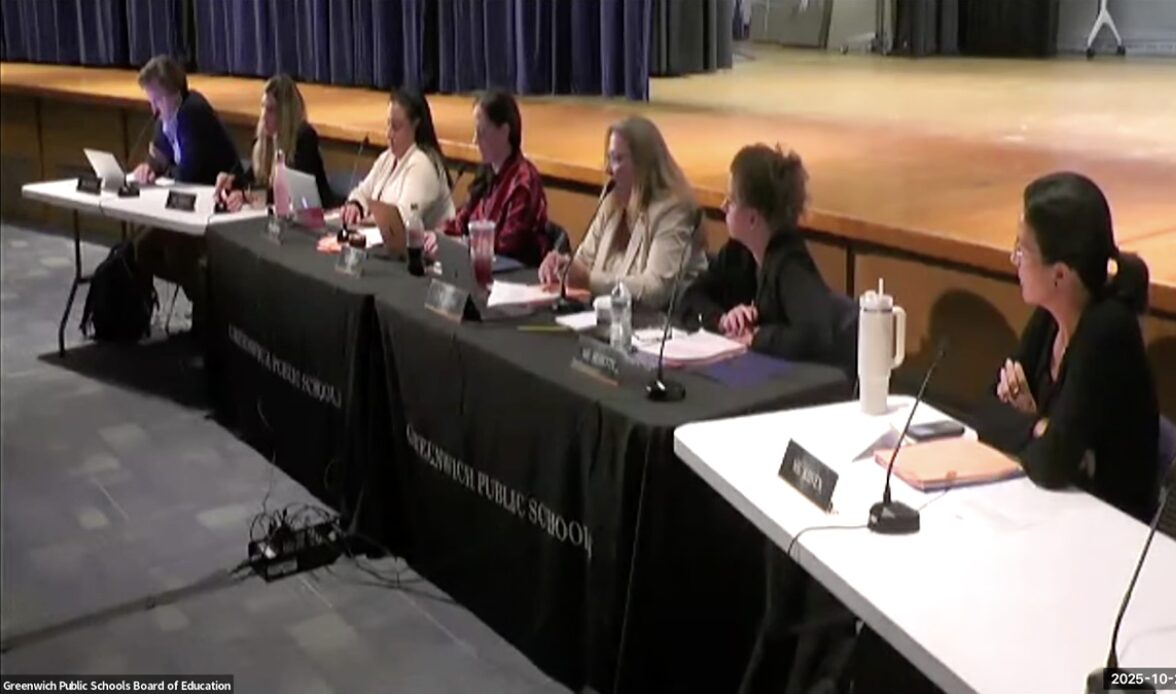
This current sitting school board will be seated at upcoming budget meeting on Nov 6 when Dr. Jones will present the district’s budget. (There will not be opportunity for questions, and no votes will be taken). Then, at Nov 20 business meeting, new members will be sworn in and officers will be elected.
At the Oct 23 BOE business meeting, during her superintendent’s report, Dr. Jones said the BET’s budget guidelines had yet to be set.
“They’re not published, we don’t understand exactly but they did. We know they’re at 3.25%, which would be about a $3.7 million reduction, to not cover our contracted costs again,” Jones said.
“The two big drivers are transportation and salaries. Those two items alone put us at about 4.9%. I’m hoping maybe it will change by the time they are published,” Jones added.
Teacher union president Margaret Jackins said the GEA would not support any program or budget changes that would result in the loss of FTEs.
“Over the past few years GPS has lost over 30 FTE,” she said. “Larger class sizes result in less individualized attention.”
Jackins urged the board not to change the GHS schedule from the current 8-block rotating schedule to a 7-block fixed schedule.
“Again the students lose: 8 blocks versus 7. That one is easy. Fewer class periods means fewer course opportunities.”
She said rotating schedules result in higher engagement and deeper learning.
“Rotating schedules have been shown to lead to better student independence and executive functioning skills. How is that not a win for students?”
PTA Council President Lisa Sylvester urged the BOE to keep the five house structure in tact.
“We understand enrollment numbers are being looked at, but please keep in mind that enrollment is like a wave, so we ask that you take a look at overall numbers before taking decisions.”
Also during public comment, John Fisher, who is now co president of the GHS PTA, brought up “program adjustments” that had been discussed late at the Oct 9 retreat.
“If it ain’t broke, don’t fix it,” he said, warning that changing the block schedule or house structure boiled down to eliminating courses and decreasing counseling.
He said PTAC did not object to consolidating 9th grade English and Social Studies from three levels to two, but they did not support changing the GHS block schedule or house structure.
“With Halloween around the corner, these look like budgeting cutting masquerading as policy,” he said.
“Replacing the 5 houses with 4 grade-level groupings was a regrettable budget-cutting idea that incited broad negative public outrage,” Fisher said. “Ignore that history and this board will be doomed to relive it.”
Mr. Fisher said changing the rotating 8 block GHS schedule to a fixed 7-block schedule was also a “terrible idea,” and would illicit public backlash.
“We call out the comment that this would ‘cut total sections, approximately 12.5%, which is where most FTE savings come from.’ Even even dressed up in fancy dress costume, it is walking and talking like cost cutting. It’s not good policy.”
Fisher warned that cutting 12.5% of the sections meant that more than one in 10 classes would be eliminated, making it harder for students to get the classes they need to follow their chosen curriculum sequence, get required courses, get elective courses to graduate on time and have the academic record they need to get into the colleges and careers they aspire to.
Several GHS teachers spoke also spoke, including Jessica von Brachel, who is a GHS parent, GHS graduate and now an English teacher there.
“I’m concerned that as these major decisions are being made about how our students learn, we’re missing the process. Complex and nuanced topics like leveling, weighting, schedules, elimination of courses, are being discussed without enough careful study of best practices and without a clear articulation of the purpose of proposed changes, and without time for real input from teachers.”
Aimee Bolash, a biology teacher at GHS, also mentioned the Oct 9 retreat and the possible move to a 7-block non-rotating schedule with classes 47 minutes in length and the premise that that over an 78 day cycle you gain instructional minutes for 14% more instructional time.
She said it would be problematic if in the case AP science courses, no extra lab blocks or doubles were included.
“From the first day of school til the Friday before AP exams begin our 489 AP science students have 144 instructional blocks, at 55 mins per block, for a total of 132 hours. A move to a 7-block schedule without lab blocks would allow 144 days of class at 47 minutes per block, for a total of 112.8 hours,” Bolash said. “This is a reduction of 14.5% instructional time in AP science classes prior to the beginning of AP exams.”
She said that represented a considerable loss in instructional time and must also be considered in the context of the College Board requirement that all AP science courses spend at least 25% of instructional time engaged in hands-on laboratory investigations.
She said the school’s 1,047 honors level students would be even more directly impacted, with a reduction in instructional time of 15.5% and that on-level and practical level courses would also see a .2% reduction in raw instructional time.
Bolash noted that today 291 students take two science courses in the same year. The maritime science program, with almost 200 students, would be unable to run their engaging, immersive and highly popular field experiences to Tod’s Point without laboratory double-blocking.
Alyssa Stack, a social studies teacher at GHS since 1999, teaching Global studies 112 113 and 113a and for six years serving as the department’s instructional coach until the recent cut, urged against changes that would impact Sem skills, where, in any given week one class may focus on SAT prep or passion projects, and that her class focused last week on rhetoric.
“Media literacy, time management, executive functioning, study strategies and so much more,” she said. “In Sem skills we teach students skills not addressed in other classes.”
She urged the BOE to vote to save Sem skills, which she described as “a special program that distinguishes GHS from its peers and helps students succeed in high school, college and beyond.”
GHS teacher Cara Peters said Sem skills develops transferable and professional skills that colleges and employers are desperate to have: time management, executive functioning, public speaking and collaborative problem solving.
She said strong growth in PSAT reading and writing test scores happened partly because Sem skills, done in a lab setting, was a “test preparation engine.”
She said it was not a luxury, but rather the humanities counterpart to a science lab that prepares students to thrive.
GHS teacher Kimberly Steinhorn the 48 block rotating schedule A-H was an effective way for students to take a wide variety of classes while earning the required 25 credits to graduate.
She said four years earlier, she served on a yearlong schedule analysis committee when Dr. Jones first proposed the idea of changing the schedule.
Steinhorn recalled that a rigorous analysis, that included an external advisor, determined the current schedule provided students the most choices and opportunities to take classes that are “exciting, challenging and required.”
She said the schedule includes opens which were critical for many to get their work done.
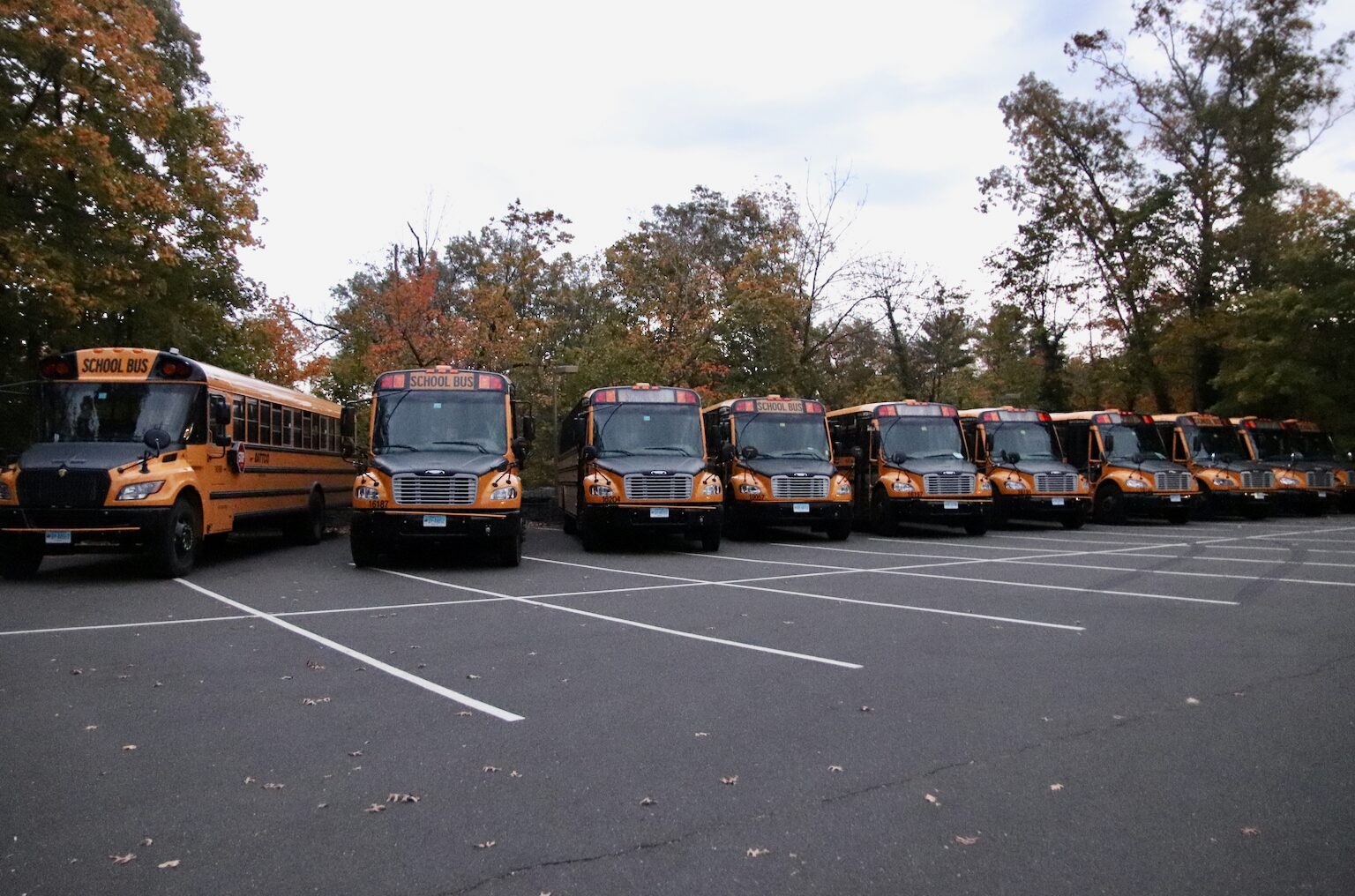
School buses parked in a parking lot behind Julian Curtiss School. Oct 24, 2025
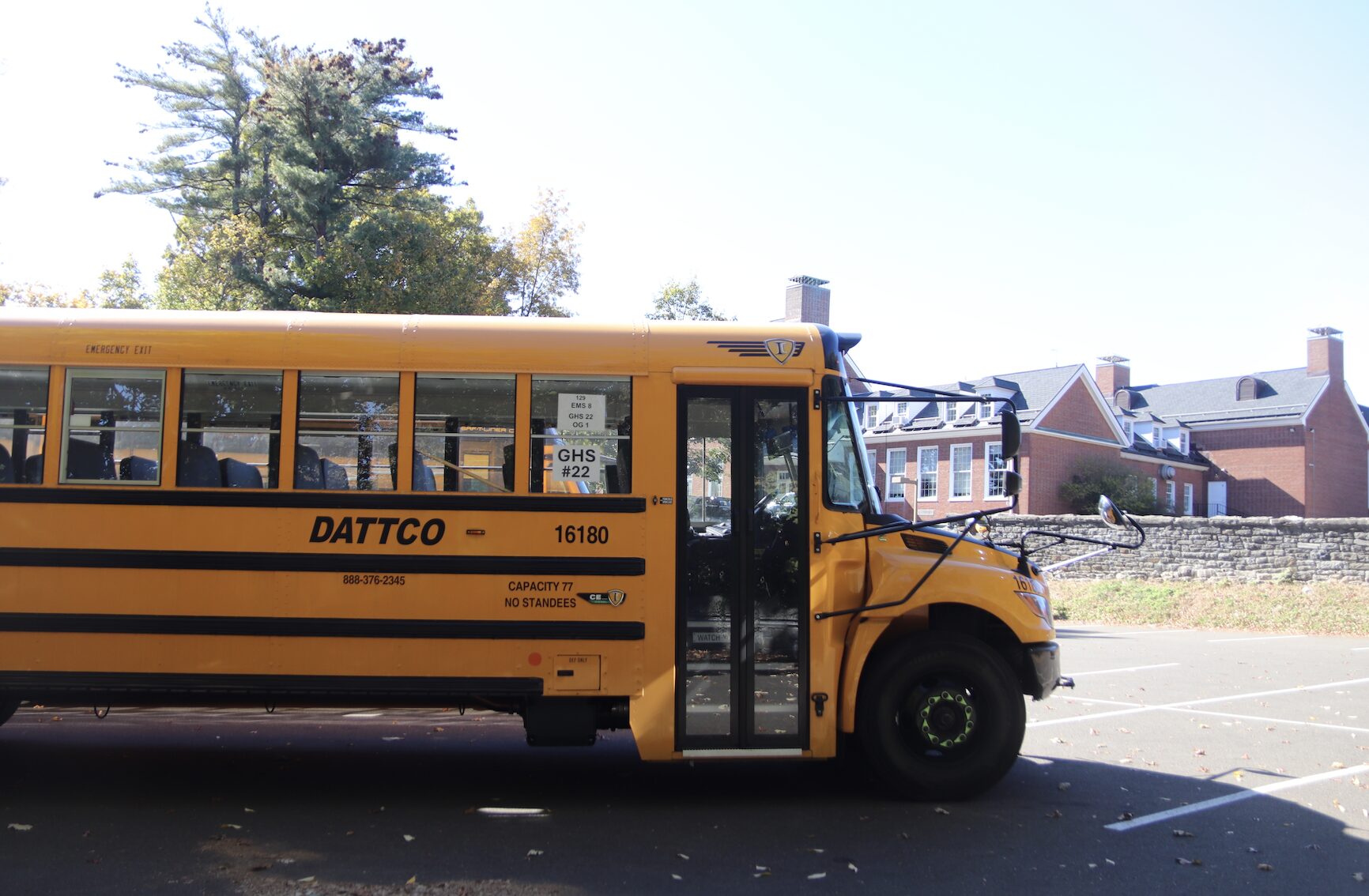
School buses parked in a parking lot behind Julian Curtiss School. Oct 25, 2025
Bus Parking and Transportation Issues
During Thursday’s public comment PTAC president, Ms Sylvester said the continued presence of buses parked at Western, and now Julian Curtiss School was disrupting the student learning environment and school facilities.
Frances Wu Nobay, the PTAC facilities representative, said the bus parking situation was “untenable.”
“We remain deeply concerned about the lack of bus parking and the ripple effects on staff parking, student recess, safety – not to mention the environmental impact. I understand the argument that it’s easier to negotiate bus contracts deals when parking isn’t bundled in, but at this point, that approach feels shortsighted,” Nobay said.
Dr. Jones said administration led by Ben Branyan had looked at over 40 potential sites to park school buses.
“We have also looked at acreage within driving distance – that’s on our radar with a real estate developer. We get really close and then the developer changes their mind. We still have a few places in play but we’re also looking at acreage.”
Buses are being parked at Western Middle School, Old Greenwich train station, Julian Curtiss School and some at Parkway.
She said drivers are parking their personal vehicles in the Island beach parking lot and taking a shuttle to their buses at Western.
Cody Kittle defended against an earlier comment about being “short sighted” in the bus parking situation.
“It’s important to recognize when we were dealing with the old bus company the reason they scrapped the contract we had is with fixed pricing is they felt they had a monopoly pricing power over us and the long term implication of sticking with that is exorbitant price increases every year. Ben and the team – it’s painful and a lot of work – once we get to a solution, being focused on the long term impact, it’s going to be so much better because we won’t be subject to monopoly price increases. It’s short term pain, long term gain.”
Ms Hirsh described the bus situation as “the perfect storm.”
“With the cut to our budget, we had to make a lot of changes. We changed start time and we changed bus companies, and had an entirely new bus system put in. We had a new transportation manager,” Hirsh said. “It’s unfortunate all those changes happened at once.”
FY 27 capital Budget
Later in the meeting Karen Hirsh motioned to approve the FY 2027 capital budget $7,823,000. Budget chair Kittle said he felt lucky to have this as my last capital budget to approve and not next year. Future years are going to be lively conversations. “Thank the heavens the (GHS) pool issue got delayed because I would not want to be involved,” he added.
The motion passed passed 6-0 (Mercanti-Anthony and Vizzo Walsh not present),
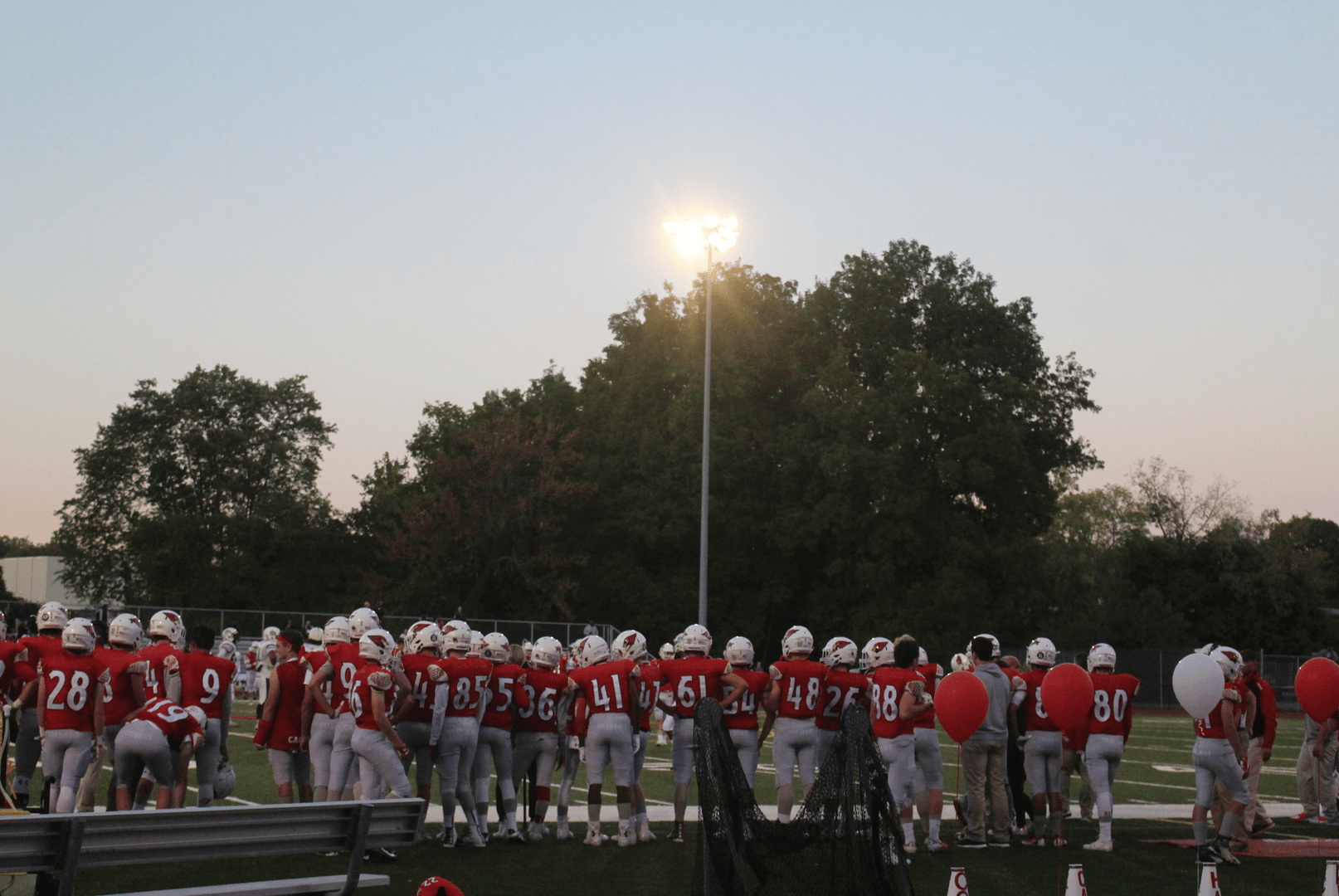 Cardinal Stadium Lighting
During public comment Randy Caravella urged the town to pursue expanded use of stadium lights. A founding member of the GAF, he wanted to ‘correct a mistake that has limited the rights and opportunities available to our young people.’
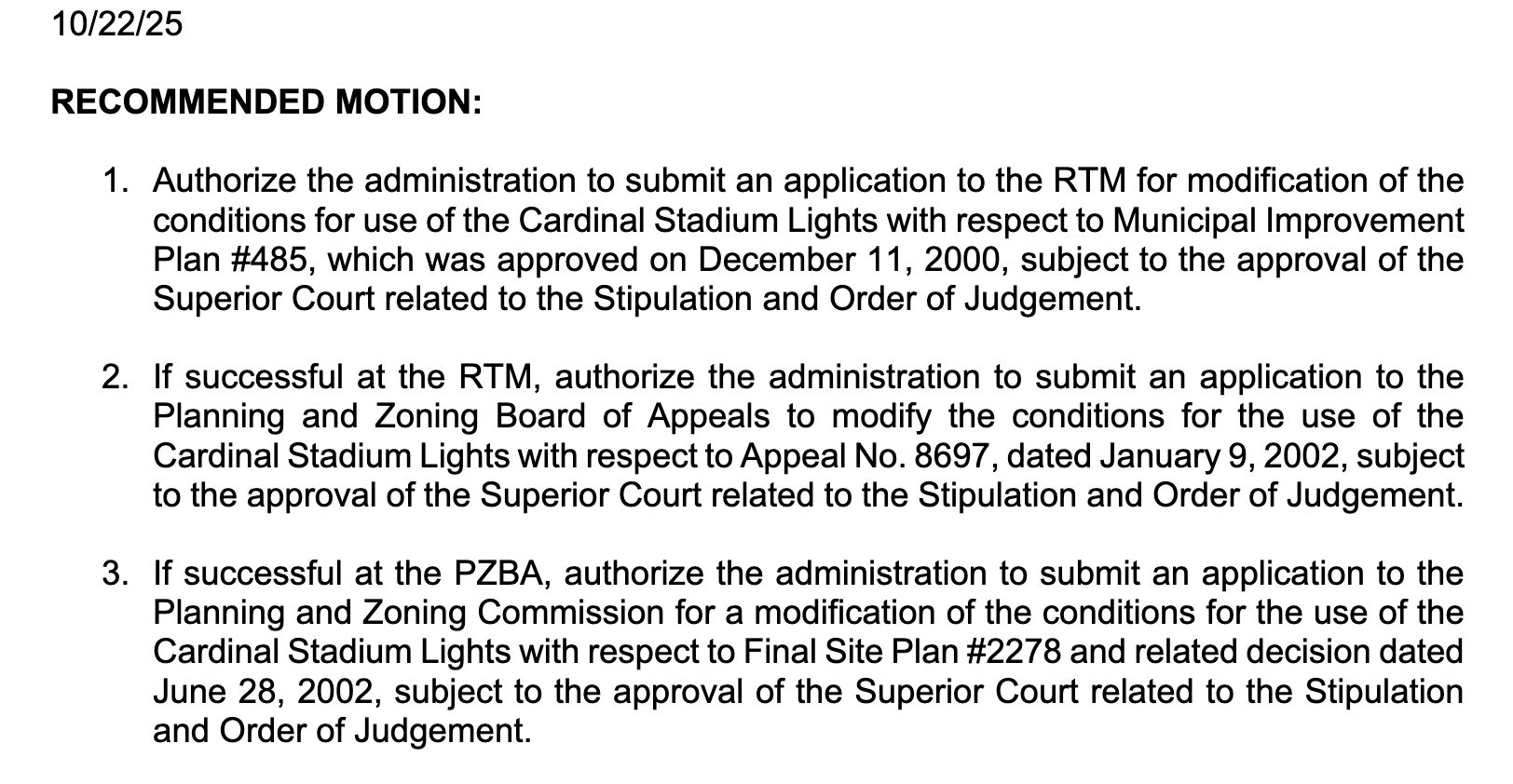
During board discussion on modifying the conditions for Lights at Cardinal Stadium, district COO Ben Branyan explained the legal process, suggesting three motions. (below).
He said modifications would require a very lengthy linear process, starting at the BOE, then RTM, then P&Z Board of Appeals, then P&Z, then Board of Selectmen, and lastly moving to superior court.
He said motion 3 was the “biggest” proposed modification.
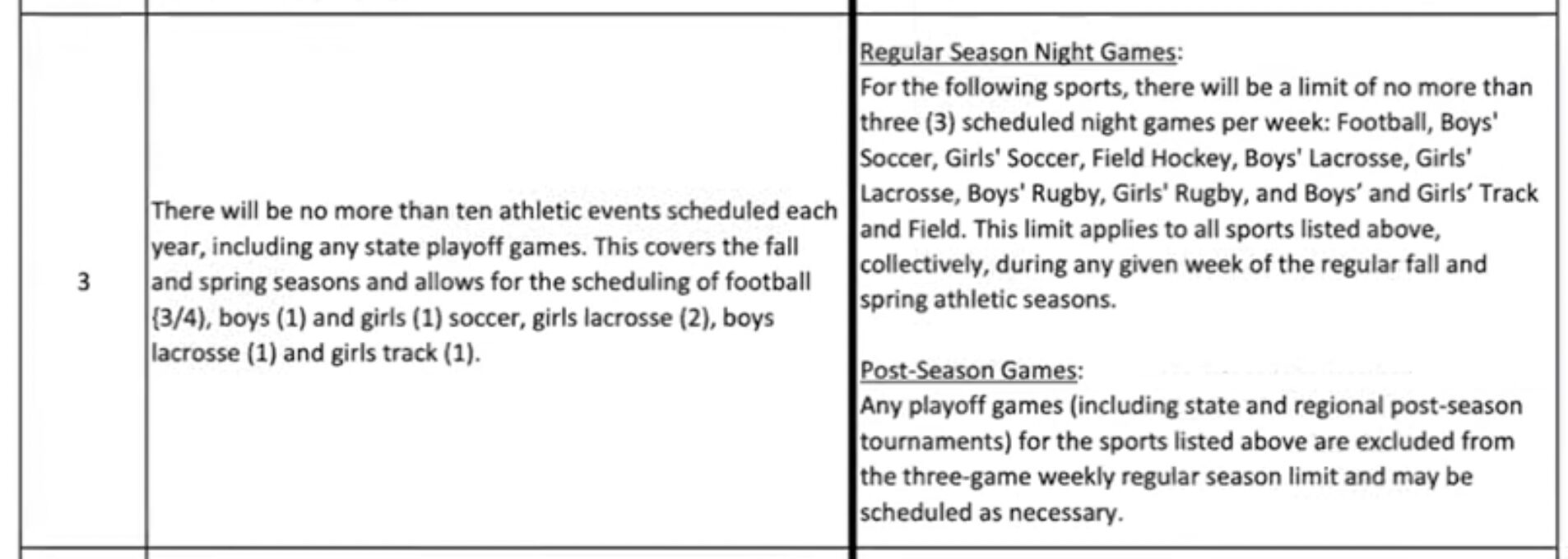
(Existing as approved by RTM in 2000 and P&Z in 2002 on the left. Proposed in 2025 at right)
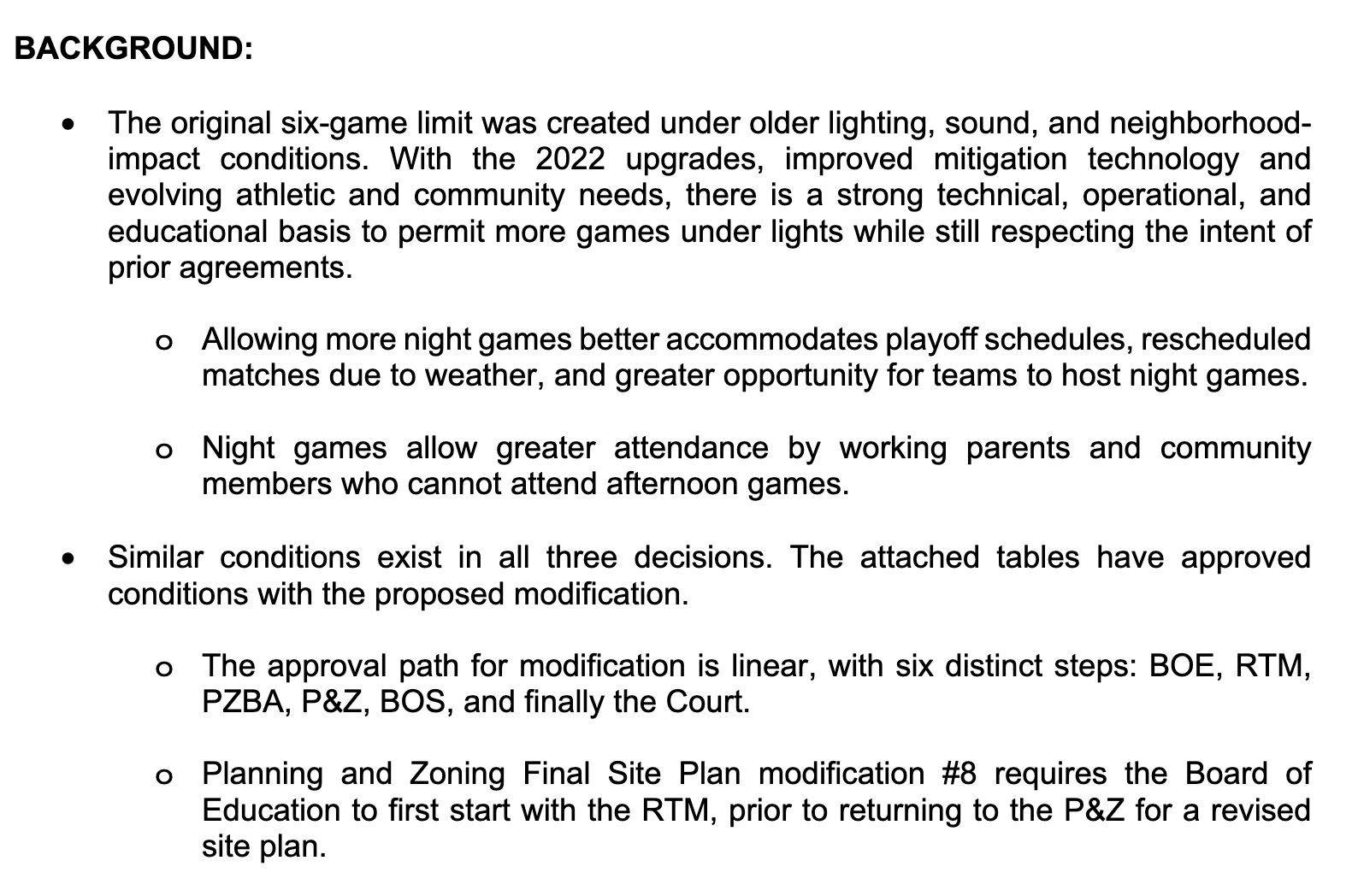
The board voted to approved each of the three motions 6-0 in favor.
Freshmen English and Social Studies: Consolidate from 3 sections to 2, unweighted sections
As discussed at the retreat, the BOE took up changing freshmen English and Social studies model from three sections to two unweighted sections at the Oct 23 business meeting.
BOE member Laura Kostin opposed the motion.
“I value all 3 levels and I don’t think we should consolidate or eliminate any of them,” she said. “It’s a system that is working and I don’t see any reason to break it.”
Program chair Brigid Barry said, “We could work with 2 levels with lots of differentiation. We strongly feel it should not be weighted because it’s a transition year – students need to grow in their skills. It’s skills heavy. We don’t want to get them into a groove where once they’re in it, they won’t be able to go up to other levels.”
She said students make tremendous growth in freshman year and following year they can sort to a variety of levels.
In grade 10, sophomores have four levels: 211 very supportive, 212 on level, 213 honors and AP level.
“We have (freshmen) who were in the on-level who go to honors, and students in accelerated go to on-level,” she said.
Dr. Mercanti-Anthony said he supported the change.
GHS social studies coordinator Lucy Arecco recommended renaming the courses, for example, English and English Accelerated and Global Studies and Global Studies Accelerated, instead of numbering them and Ms Barry agreed.
“I think the elimination of levels eliminates some tracking and supports students to higher aspirations,” Dr. Mercanti-Anthony said.
Ralph Mayo said once 113a was added, parents and students started looking at 112 as a non-college prep class. “It is a college prep class but that’s not how it’s perceived.”
“I think having two levels is much more appropriate for our students than three,” Mayo said, adding that when students they go into sophomore year there would be honors, AP, regular level courses.
Mr. Kittle said he had been skeptical, but had changed his mind since the Oct 9 retreat.
“My impulse is always anti-progressive, so I was questioning this one. But upon further digging into it, I think it’s quite compelling. It’s one thing if you’re taking a top class and pulling people lower, but you’re taking at the bottom and pushing people,” Kittle said.
A motion passed to adjust freshman English and Social Studies from 112, 113 and 113a to a two-section model, to be renamed, at teachers’ discretion, with both sections to remain unweighted.
The motion passed 5-1-1 with Kittle, Mercanti-Anthony, and Koven voting yes, Kostin voting no, and Hirsh abstaining.
After the action items were discussed, Dr. Jones presented the highly anticipated enrollment report.
She said enrollment including Pre-K to grade 12, across all 17 schools and programs, including Windrose and Community Connections the district enrollment was down by about 120 students in 2025 from the previous year.
“While some people think that’s a big number when you spread that out across all the many grades and buildings, it’s it’s not super impactful.”
outplacement and settlements…”Last year at the end of year we recaptured some of the outplacement funding. So it’s nice to see this not going up year after year.”
Page 3 has the enrollment report by grade.
“You’ll notice we still have some larger classes at GHS that are 676, 674 – smaller than they were five, eight, ten years ago, but still larger in comparison to the district. What’s going to happen in the high school is over the next couple years their enrollment is going to continue to go down. Next year it’s down another 80 (students), because you have grades 6, 7 and 8 pretty small class sizes that will come through. Our 6th grade class is only 563 students, 7th is 611 and 8th grade is 598. ”
But, she said with the number of younger children, now in second grade and third grade, enrollment will rise.
Page 9 breaks down “high needs” by school.
Page 11 has information on racial balance.
“There is discussion about legislation that would go in and study this. What I’m asking for from our state representatives, is if the will is not there to pause it or eliminate it – it really impacts Fairfield and West Hartford and us. It’s disappointing to say Greenwich is out of balance when we actually have a very diverse community and diverse school district.”
The report includes information on magnet students and tuition students. Kindergarten data reflects the recent change in legislation about cut off dates for five year olds.
Page 20 shows enrollment in private schools.
“What you’ll see is GCDS, because they’ve added classes and expanded offerings – they’ve been going up, but most of the private schools are either flat or in decline – similar to enrollment across the country,” Jones said.
Jones said for example, enrollment from Greenwich residents at Whitby was 263 students in 2016-17 and dropped to 194 in 2024-2025. Greenwich students at King School was 156 in 2016-2017 and now is 101 students.
An IT report was presented by Mike Ting, who touched on the cellular improvement project at GHS. He said it was a two-year project in response to the $1.1 million request, breaking it down to $600,000 the first year and $500,000 this year.
He said the project would bring reliable mobile service to every corner of GHS including “tricky basement classrooms.”
Ting said that reflected that students are coming in with more devices connected to the internet like smart watches.
“Have we not had any cyber security takeovers or attacks?” Kittle asked.
“We get attacked constantly, but we have protocols in place. We have a 24/7 monitoring system in place which detects and mediates a lot of those attacks. None of the attacks have been successful.”
“The last successful one was in 2019 and was performed by four GHS students from the inside,” Ting said.
Teacher absentee monthly report was presented by Jonathan Budd, the district’s chief HR officer. He said absenteeism in the first 7 weeks of this year compared to the previous years, had dropped for teachers and administrators.
See also:
Greenwich Board of Ed May Consent to Town Litigation of 2003 Lighting Restrictions for GHS Fields
Oct 19, 2017