Greenwich Country Day School went before Greenwich P&Z with a pre-application for a new 2.5-story, eight-unit apartment building, 12 pre-fabricated three-bedroom townhouses, a pre-fabricated 2,853 sq ft addition to the faculty day care facility, and 28 parking spaces.
In 2006 the commission approved 20 units. Today the total units on site is 43.
Since GCDS took over the former Stanwich School campus for their own high school, there are more staff, and due to turnover there are young members staff seeking daycare.
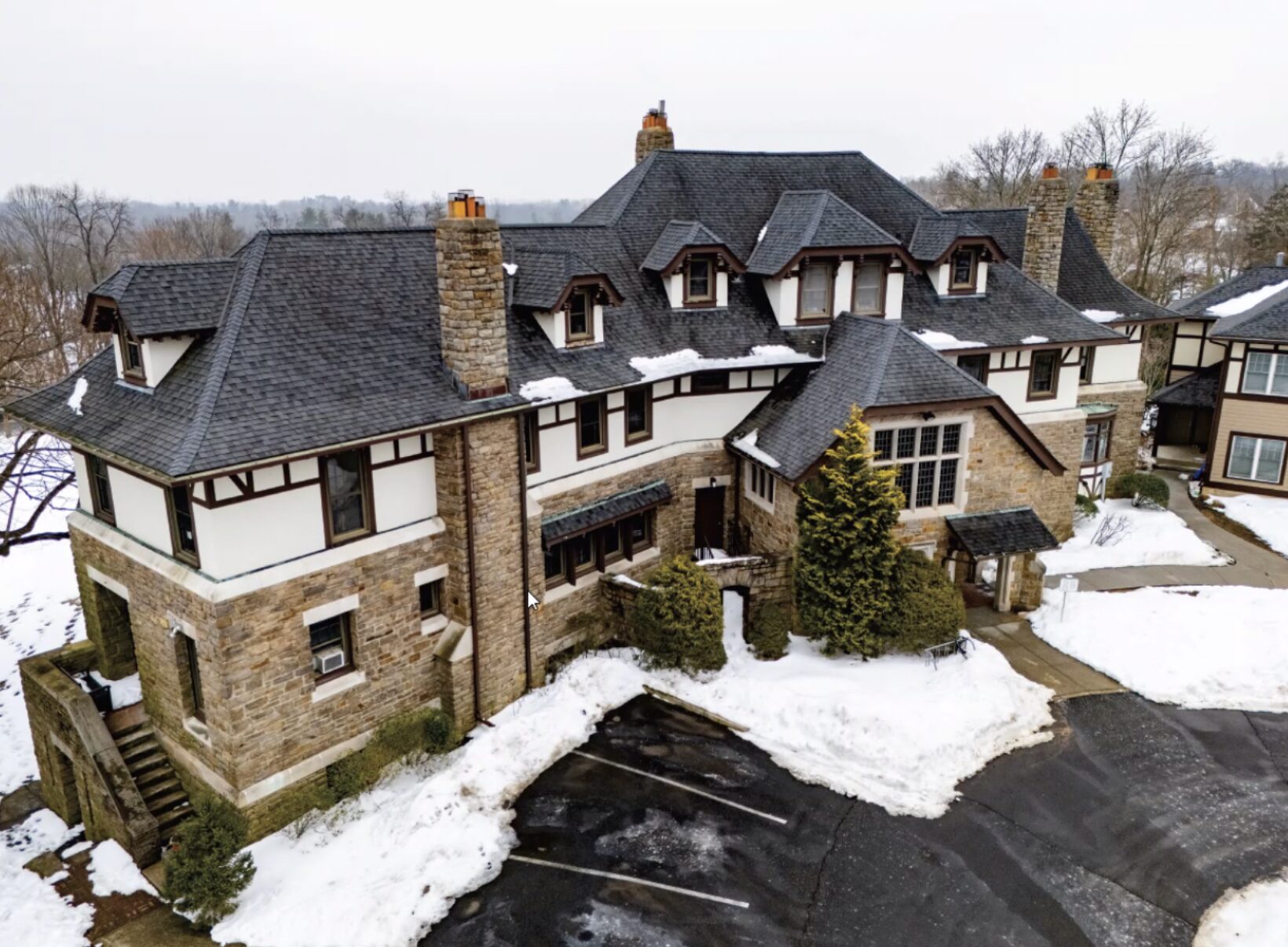
Former Schwarz mansion today contains 9 apartments for GCDS staff.
Michelle Cronin said the Schwarz Campus is 41.5 acres in the RA-1 zone and the school does not get any FAR bonus for educational use.
The Schwarz Campus at 23 Fairfield Road was originally developed as part of the F.A.O. Schwarz estate, which goes all the way down to Cardinal Road.
Even if the school added the units, they would still have FAR left, but the discussion revolved around the proposed apartment building in the RA-1 single family zone.
Cronin said the multi-family buildings are modeled after the original Schwarz mansion, which today has 9 units in it.
She said while the proposed building would be prefabricated units, they would be “Tudoresque” to mimic the original mansion.
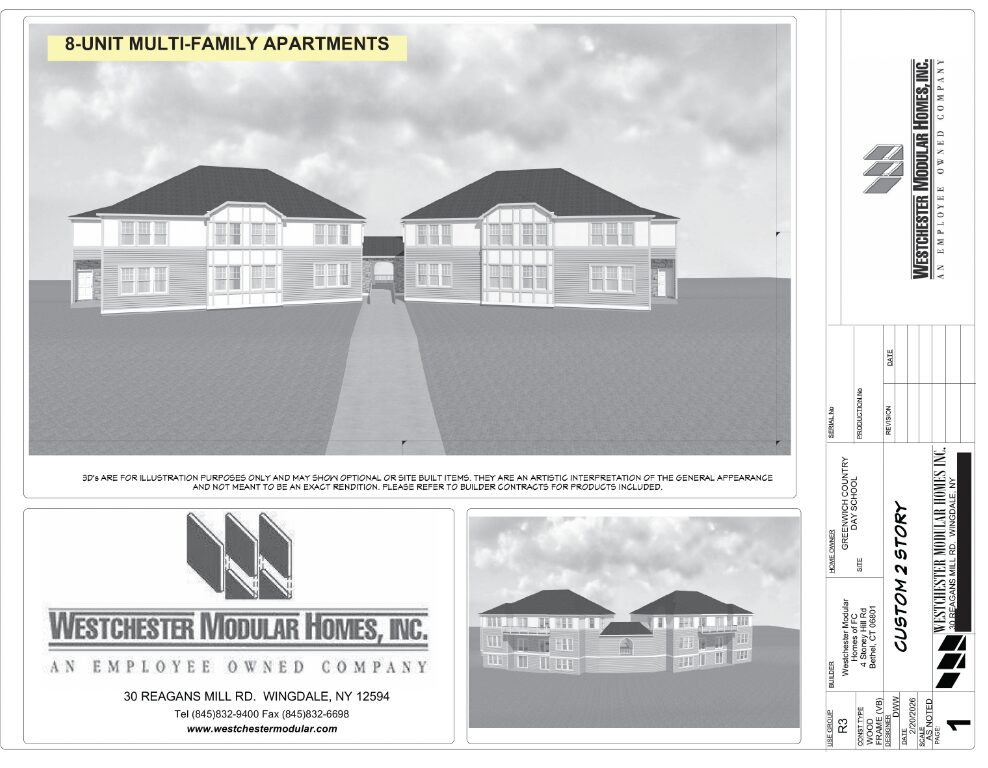
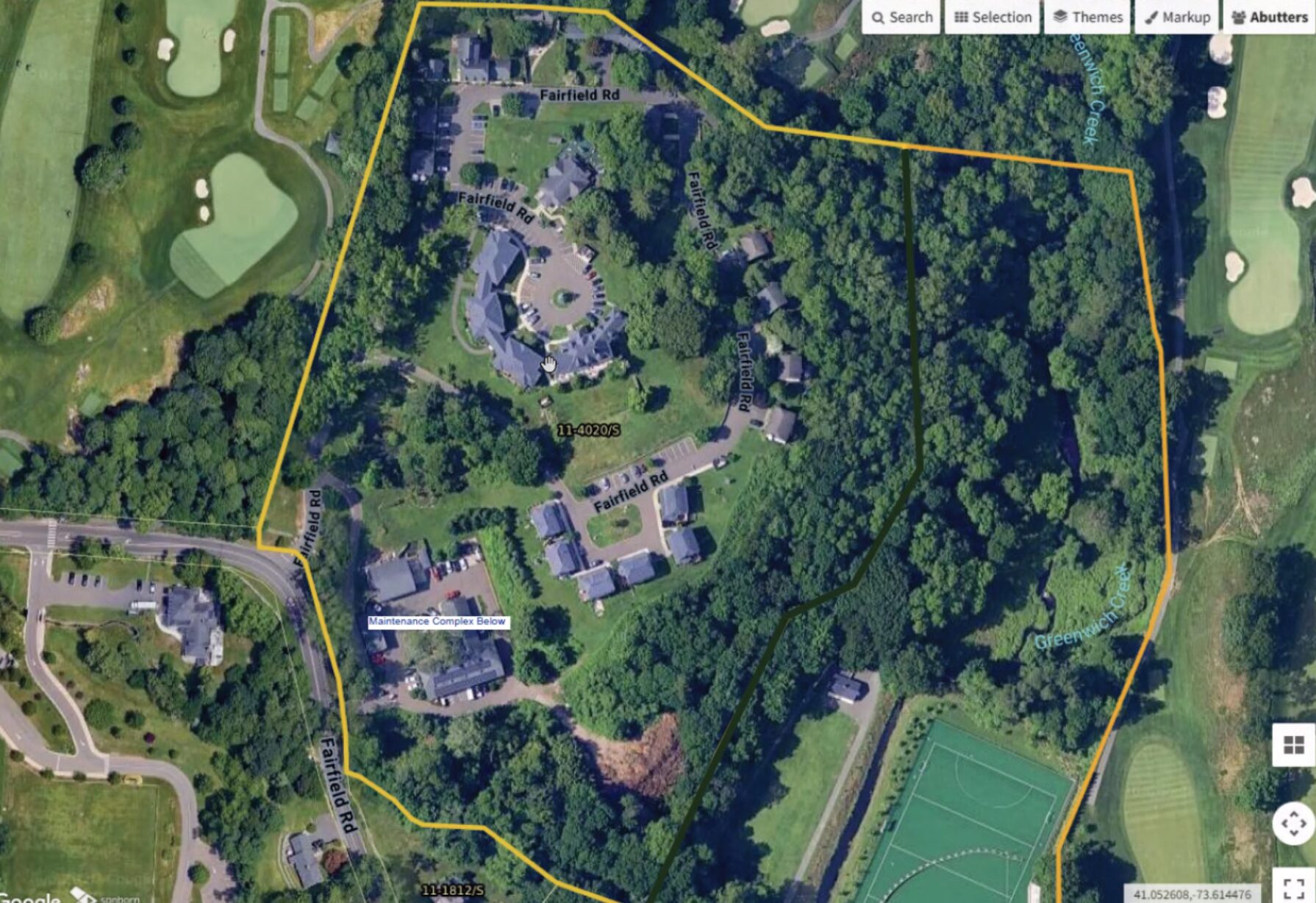
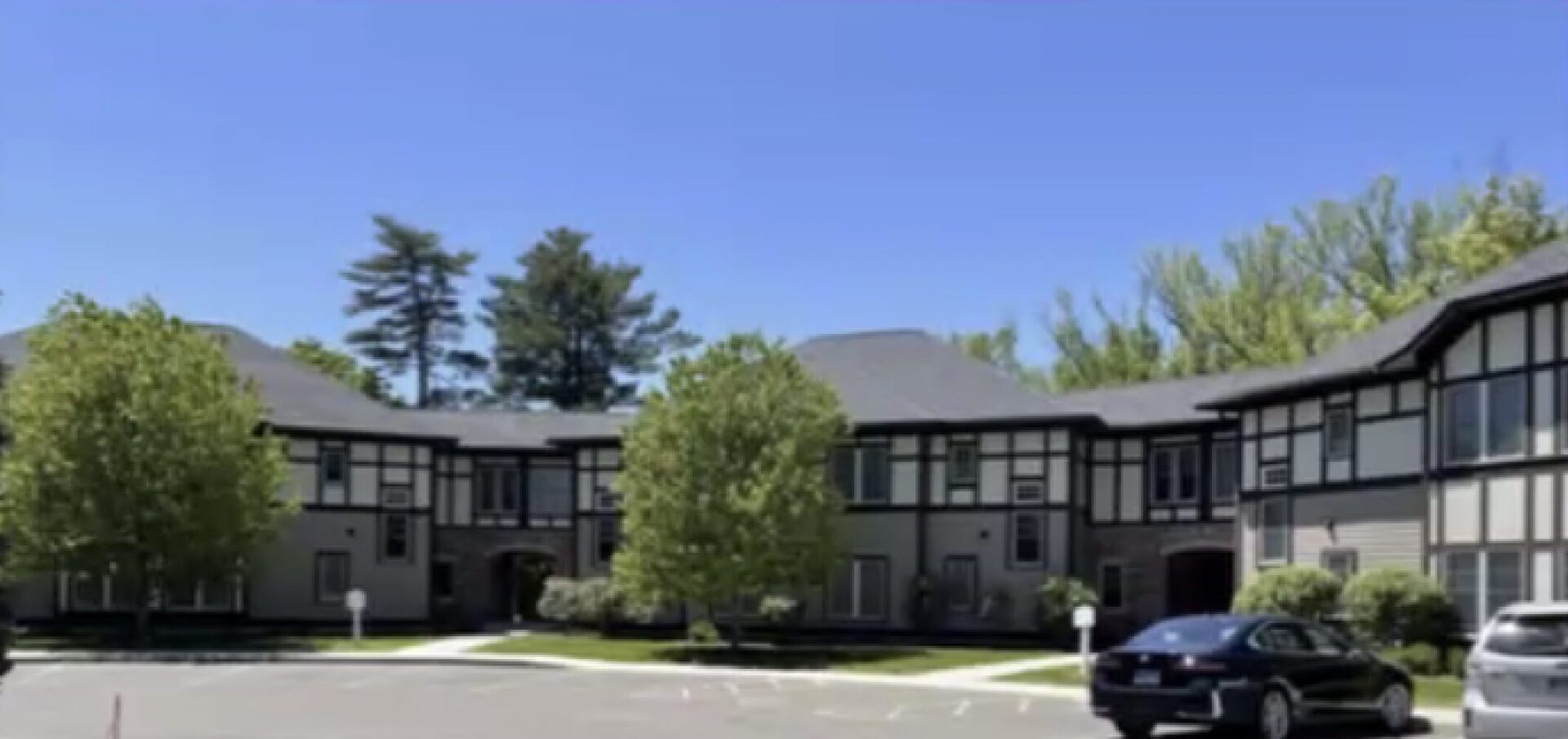
Existing staff housing does not appear as one large building because the facade is broken up to appear like separate buildings. Proposed apartment building would mimic this “Courtyard” housing.
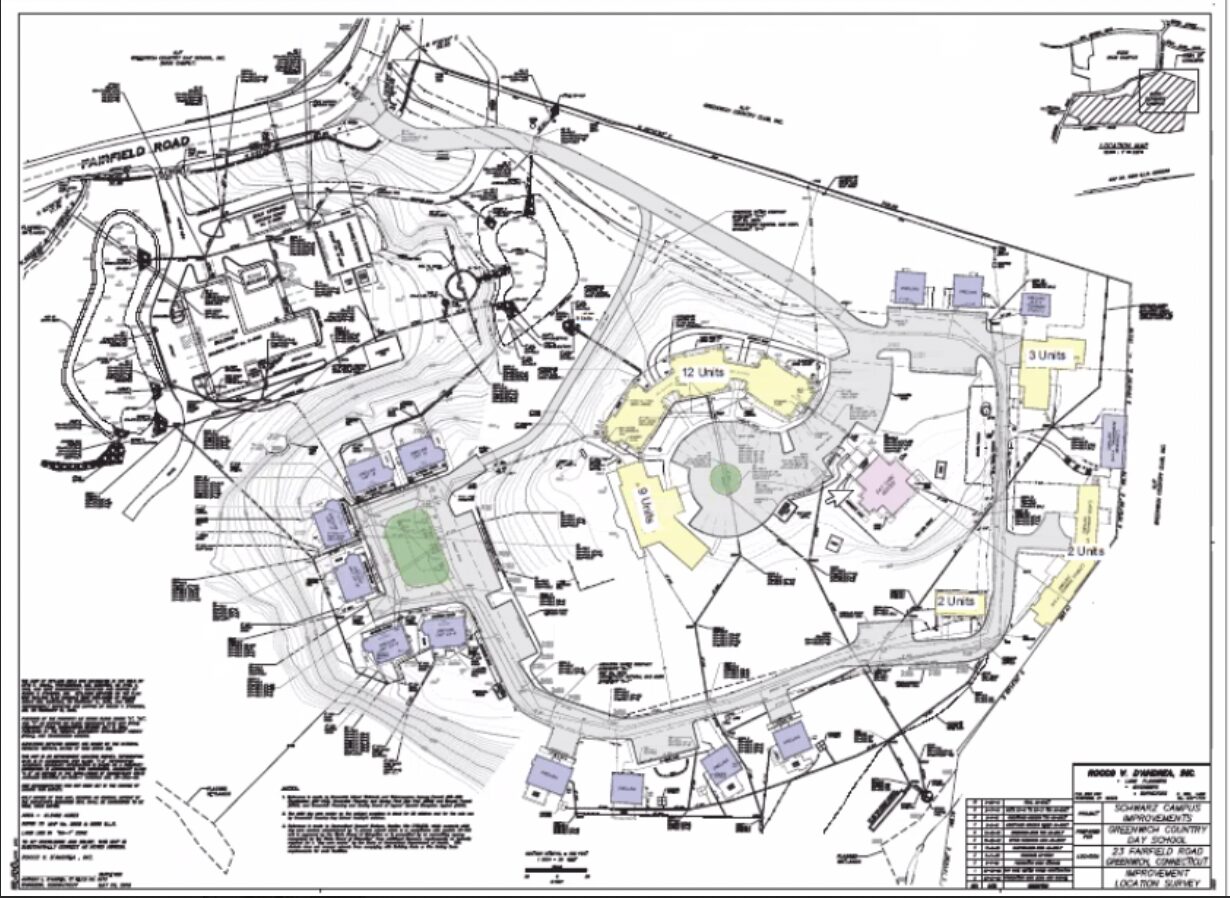
Buildings highlighted in yellow are multi-family buildings. Buildings in blue are single family structures and the pink is the existing daycare.
She described the housing as “tucked away,” and not visible from the street.
And, although the town doesn’t get credit for it, the units would be “workforce housing” for employees who want to live close to where they work.
P&Z chair Margarita Alban acknowledged that the additional units would result in fewer commuter trips in and out of Greenwich.
Cronin said there is a shuttle service for staff who work at the high school campus on Stanwich Rd, but others would likely walk to the main campus.
There is a waiting list of 43 people for on-campus housing.
Commissioner Peter Lowe asked if the proposal was part of a longer term master plan for more housing.
“It seems to me you have all this demand and you’re fortunate you have all this property,” he said.
About 20 years ago the school housed about 70% of their faculty on campus, but now they only house about 40% of faculty, reflecting the opening of the high school and the additional staff.
Commissioner Nick Macri suggested that when the applicant returns Ms Cronin explain how the additional housing benefits the town.
“It’s housing for the school, specifically, on their property. It’s not on the tax rolls. Where does the Town benefit from this, other than it’s housing for a private school?” Macri asked.
Ms Alban said the state will be assigning Greenwich “housing targets,” and the state may require an overall housing unit availability target from the Town.
“Not enthused about the apartment building idea,” Alban said. “Understanding this is not visible from the street, and understanding it does not affect the character of the neighborhood because it is not visible.”
Macri noted today there are large buildings around a courtyard including townhouses and the original mansion.
“I’m seeing connected townhouses. I’m seeing a large parking lot. I’m seeing multi-unit duplexes. To me this is a large commercial development in a part of town that probably shouldn’t have been developed with large multi-family. Understanding it is a school and set back. Regardless of who it serves, what I’m thinking and seeing is a commercial development,” Macri said.
Ms Alban said when the town wrote its affordable housing plan was written, it said housing growth would focus on areas that are on the Town sewer lines, which this site is.
“The State language Public Act No 25-1 talks about housing unit growth – having more units,” Alban said. “Second, this one is not visible from the street, but another one would be. If we’re doing an ‘apartment building’ on a campus and school that isn’t visible, the next school will come in and ask us for one that is. So, we’re then in a sticking point because we have to treat people with uniformity.”
P&Z alternate, Mary Jenkins said there would not be a lot of site disturbance.
“You’re not taking down trees. You’re not opening anything up. You’re just filling in the space you have now between private houses on one side of the circle and your existing multi-family on the inside,” Jenkins said.
GCDS head of school Adam Rohdie responded to Mr. Macri’s comments.
“In terms to the benefits to the town, please know that we’ve entered into a pilot agreement with the Town where we’re offering significant yearly payments to the town. Any increase in the number of houses we add to the property will increase that amount that we will pay to the Town.”
“If this was not a school and was just a neighborhood developed with these residences, and a private developer was coming in to do this work, we would have a level of scrutiny that would be very critical of what’s going on. Every aspect of it – architecture, infrastructure,” Macri said.
“I’m separating its use as a housing development – yes, it benefits the school – but to me it’s a commercial development of residential units,” Macri said.
Ms Cronin said the Town has regs for conservation clusters that apply to residential developments.
“We’re keeping the development in an area that is already disturbed so that the rest of the hill and the field can all stay open. It’s very green right now,” she said.
Mr. Lowe told Mr. Macri that he struggled with the “commercial” label and did not see the “detriment to the Town.”
“It seems somewhat pejorative,” Lowe said. “They have the great luxury of having this land…It’s basically invisible for the garden variety citizen using Fairfield.”
As for the daycare, Ms Cronin said as teachers retire, new, younger faculty are having children and there is a need for expanded daycare.
P&Z commission alternate, Brooks Harris said the discussion would be “enhanced” if the state laws were more conducive to this kind of proposal.
“Statute 8-30g doesn’t consider this Affordable Housing when a lot of people would look at this as low cost housing… I would suggest that going forward, if you could engage that debate and change the rules to be more conducive to these kind of projects – that might make this discussion easier.”
Alban explained that HUD definitions of affordable housing refer to avoiding selection bias.
“The moment they are only hiring teachers, it does not count as affordable housing because you have a selection bias by class,” she said.
“It could inopportune other protected classes and therefore, it is not deemed acceptable under the Fair Housing Act. So it’s federal. The argument that is in the Dept of Housing Policy, if you potentially are disadvantaging a class of citizens – like the disabled, or ethic or whatever – by having this preference, then you are violating federal law.”
Alban noted the proposal would reduce trips to campus, and the applicant might make the case that overall traffic demands would be reduced, and cite where teachers on the waiting list for housing live currently.
Also, she said the applicant might consider reducing impervious surface and flexibility with modulars to break up their appearance as one large building.
“So that it doesn’t look like a single fronting apartment building, and has depth changes,” she said. “I’m thinking more about if someone else comes to do an apartment building, and they’re right on a street we see all the time, like North Street.”
“What if St. Michael’s wants to do this?” she asked. “You want your approvals to be as consistent as you can. So let’s do something that if you picked it up and moved it to St. Michaels, it would also be okay.”
The commission agreed with the applicant that a site visit would be useful.
The item was a pre-application and will return to the commission at a later date.
See also:
P&Z Commission Skeptical about Fitness Use in Cos Cob LBR Zone