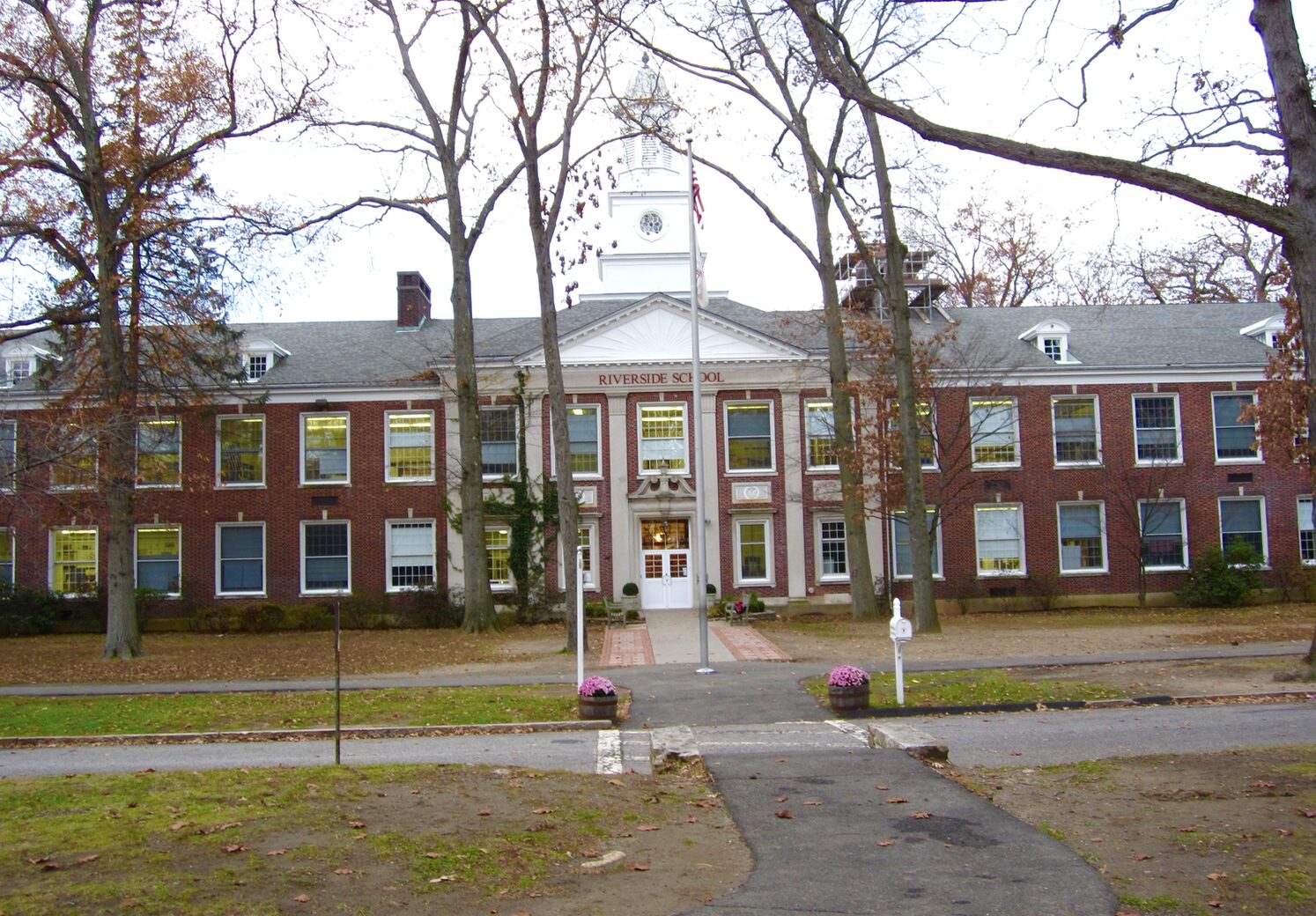
At their last meeting the Greenwich school board took up an action item to restore two Pre-K classrooms to the ed specs – detailed planning documents used in school construction and renovation – for the Riverside School renovation project.
Adding the Pre-K classrooms back into the ed specs allows the district to secure an additional 15% state reimbursement rate applied to the entire project’s construction cost because Connecticut now provides the higher state reimbursements to encourage the expansion of early childhood education, including structural funding for districts facing space constraints.
Adding the Pre-K classrooms back into the project is expected to save the town up to $5 million.
The Pre-K classrooms were originally in the ed specs but were removed by the BOE back in Feb 2025.
Riverside has waited its turn for a renovation, with a new Central Middle School and renovation at Old Greenwich School coming first.
At the 2026 BET budget hearing, a Riverside School PTA member said the school had some of the smallest classrooms in town, averaging 738 sq ft, significantly below the state standard of 850 sq ft for grades 1-5 and and 1100 sq ft for kindergarten.
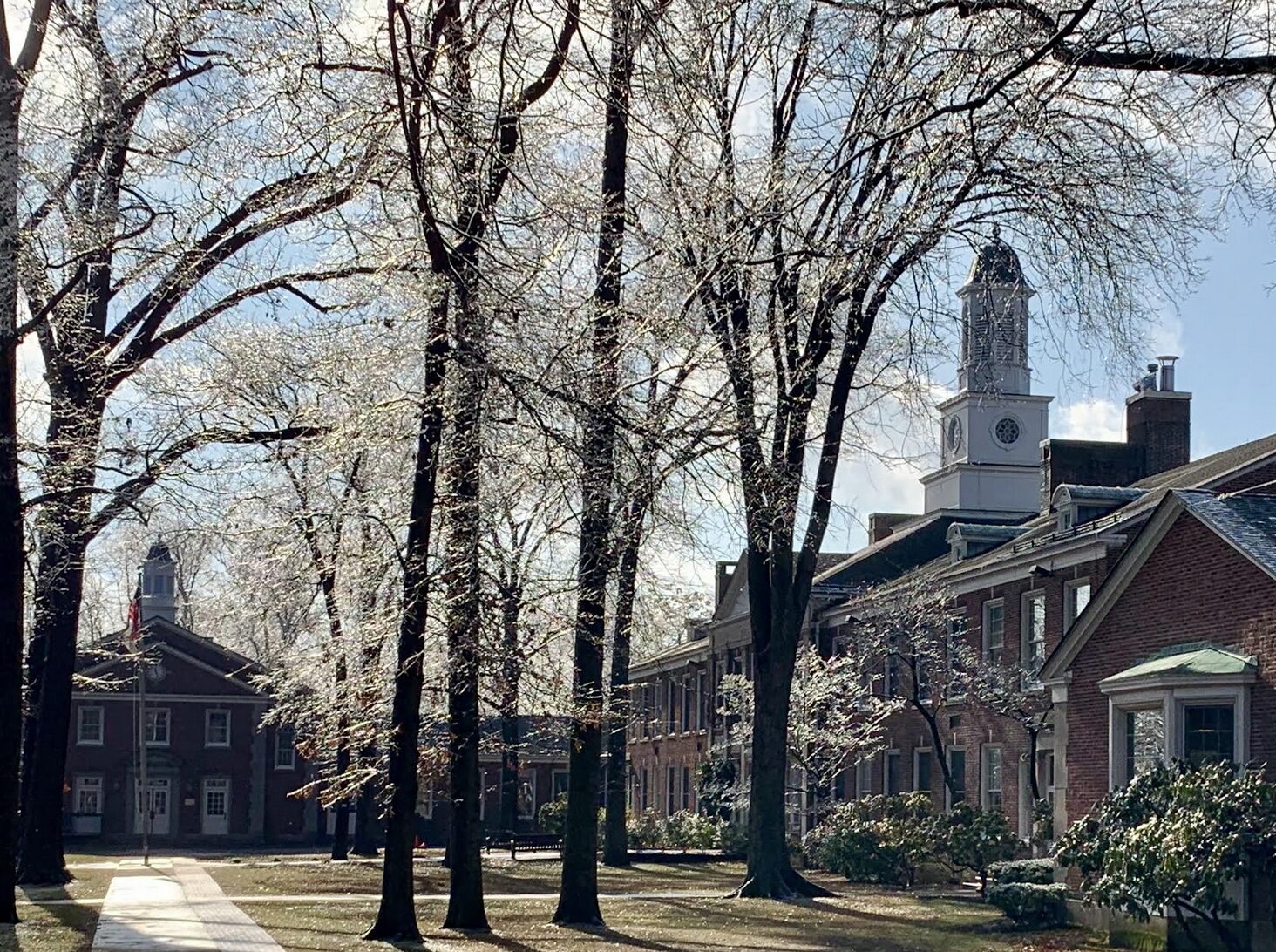
The main building was originally constructed in 1932. The school’s enrollment today is 431 students.
Riverside’s deficiencies include:
• Lack of an elevator and other ADA necessities
• Main entrance security shortcomings
• Lack of sprinkler system
• Undersized kitchen and cafeteria, resulting in long lunch short lunch shifts and some students eating very early and others eating late
The Riverside building committee was formed earlier this year and is in the process of selecting an architect.
For 2026 there $2.0 million was budgeted for architectural and engineering work. The price tag for construction in FY 2027 is $48 million.
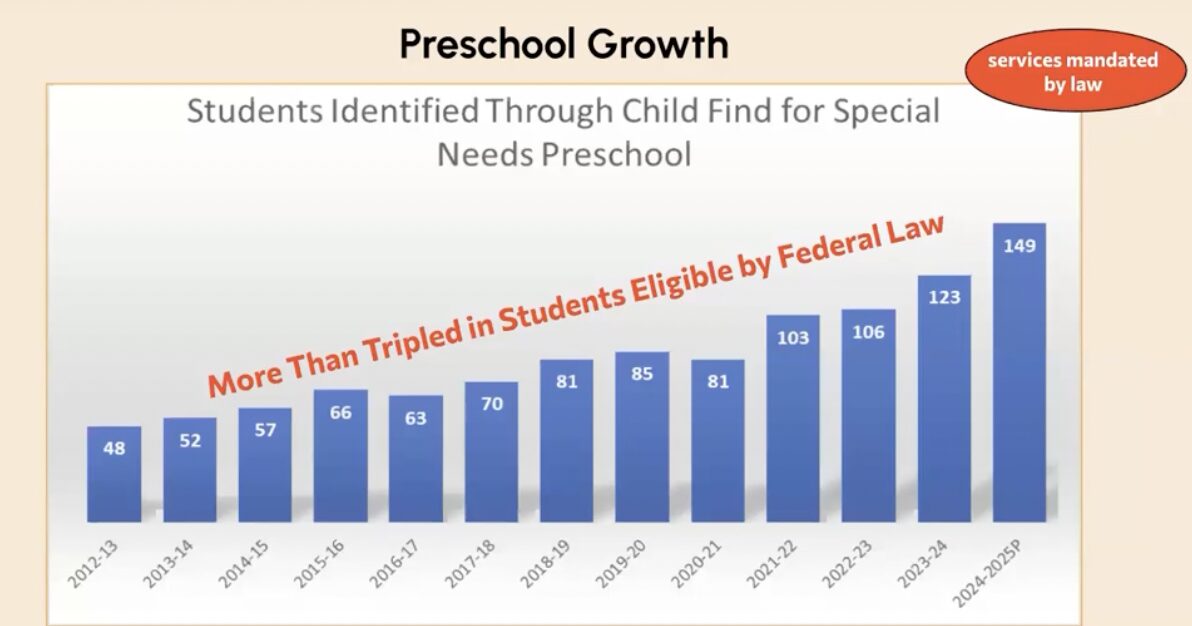
Special education is required by federal law, Individuals with Disabilities Education Act (IDEA), and 3 to 5-year olds are entitled to free special education in a “regular class,” in a setting with typically developing peers. This reflects the mandate for “Least Restrictive Environment,” which requires that children with disabilities are educated alongside nondisabled peers to the maximum extent appropriate.
At that February, 20 2025 school board meeting, superintendent Dr. Jones Jones and Chief Officer of Special Education Dr. Stacey Heiligenthaler gave a thorough presentation on the district’s Pre-K situation.
The number of children eligible for Pre-K in Greenwich has tripled since 2012. Dr. Heiligenthaler said the trend is not unique to Greenwich.
The ratio for Greenwich Pre-K classrooms is 15 students: 9 peers and 6 special needs students.
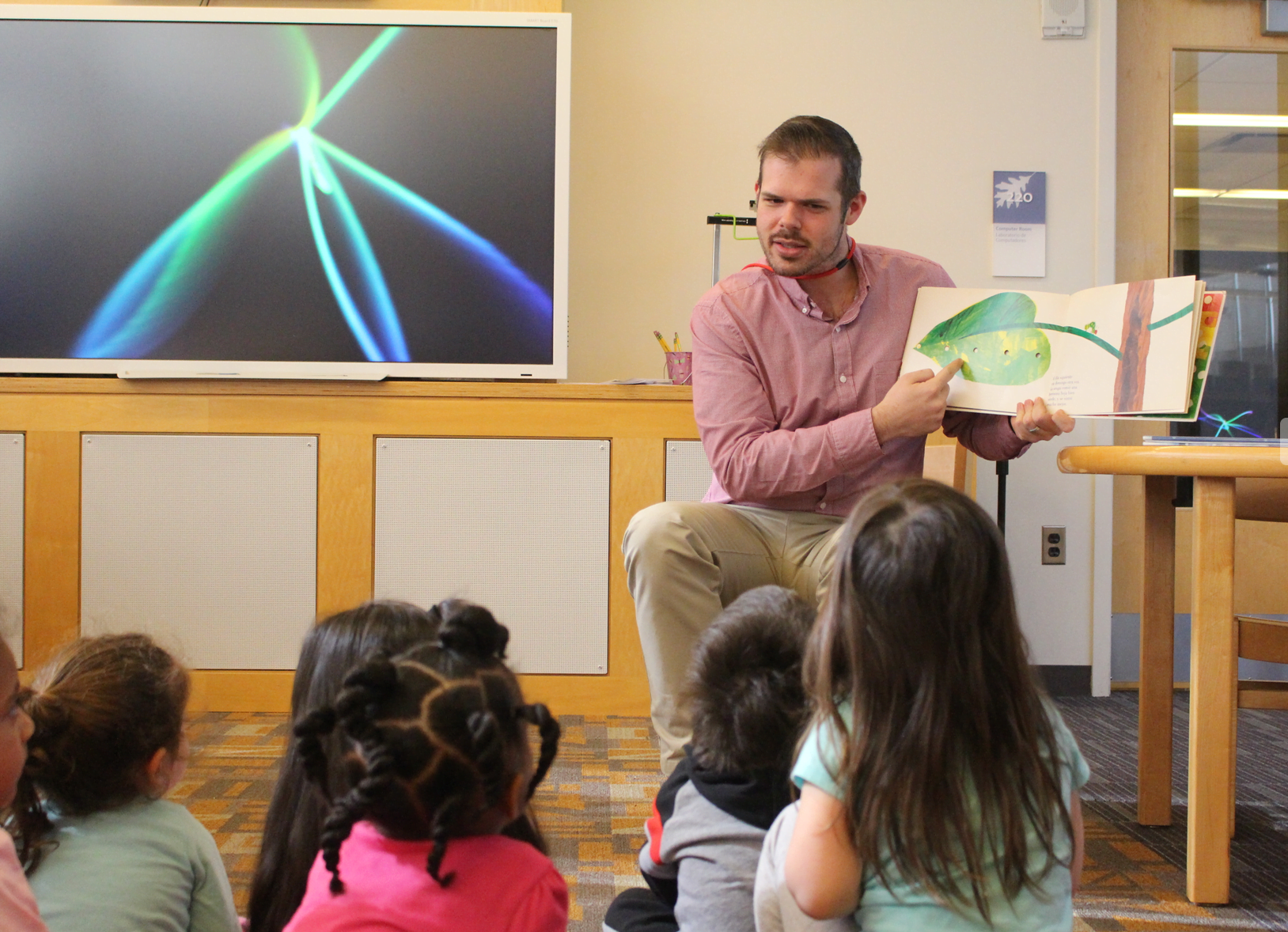
Cody Ludvinsky, a Hamilton Avenue School FLES teacher, read to preschoolers. File Photo: Leslie Yager
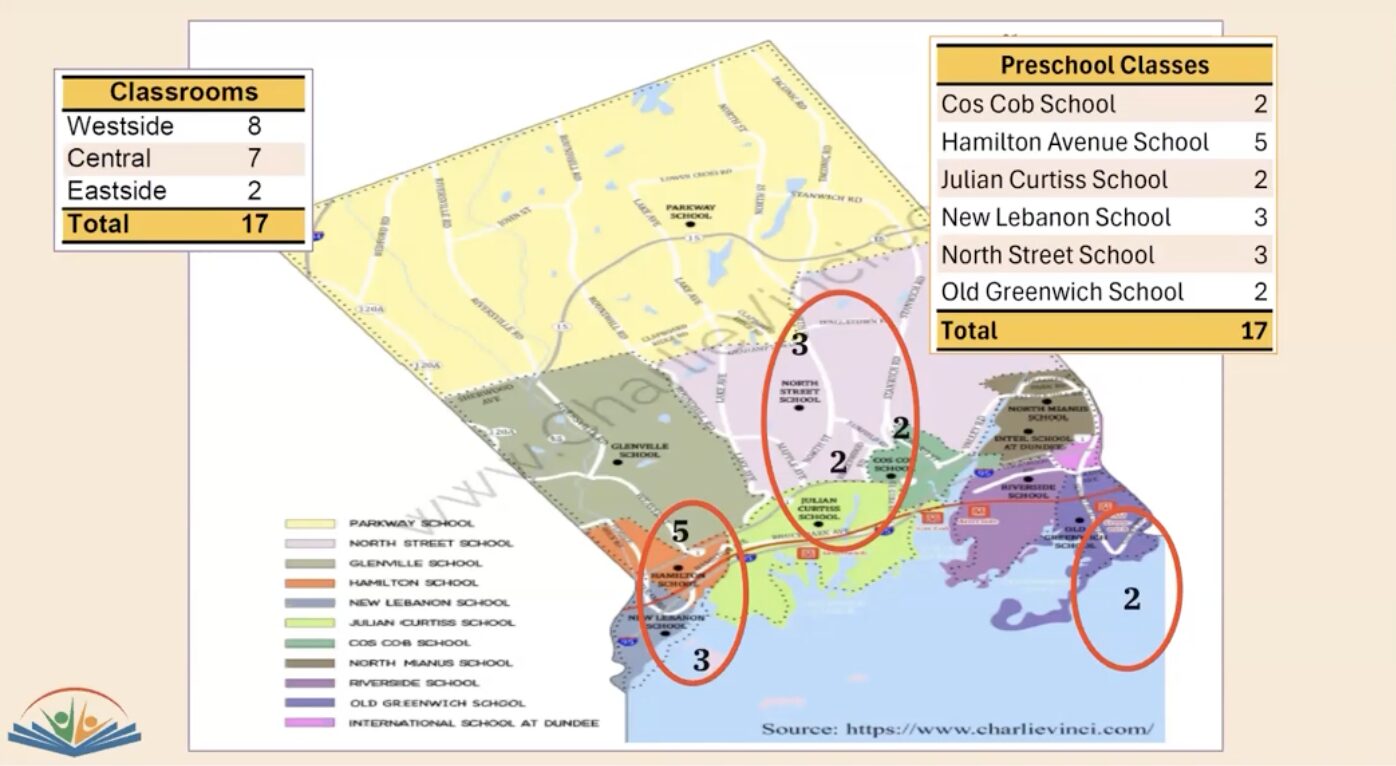
A map showed the concentration of Pre-K classrooms is on the west side of town and in central Greenwich.
There are currently two Pre-K classes in the works at Julian Curtiss School in downtown.
On the east side of town there are only two Pre-K classrooms within Old Greenwich School. There are none are at ISD, North Mianus or Riverside.
There are Pre-K wait lists for the typical learners across town, and those students pay tuition.
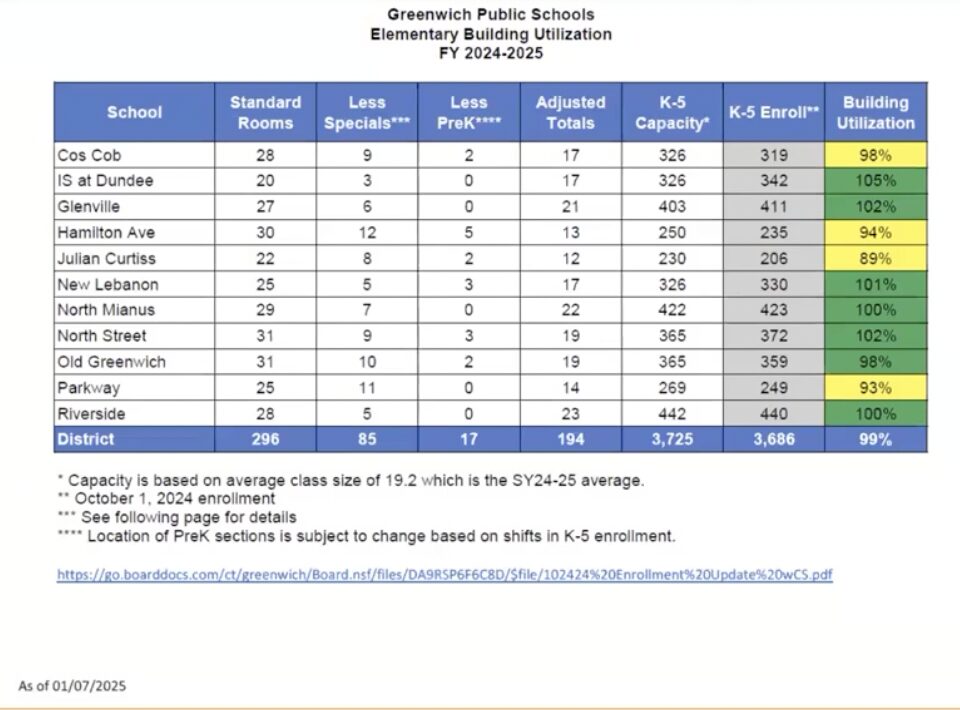
Dr. Jones and Dr. Heiligenthaler warned that elementary schools are already at, over, or near capacity.
Parkway has available space given their 93% building utilization, but they urged against having 3-year-olds on buses for 45-minute rides given the distance to back country and the fact that buses would stop multiple times to pick up other children.
There hasn’t been Pre-K at Parkways since about 2020.
At that Feb 2025 meeting, then BOE member Cody Kittle was not convinced about adding Pre-K to Riverside. Wendy Vizzo-Walsh agreed with Mr. Kittle.
She suggested adding two more to the ones already scheduled as part of the Julian Curtiss School renovation for a total of 4.
Kathleen Stowe said she was torn.
Mr. Kittle asked why the numbers of special education students was increasing and how children are identified.
Dr. Heiligenthaler explained children are referred by health professionals. Also, she said, the number of children diagnosed with autism is growing across the country.
Another factor is that the birth rate increased during Covid and there is a wave of “Covid babies” who are entering public school.
Kittle argued that Riverside parents pushed for their building renovation, but had not clamored for Pre-K. He asked how much would be saved by taking out the Pre-K classrooms from the ed specs.
Ben Branyan said the 24-page conceptual estimate was “based on the trades and square footage” rather than a separate item with a price tag.
“It’s not as simple as just reducing the square footage from the conceptual estimate.”
Dr. Jones said the additional 2700 sq ft might amount to roughly $800,000 per classroom.
Jones said that with elementary school buildings at capacity, alternatives to adding Pre-K classrooms would include renting space, increasing class size upward of 15, changing the ratio to peers again (the minimum ratio required by the state is 50-50 which is not ideal and asks teachers to do a tremendous amount), displacing other district programs to capture space (convert an art classroom to “art on a cart,” for example), or constructing a new early childhood building, which is expensive because it requires the equivalent of a principal and assistant principal, and finding space in Greenwich to build is a challenge.

Subscribe to the daily Greenwich Free Press newsletter.
Sophie Koven said the consideration should not just focus on the cost of the two classrooms at Riverside, but consider the cost of adding them at Julian Curtiss, and the cost of busing children across town.
“How are we looking at this? If it’s really purely a cost question and we’re saying it feels like a lot of money – compared to what?” she asked. “We have no price tag attached to any of the alternative solutions.”
In the end, the board members agreed in Feb 2025 that they had much to absorb from the presentation and voted to remove the Pre-K classrooms from the ed specs and take time for a longer and more robust conversation on the topic.
Fast forward to the May 28 meeting.
During the discussion, Veronica Chiavaroli, the BOE rep to the Riverside building committee, said the cost savings to adding Pre-K were “tremendous.”
“We are likely to need new Pre-K classes going forward – some of our schools are reaching 100% capacity – where we’re going to need those classrooms for our K-5 students,” Chiavaroli said, noting Pre-K is state mandated.
Dr. Mercanti-Anthony said, “While I appreciate the thought, I remain opposed. Last year the board voted specifically against this because we felt, as a board, that it was not in the best interest of that campus to add Pre-K. There’s nothing that has changed there. The only thing that has changed is now we can get money for it. I don’t think that’s a good enough reason to change that thought process. Riverside is our biggest school. Adding two sections of Pre-K on top of that creates a large challenge – it creates an administrative challenge, it cuts down on playground space, it adds traffic because you’re going to have busing – all the reasons we didn’t want to vote for it last year, and we voted it down.”
Mercanti-Anthony said the board should re-think where pre-K classes are located.
“I feel strongly that changing course here and shoehorn it into Riverside when we had a very thoughtful discussion last year and wanted to remove it, and haven’t heard any reason why we would change that other than we are getting money, but we get money for any site where we want to put Pre-K. Putting it here, is I think penny wise and pound foolish.”
Sophie Koven disagreed.
“I’m glad there is an opportunity to add it back. It’s not true that we would get money back for putting it elsewhere. Specifically, we are getting a state reimbursement here for putting Pre-K in a very large building project.”
“The amount of money we would be getting back is calculated based on the total cost of the construction project, so building it elsewhere, we might not realize that at all,” she added.
“Also, I think there is an argument to be made that our special needs students are distributed across the entire town and we don’t have as many Pre-K classrooms on the east side of town. I think it would benefit that population to have classrooms more equally distributed around the town.”
She added that most children who attend Riverside School can walk to school.
“We have one school bus, and maybe 10 kids on it. I’m not so worried about the parking issue that you might see with other schools where lots of people drive,” she continued. “Also Riverside is a very large campus and we have at least three playgrounds.”
Karen Hirsh said was originally reluctant to remove Riverside Pre-K classrooms from the ed specs.
“We’ve heard from Dr. Jones time and time again, every year that we have growth in our Pre-K program, and every so often have to add at least one classroom somewhere mid-year and have often have run out of space.”
“To me this is a no-brainer. If we can save over $5 million, I think the reimbursement for adding Pre-K is over $7 million. The cost to add it would take it down to a $5 million bonus.”
Ms Chiavaroli said there were many elementary schools in the district that are asked to house multiple district programs besides their K-5 responsibilities, whether they are maxed out in building utilization or not.
“They might have the co-taught like Cos Cob School has, on top of having Pre-K. Old Greenwich has the Positive Pathways and Pre-K. North Street School has the Unique Learner program, has Pre-K and has a number of students who are deaf and blind students – in and of itself creating almost another program,” she said.
“Riverside just has K-5. It’s one of the only schools with no district program,” Chiavaroli said. “And I think equity across the district is something to be considered.”
“Many of these schools, as a result of these programs, have had to make modifications to their playgrounds, or their transportation, or their traffic flow – arrival or dismissal, especially when you’re talking about some of the higher needs populations that I mentioned. This is something the building committee would work tremendously hard with architects to ensure it remains a safe, walkable school, pick up and drop off times are dispersed, that the Pre-K students can get there as well as separate entrances.”
Wendy Vizzo-Walsh remained opposed.
“The increased project. The increased traffic. The decreased field space. There’s not enough parking as it is. And so, those are my thoughts,” she said.
Paul Cappiali said, “I heard a lot of comments about the huge campus. That’ something we should recognize. It is a big campus. At the administrative level, there is a principal and assistant principal. I think the reason there are not those extra programs there in K-5 is this is our largest school population. I’m also concerned with the fact that this was already deliberated on – I wasn’t there then – and the only thing that changed is the economics.”
“We’re going to save $5 million. I think we’re all missing the point that we are actually all taxpayers in the state as well as in the town of Greenwich,” Cappiali continued. “We pay four times the amount of taxes in Greenwich – on average for the rest of the state. This isn’t free money.”
Dr. Mecanti-Anthony called the question: 6 yes, 2 opposed, with Mercanti-Anthony and Vizzo-Walsh voting against.
Voting in favor were Karen Hirsh, Bob Chaney, Veronica Chiavaroli, Sophie Koven, Paul Cappiali and Karen Krause.
See also:
Jan 28, 2026
Jan 29, 2025