Tuesday Board of Estimate and Taxation budget committee meeting featured presentations from First Selectman Fred Camillo and Greenwich Schools Superintendent Dr. Toni Jones, followed by public comment.
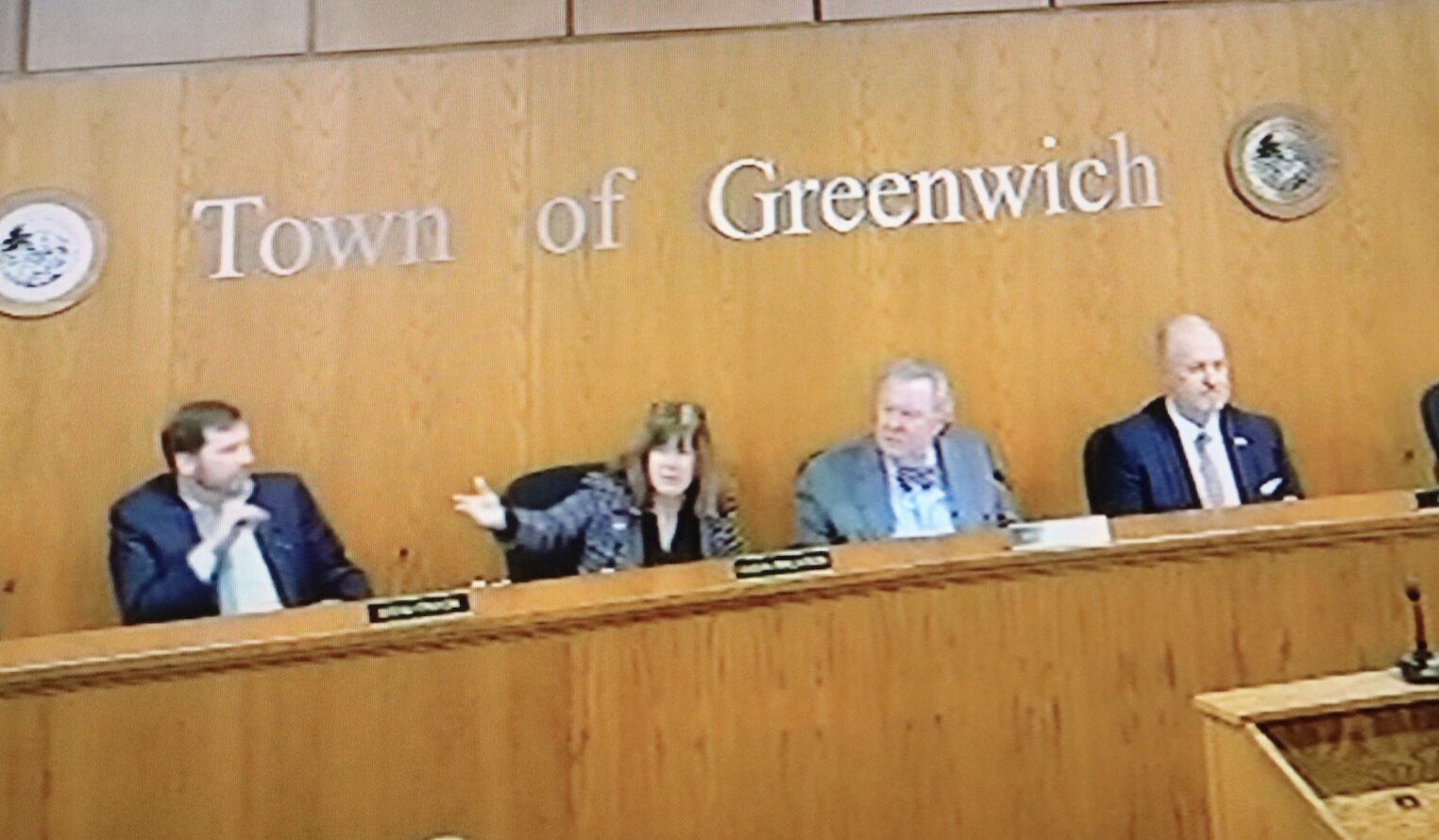
Doug Fenton, Laura Erickson, Harry Fisher and Joe kelly. Jan 27, 2026
The newly appointed four-member budget committee includes Democrats Laura Erickson and Doug Fenton, and Republicans Joe Kelly and Harry Fisher.
The committee is now chaired by a Democrat, Ms Erickson, reflecting the Democratic party’s control of the finance board for the second time in a century.
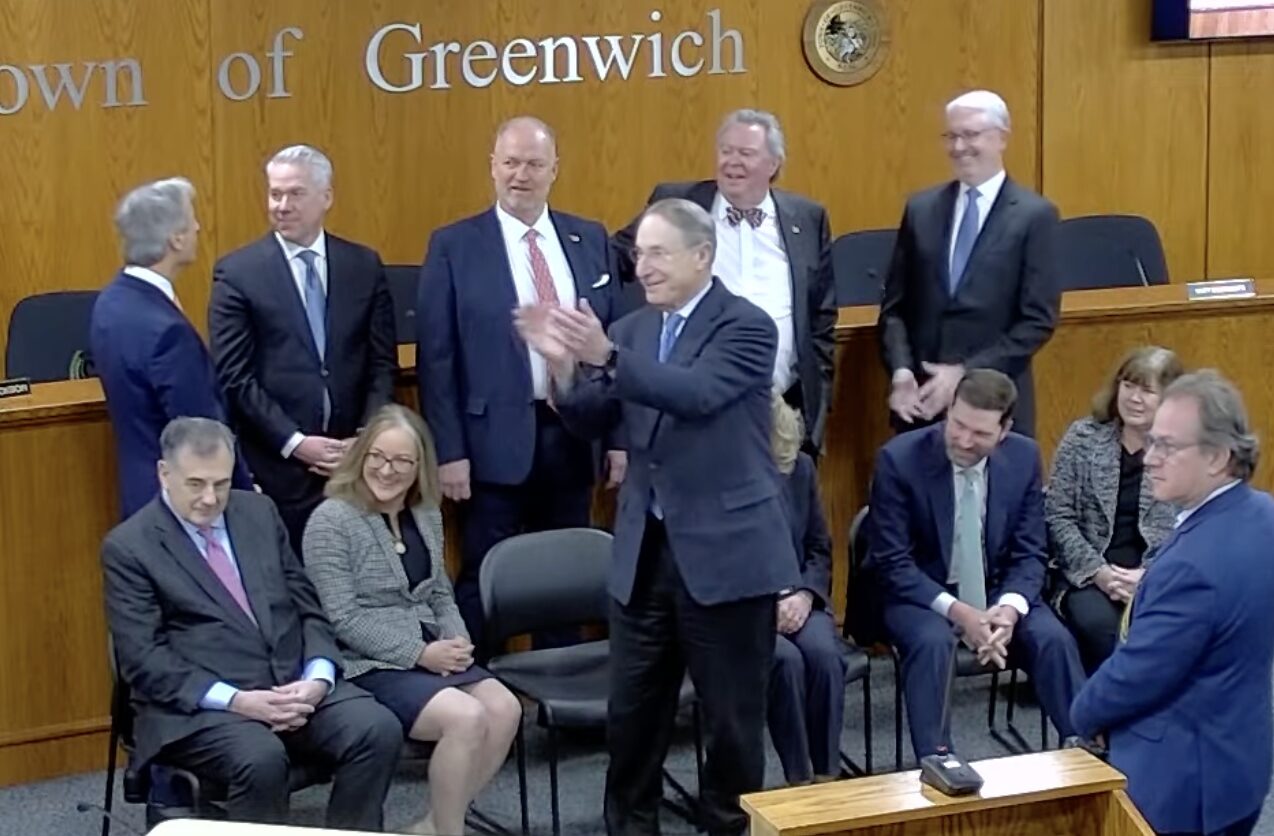
Greenwich Board of Estimate and Taxation member David Weisbrod welcomed people to the BOE meeting. Jan 7, 2026
David Weisbrod was elected chair of the finance board on Jan 7, 2026.
The upending of Republican control of the board and its tie breaking vote followed months of public unrest over the schools budget last spring.
Camillo’s presentation featured $541 million in capital projects over five years.
“In Greenwich we thoroughly vet things, and you ask the right questions, but our objective in the new fiscal year, with this new BET, is to get to yes quicker,” Camillo said.
His FY27 capital budget included ongoing infrastructure projects for public works including annual paving, highway maintenance, stormwater drainage, sidewalks and building ADA compliance. And, at the BOE, ongoing projects include door, window and roof replacement, HVAC system, furniture replacement, security entrance redesign and implementation. And for Parks & Recreation, ongoing infrastructure projects include the ADA parks master plan.
Today an ADA project is taking place at Byram Park Marina.

ADA accessibility project at Byram marina. Jan 14, 2026
He said deferring projects amounted to passing along obligations and responsibility to future residents and officials.
His FY 27 proposed capital budget highlights included a two-year Voice Over Internet Protocol (VOIP) for the current phone system which has been phased out by the manufacturer.
Next, the Island Beach Ferry is over 60 years old and needs a major structural rehabilitation. In FY 27 Camillo proposes $600,000 to replace the hull and keel.
He also proposes $1.1 million for fire tankers in FY 27.
“We’re paying half for the Round Hill truck and one in Banksville. We’re adding a tanker to our fleet that will be wholly owned by the Town of Greenwich and will also be stationed up at Round Hill.”
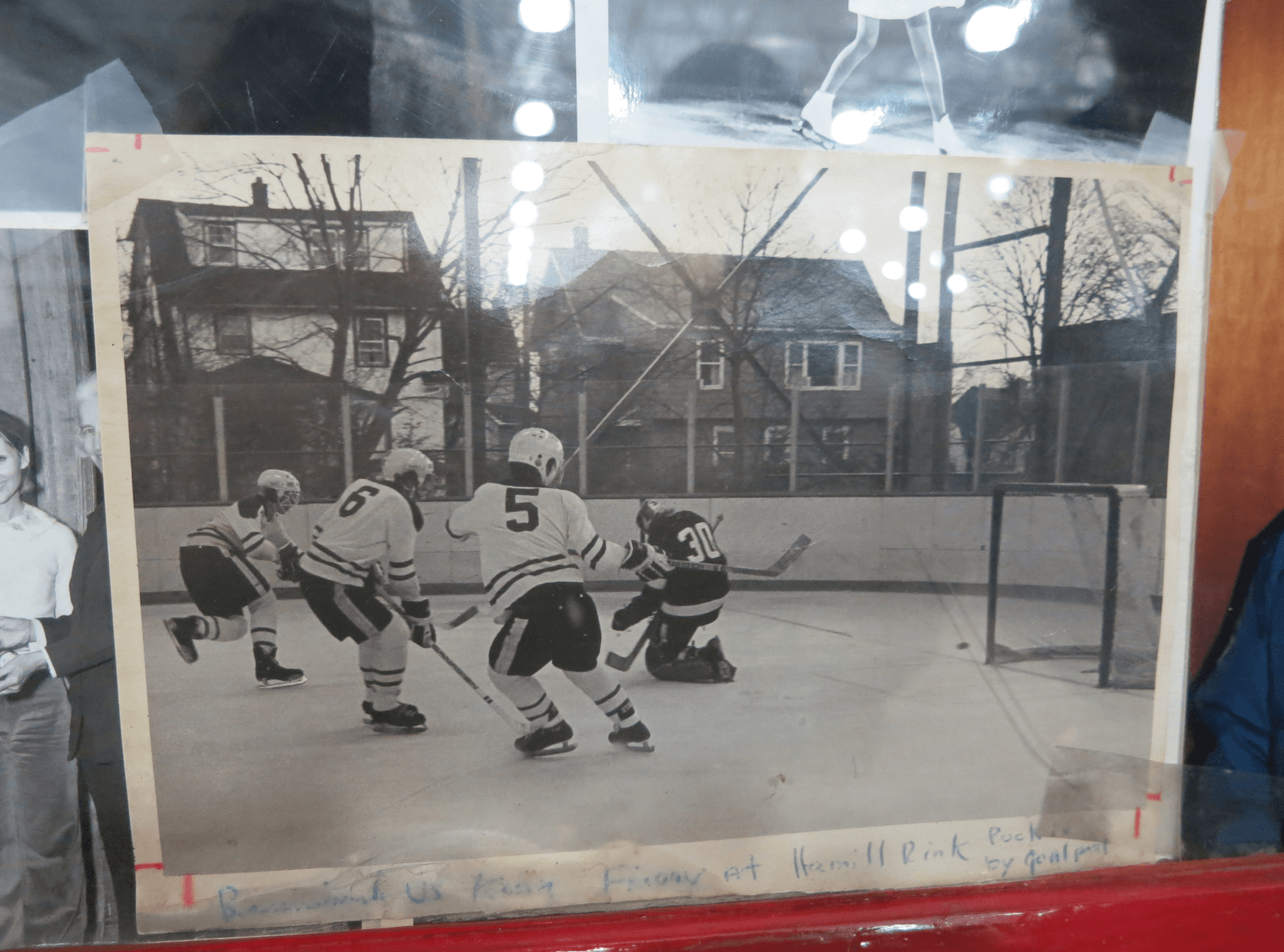
As for a replacement of the aging Hamill Rink, which opened in 1972, Camillo’s capital budget includes $41.2 million in FY 27 – $2 million for design and $40 million for construction.
Camillo said to build in place would be too expensive and that two rink task force committees had both concluded that the flip was the most cost effective approach.
“It doesn’t lose any ice time. We don’t have to shut down for two years,” he said. “We’ll be able to capture energy which is important to our energy management advisory committee – which we cannot do in the present spot because the trees there are too big. There’s also a lot of ledge under there.”
Later during public comment, members of the community would dispute that the flip was ideal.
Camillo said he has been speaking to individuals and foundations who have pledged to help with donations and there would be opportunities for “tasteful” naming rights for areas such as locker rooms, sheets of ice and penalty boxes, but the arena would remain named after Dorothy Hamill.
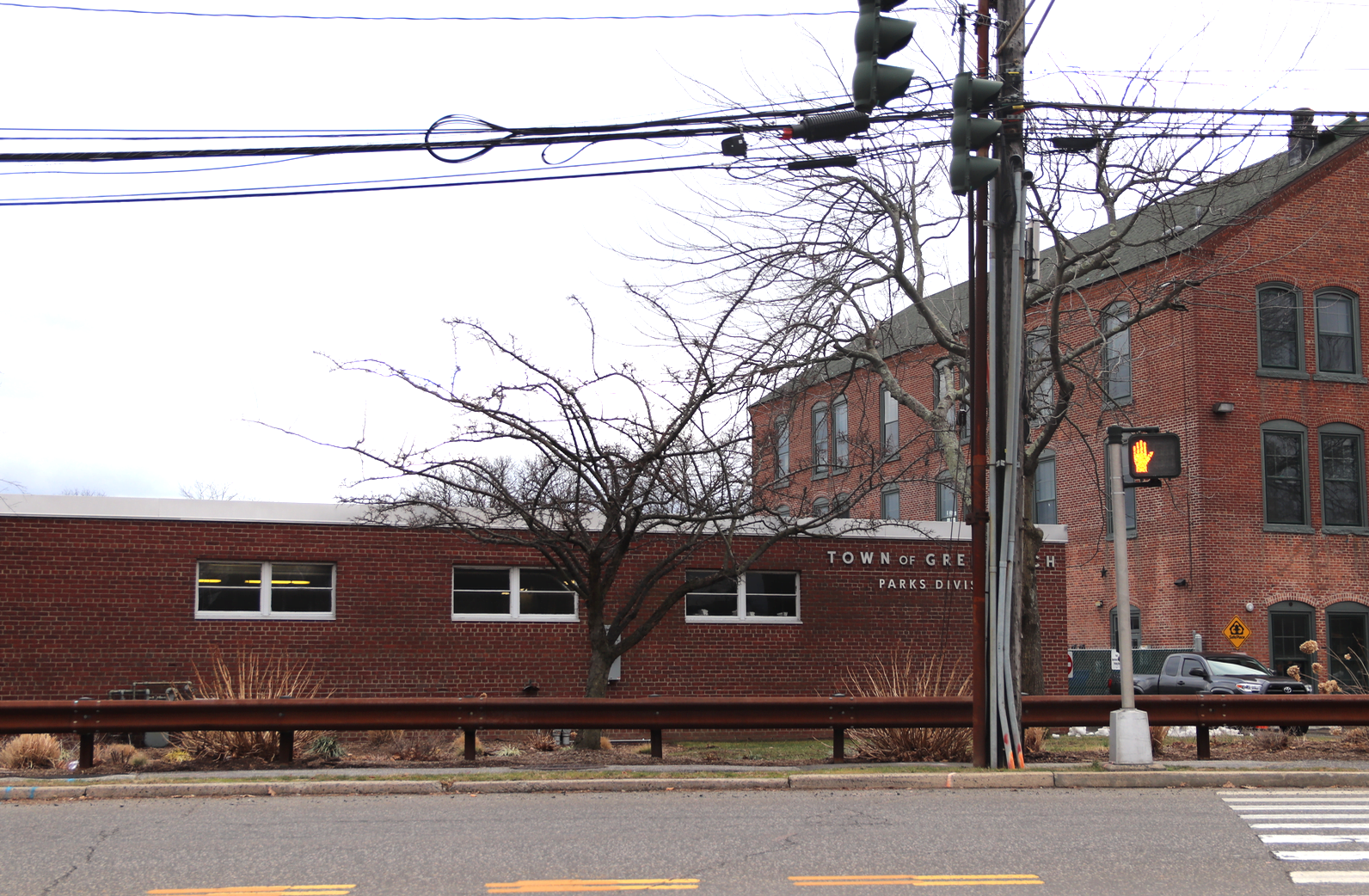
Parks building on Arch Street. Photo: Leslie Yager
Camillo’s capital budget also includes $10 million for design and construction at Roger Sherman Baldwin Park on Greenwich Harbor, including relocation of the Parks & Trees buildings and creating a new park gateway, green spaces and walking paths.
He said “the big hold up” had been where to relocate the activities of the parks building on the harbor.
“Where do you put these trucks? We finally settled on the transfer station – for townies, ‘the dump.’ That is something we have been talking about since the 1980s. That’s a big expense. Nobody is rushing to give us a public-private donation to fix up the dump so that might be on us.”
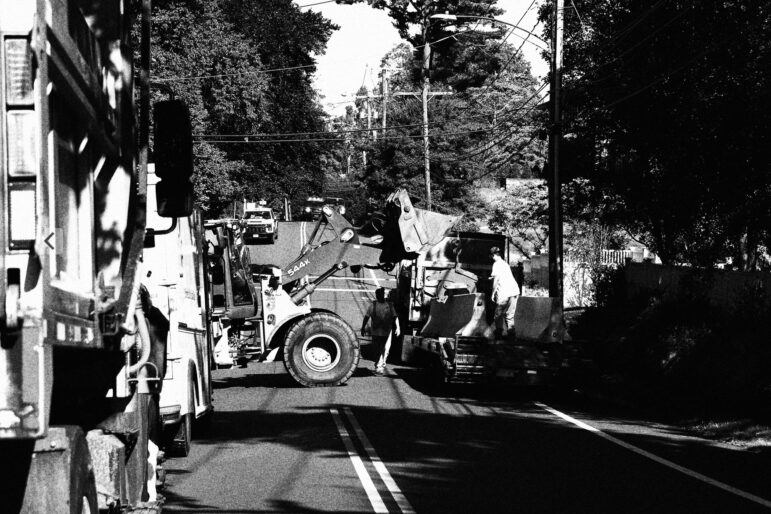
The town erected jersey barriers on Dearfield between the library and the traffic circle after heavy Post-Ida rainfall washed out everything underneath the roadway. Sept 2, 2021 Photo: Leslie Yager
The proposed budget includes a maintenance project at the Dearfield Drive and Grove Lane culvert to improve drainage and prevent flooding. This would include $250K for design costs in FY 27 and $4.45 million in both FY 28 and FY 29 for construction.

View of Byram River Bridge over Byram River from Port Chester, NY. Photo: Leslie Yager
The budget also proposed funds for the Byram River Bridge Replacement at the border of Port Chester, NY, including $4.0 million in both FY 27 and FY 28 to replace two bridges over the Byram River.
The project is cost shared with 50% from the US Army Corps of Engineers, 25% from NY Dot and 25% from the Town of Greenwich.
“The Byram River flooding has been flooded since at lest the 1950s,” he said. “That’s never been fixed.”
He said the plan was to elevate the bridge and widen it to allow a greater amount of water to flow through.
“It’s a historic bridge so we’re going to try to keep that look,” he said, adding that he pledged to work with various jurisdictions to rename the bridge, “The Gulliver’s memorial Bridge,” noting that 24 people lost their lives including some Greenwich residents in a fire at the former night club adjacent to the bridge in 1974.
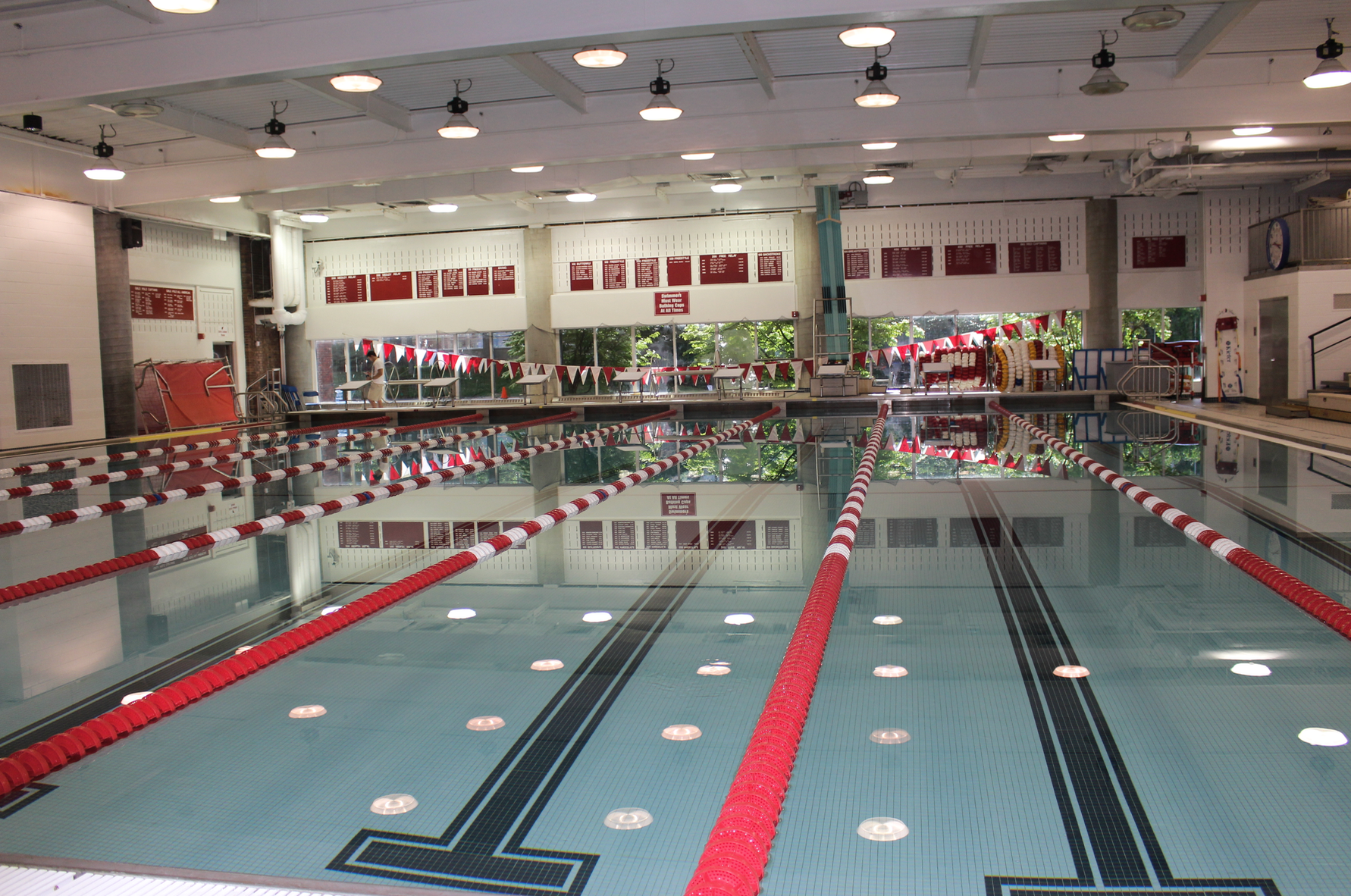
Existing GHS pool. File photo
Camillo’s proposed capital budget includes $4.0 million for design and A/E costs for a Greenwich High School Pool project and $55 million for construction in FY 28. The town recently learned the pool is out of code compliance and the diving board is out of service.
“We want to make sure that every year we are very focused on getting school buildings renovated,” Camillo said. “We have to focus on that, but unfortunately what it’s been doing the last six years is pushing town projects out.”
He said he anticipate the pool project would cost $55+ million, but he expected some funding would be privately raised.

File photo at GHS from 2014
Camillo said good news was that the GHS soil remediation project nearing conclusion, with $2 million in his proposed budget for FY 27. The final year of the project includes additional Field 2 work and final sampling and regulatory paperwork.
In prior years the project was funded to $34.75 million.
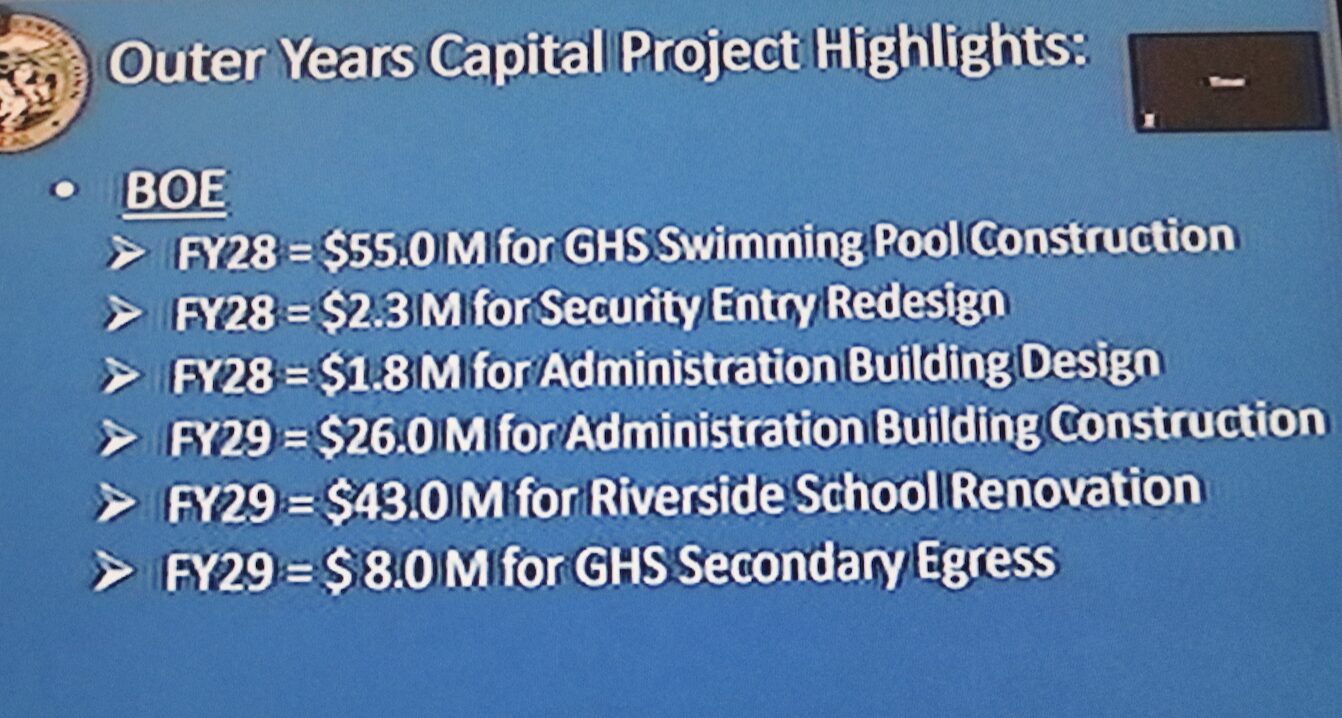
Caillo said he wholeheartedly supported adding a second egress for Greenwich High School.
“GHS is the only high school of that size in Connecticut that has only one road going in and out. It is a safety issues as well as a congestion issue.”
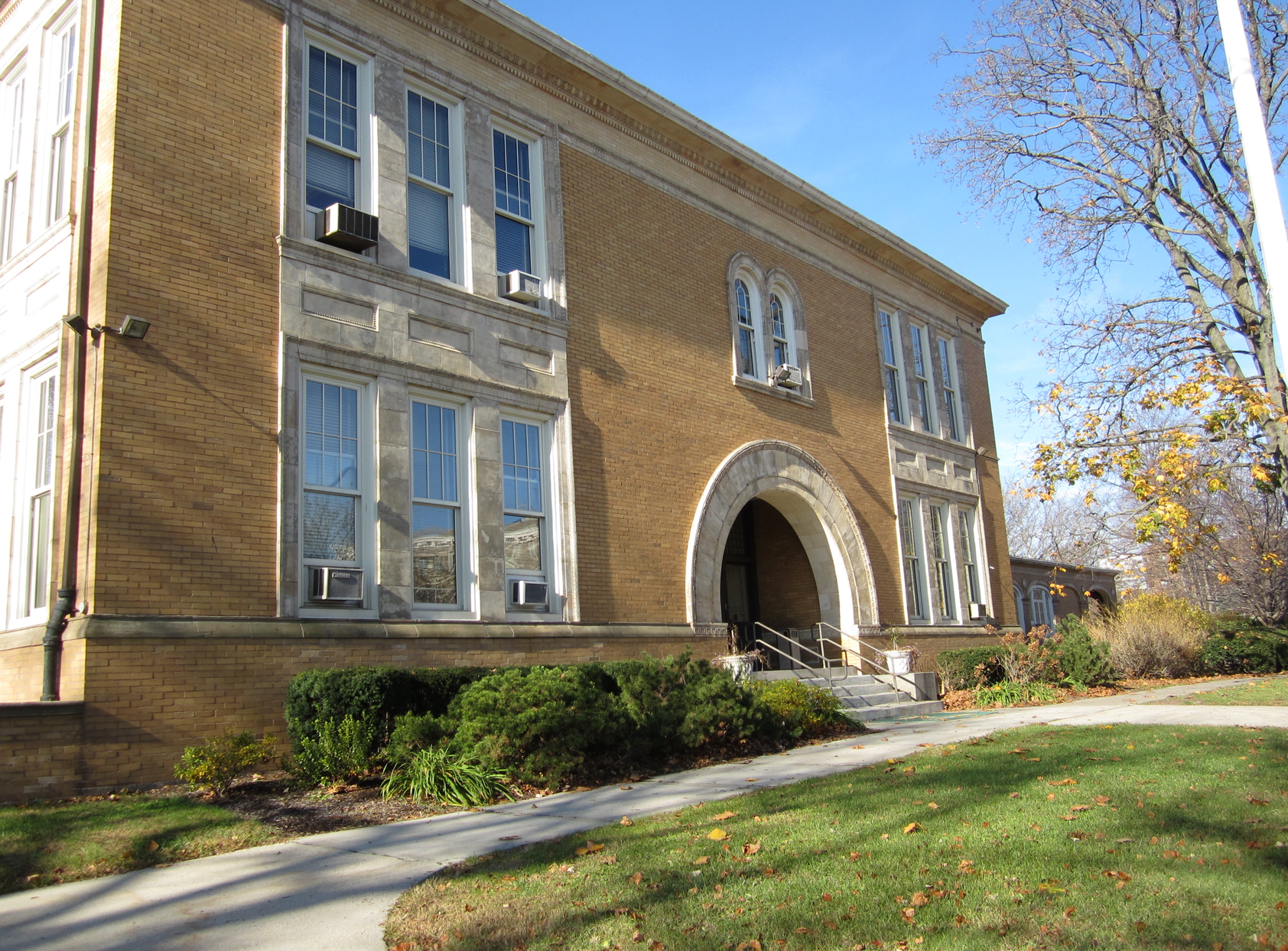
His budget for FY 28 and FY 29 includes funding for a new building for the Greenwich Schools administration to get them out of the Havemeyer building.
“The cost avoidance is big in our favor,” he said of not paying town funds to renovate the historic building.
In June there was a public hearing on the fate of the building, with mixed reactions to the idea of a boutique hotel.
He said estimates to repair the building ranged from $30 to $40 million, he but that one developer who responded to the RFP proposed a $74 million project.
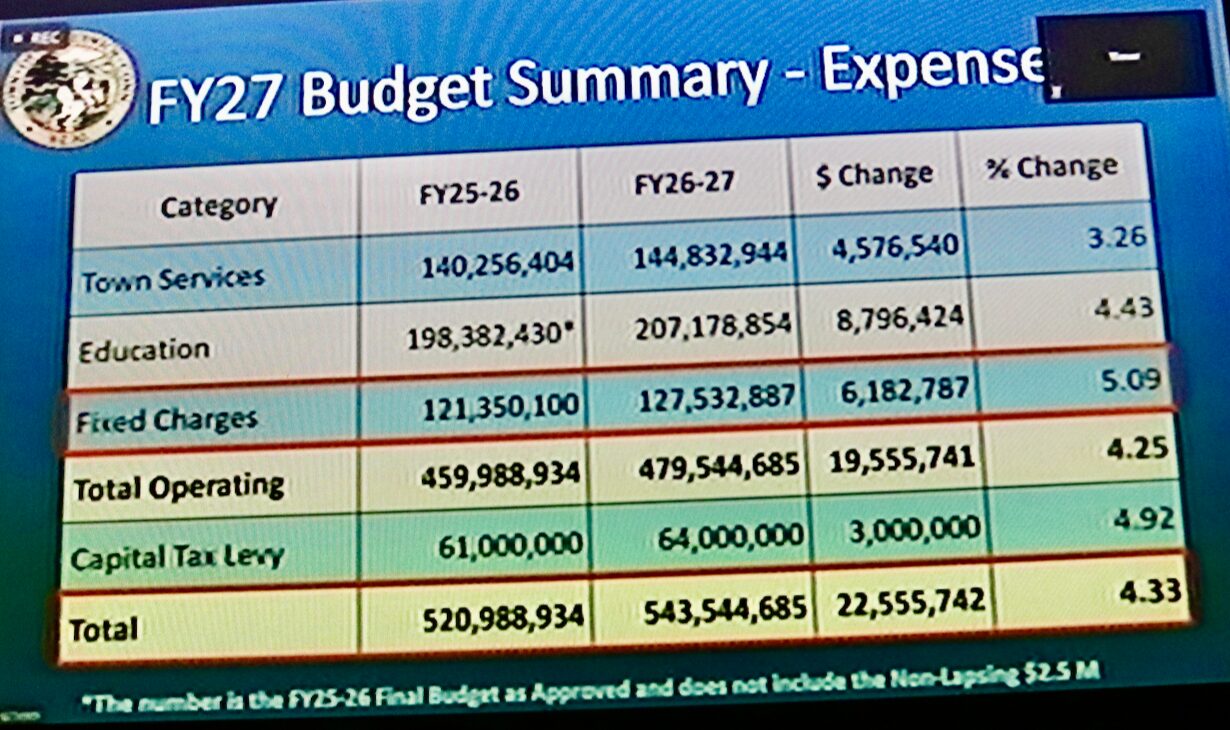
 Camillo said the amount of state and federal aid was down almost 30%, while property tax revenue increased almost 7%, with the difference being almost 5%.
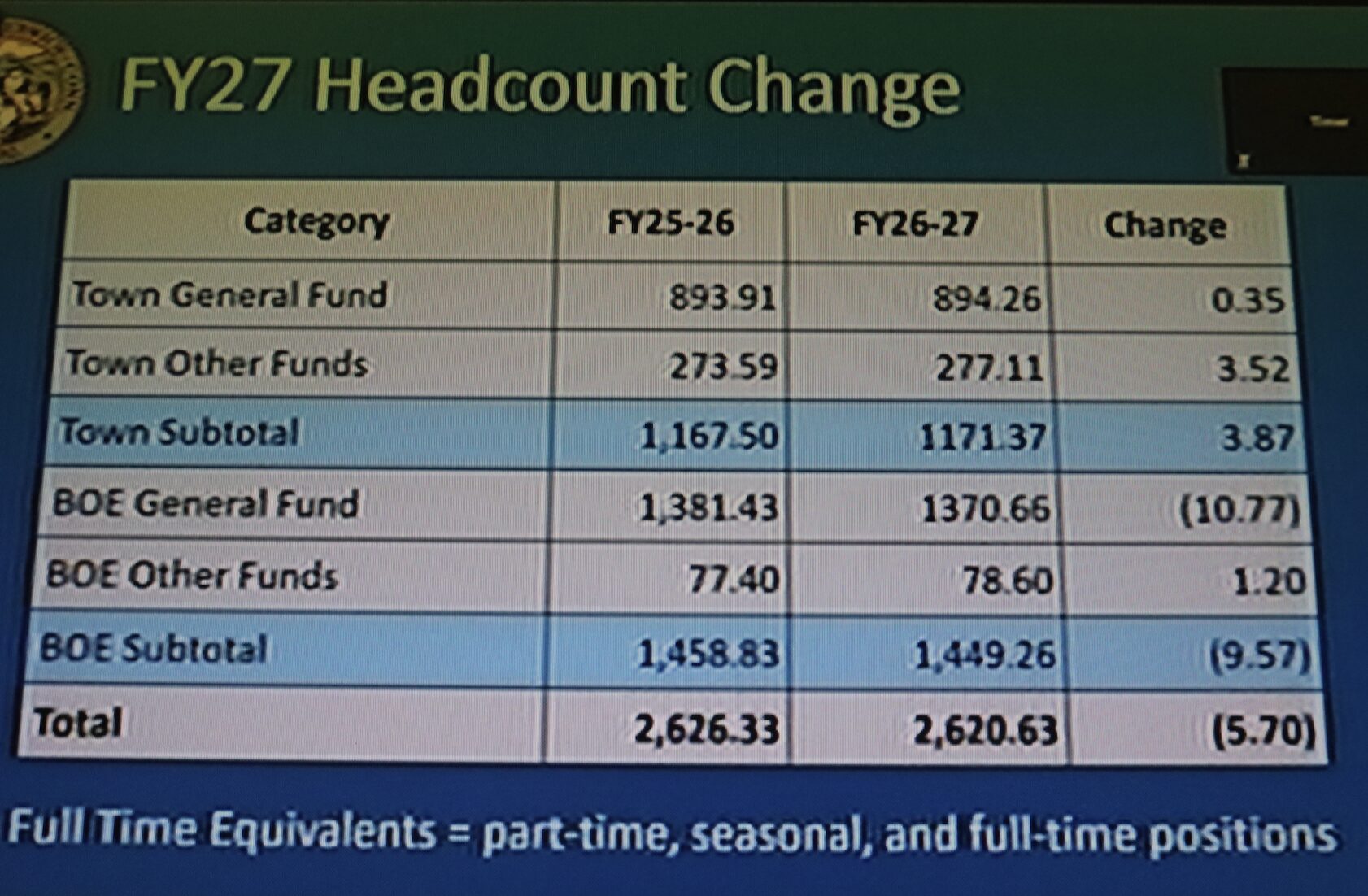
He said his proposed headcount increase for the town was +3.87, proposing to add three full time positions: one in finance dept, one in the Greenwich Police Dept to respond to FOI requests, and one at Greenwich Library. Meanwhile he proposed to eliminate 2.65 FTEs (part time employees).
From other funds, he proposed to eliminate one FTE from Health; and add 4.1 FTE at the Nathaniel Witherell, the town owned nursing home, and add .42 FTE for Parking Services.
Mill Rate
“You never want to lose that low mill rate. That’s a great selling point but it also makes it affordable for all of our citizens to live here, including our senior citizens,” Camillo said.
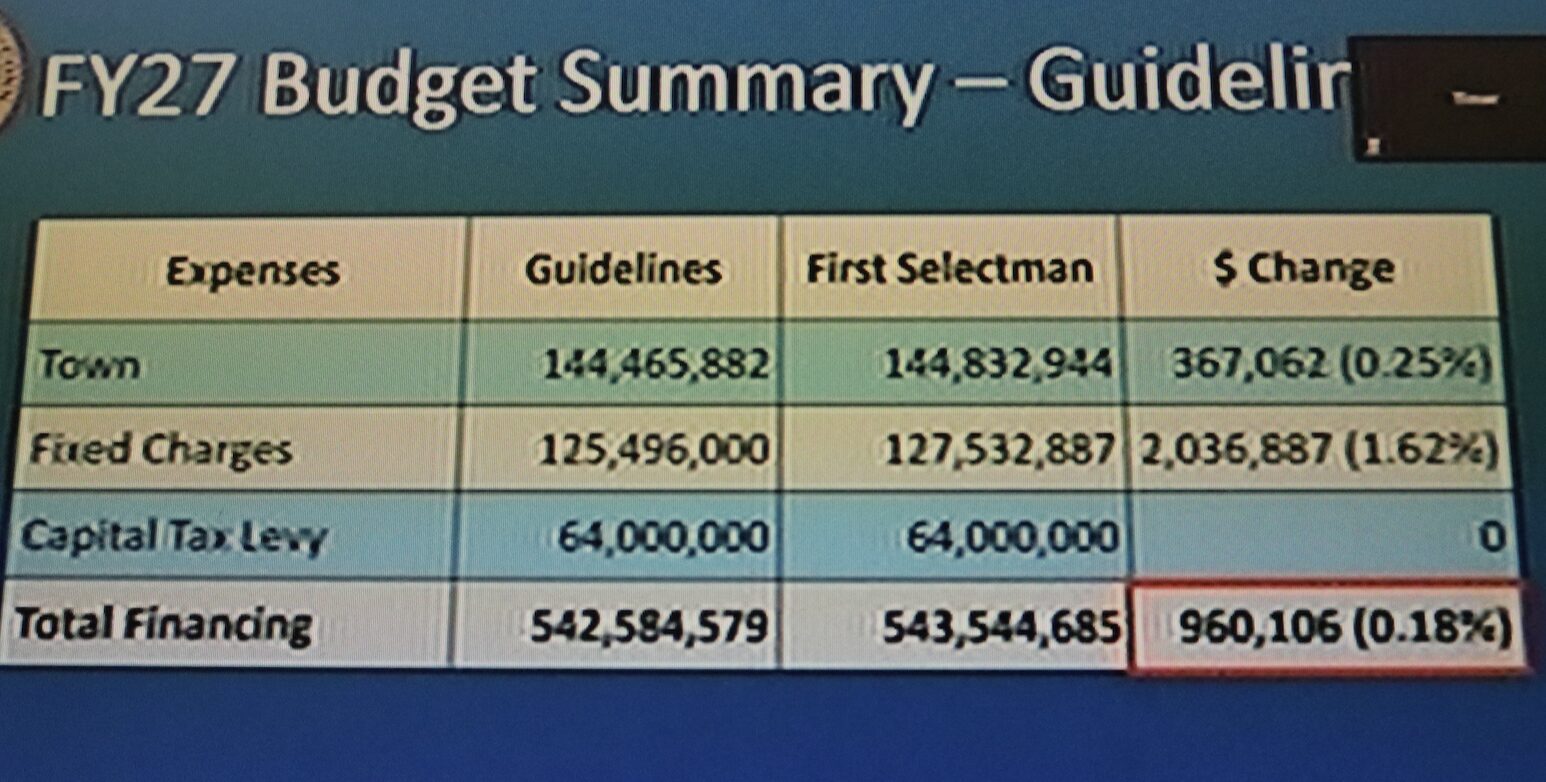
He noted the town mill rate guidelines were 12.591 and he proposed 12.765, for a difference of .174. He said, for example, that would mean tax payers with an assessed home value at $1 million might see their annual property tax increase $724.
School Budget
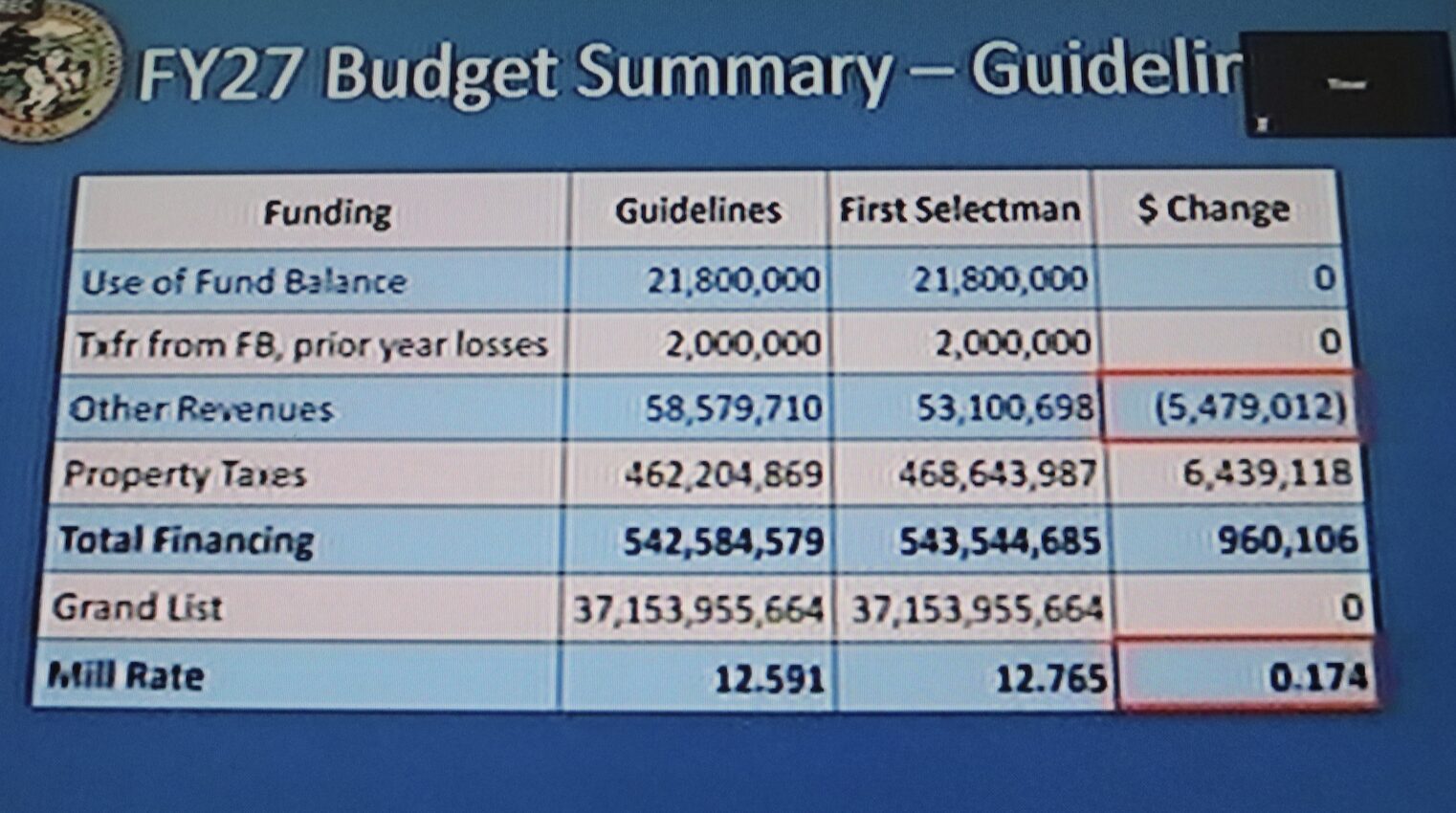
The Board of Education’s 2026‐2027 operating budget, approved in a 7-1 vote by the school board, is $207,178,854, representing a year‐to‐year increase of $6,296,424 from the revised budget for 2025‐2026. This is an increase of 3.1%.
This includes funds utilized this year from the non‐lapsing account at $2,500,000. This adjusted the revised budget for the current year to $200,882,430.
School board chair Dr. Michael Joseph Mercanti-Anthony said he was proud of the budget.
“We feel it very much represents our fundamental responsibility to support the individual potential of every student in GPS,” he said, adding that Greenwich was one of the first districts in the state to eliminate the learning loss of the pandemic.
He noted that teacher contractual increases and transportation increases were the two significant areas of increased costs.
However, Mercanti-Anthony said, “We have the most talented and dedicated teachers in the state. We also have the highest paid teachers in the state.”
He said it was a “misnomer” to say the district worked backward from a BET guidelines. “The team starts every year from zero,” he said.
Schools superintendent Dr. Jones said she is often asked about student demographics in Greenwich. There are approximately 11,000 to 12,000 students living in Greenwich, and 75% of them are in the public school system.
“We are a very diverse school district,” she said. “This is something people don’t realize about Greenwich. Those of you who are townies that have been here a long time, if you were here in 1980 the school looked very different. The diversity rate in Greenwich was around 6%. Now we are at 41.2%.”
She talked about regional comparisons, where Greenwich tends to rank higher among other districts in DRG B, which is the group of similar districts for comparison purposes.
She said enrollment projections were done by an outside demographer, but it was difficult to be accurate beyond one or two years, given factors such as housing turnover.
She noted preschool enrollment continues to grow. K-5 enrollment is anticipated to trend up by 160 students, though from 2019 to 2025 the K-5 enrollment had dipped by over 100 students.
“The birth rate is back up. If our in-migration stays as high as it has been we will see larger cohorts of children moving through the system,” she said.
While 6-8th grade enrollment is down from 2019-20 when it was just over 2,000 students, and next year it is expected to decrease next year to about 1,700 students.
At Greenwich High School, she said in 2019-2020 class sizes at GHS were about 700. Today GHS classes are about 600, for a total of just under 2600 students.
And although there are smaller cohorts of children moving through middle school, enrollment is starting to increase in elementary schools.
About 20% of students quality for free and reduced lunch.
Special education numbers had spiked, but recently leveled off.
While the overall number of students has decreased, the number of special education students has increased.
The number of FTEs is down overall. Jones said special education staff have been added while general education staff has decreased.
“It’s done through natural attrition. Somebody retires and we haven’t re-hired for that position. In special education we have needed speech teachers, OT/PT and special education teachers – we have been trending up.”
Jones said student achievement was impressive, with Greenwich’s district performance index was higher than New Canaan and Westport.
Further, she said at GHS, AP data showed a higher number of exams were administered despite the loss of several hundred students in recent years. She said 97.38% of students taking AP exams scored a 3, 4, or a 5.
Lastly, Jones was proud that the district has 10 schools of distinction in the last year.

English Language Arts, Math and Science scores across districts.

Jones said survey data showed high parent satisfaction with the schools – almost 94% of parents are happy with GPS.
Secondary schools satisfaction was 85.6% (grades 6-8) and 82.9% satisfaction for high school parents.
Jones said 76% of the operating budget is salary, and administration is 2.9%.
She said the cost of transportation reflected a large increase at 18%.
Contractual salaries and transportation combined make up for $7.5 million of the operating budget.
She said she anticipated an extra pre-school class will be needed by mid year and another speech teacher for special education will be needed.
Jones said a new automated scheduling program at GHS has resulted in students getting 90%+ of the courses they request, versus 76% when schedules were done by hand calculations.
The superintendent listed budget reductions starting with a reduction in Full Time Equivalents of 11.5 which she said was due to reduced enrollment in the district.
Other reductions include utilities, pupil allocation and cumulative vacation and sick time, and the elimination of the print shop two years ago. The summer school budget was reduced by $500,000 because fewer people are required to run the program, all while the number of students rose from 549 to 830 students.
“We actually were able to provide more for our students and do it in a more cost effective way,” she said, adding that high school students were able to “recover” 139 credits, meaning for example a student who didn’t pass a course during the school year took it again in summer school.
She said 171 students satisfied their high school personal finance credit over the summer, in the process freeing up their schedule during the school year for other selections.
She said BET guidelines voted on October 21, 2025 were $198, 382,430 but last year was the first year there was a non-lapsing account per a new state law, which meant the base for this school year increased $2.5 million which the district was able to put toward transportation.
The BOE approved the operating budget with an increase over the revised budget of $6.2 million or 3.13%.
“It is slightly below the guidelines, but the non-lapsing ($2.5) has to be taken into consideration,” she said.
Dr. Mercanti-Anthony the new CMS was set to open in the fall, representing the most significant capital project in the history of the town. Renovations at Julian Curtiss are ongoing and Old Greenwich School is scheduled to start in April.
“Riverside is in the current budget, and we hope the BET at this point next year will remove the conditions on that project,” he said, noting a building committee had recently been formed.
He said currently there is $91 million in open capital, of which 67% is allocated across the unprecedented number of school building committees: six.
He said work on a new pool at GHS is “morphing” to be a campus-wide project to involve the tennis courts and incorporate a second access road.
Public Comments
While there was less tension in the air than in years gone by, the bulk of public comments concerned the public schools.
With the Old Greenwich School renovation due to start in April, many comments Tuesday night focused on prioritizing the renovation of Riverside School, a 90 year old building and was last renovated 30 years ago without addressing ADA compliance or security concerns.
Kristen Addeo, a mother of four who is on the Riverside School PTA board, said the community was ready to shift from identifying problems to implementing solutions. She asked the project be allocated $43 million for construction in the 27-28 capital plan.
She listed longstanding issues, including cramped classrooms, undersized common spaces and the lack of designated areas for specialty instruction, student service support and large group programming.
Addeo a former special education teacher, said it was especially disheartening that many of her former students could not be properly accommodated in the building.
“Safe access and appropriate space are not extras,” she said.
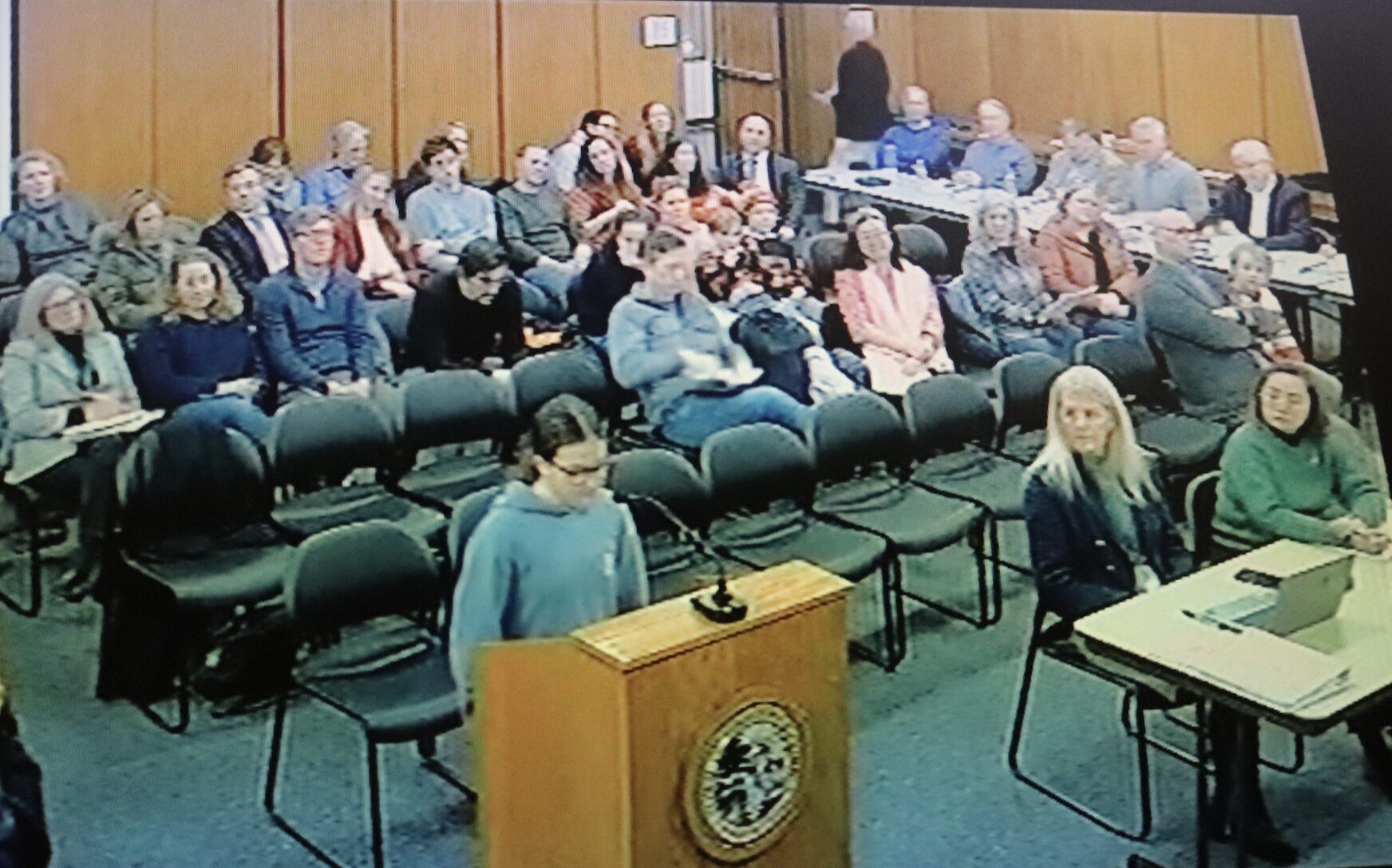
Riverside 5th grader Charlotte Fein urged the finance board to prioritize a renovation of Riverside School. Jan 27, 2026
Riverside 5th grader Charlotte Fein said in third grade she had a classmate that had become so upset that the entire class needed to exit the classroom because there was no space for the student to go calm down.
“Other Greenwich schools have a special area for this called a sensory room, because they have space for one,” she said, adding that orchestra lessons were taught in a dark custodial closet.
She recalled being on crutches for 2 months in first grade and her class had to miss a clay unit in art because they couldn’t get the necessary materials down to the first floor.
Pete Bothwell said his wife attended Riverside School and their four children would as well. “While not much has changed with the interior look of Riverside, so much has changed in the community and with the resources required to teach children.”
“My ask here tonight is to prioritize Riverside School and allocate the $43 million needed for construction costs in the fiscal year 2027-28 capital plan,” he said.
Hamill Rink
Several comments focused on funding for a new Hamill Rink, but beyond the cries for a new rink there remained a persistent a divide between hockey families in favor of “the flip” which places a new rink adjacent to the existing one which is tucked in a corner of Morlot Park, and those who don’t want a large warehouse style building closer to the middle of the park’s green space.
Lucia Jansen, a former BET member and former Budger Overview Committee chair, said while everyone was anxious for a renovation, the conversation felt like “groundhog day. She blasted the “flip.”
“A familiar replay that leads back to the same conclusion,” she said. “There is no documented analysis of ice time in the region during the construction period. For years we’ve been told there isn’t enough ice, but no data has been produced to support that claim.”
“As far back as 2021 when i was chair of the BOC of the RTM, our committee made a formal request,” she said. “That report has never been delivered.”
Second, she said there was no usage or financial impact analysis reflecting the reduced usage of Hamill Rink by the Greenwich Skating Club, Hamill rink’s largest customer.
She said based on her own review of published schedules, Greenwich Skating Club’s usage of Hamill rink appears to have dropped roughly 48%, from 356 hours to 185.
Lastly she said there were concerns about how the task force evaluated sites without considering of actual layout. “Yet a new cost estimate from $24 million to a ballpark $40 million,” she said. “At the Jan 16 2026 task force meeting, surprisingly, a new rink layout and road through the park was revealed, called an alternate to the alternate flip.”
Johna Kalandranis, a Byram resident and parent, who recently was part of a group letter to the editor in support of the modified flip, said, “After 9 months of open and transparent work the Hamill rink task force reached a strong majority recommendation that the modified flip was the most practical and cost effective way to deliver a new rink without shutting down programs.”
“It is also important to note that a small but vocal group does not represent all of Byram. Many Byram families rely on Hamill and support moving this project forward,” she said.
Lucy von Brachel addressed what she said was a “mischaracterization” about how the Byram community feels about the rink.
“It’s mixed and it always has been. The BNA never said, ‘Don’t build a rink in Byram.’ I’ve always supported building a rink in Byram. I’ve always wanted to have it in the same footprint and have a temporary rink. That was one of the options the task force looked at – it costs more money – not substantially more, but we’re also looking at plans that are much less fully developed than prior plans, so the finances to me are still a bit incomplete.”
“I hope that people have a bit of sympathy for people who are underrepresented in Byram. I’ve spoken to a lot of those people in the 100 or so meetings I’ve been to. I reached out to people in McKinney Terrace, which the task force did not do. I’ve reached out to people across the street from the rink and I’m very familiar with the neighborhood and the concerns other residents have that maybe aren’t quite ready to see the flip happen.”
Joe Rothenberg defended the recommendation of the task force, which he described as diverse and representative, including RTM and BET members as well as veterans groups, and noted they solicited feedback from residents and constituent groups.
“The process was exhaustive. Everyone had their say and the task force did the job we asked them to do,” he said, warning that further delays would increase risks, increases costs and puts established programs for children at risk.
“This project has been delayed for many years and the community feels marginalized. I urge you respectfully on the BET to approve funding the project in the capital budget.”
Seth Bacon, a strong supporter of the rink replacement, praised the task forces efforts. He said it was only a “small group of people” who didn’t like the answer, and warned that further delay risked “a devastating impact to the hockey community.”
“I want to make at least into the BOE budget presentation. I hope that you give consideration to the mental health crisis happening to kids in this country. Dr. Jones talked about an increase in special education needs. I want to make sure that you consider those and don’t view that as anything but funding a critical need for our community.”
Energy Manager
Rachel Khanna urged the BET to allocate funding to DPW for an energy manager to create a resiliency plan for the town.
“As we look to the future, we need to ensure our town is prepared for the realities of flooding, sea level rise and needed upgrades to protect our infrastructure,” she said.
She also asked the BET to fund P&Z’s request for a consultant to help develop the town’s next POCD.
Public School Budget
There were also criticisms of the proposed schools operating budget that reduces FTE (full time equivalents).
Jonathan Fisher, PTAC past president and GHS PTA co-president, said the proposed school budget was unnecessarily austere, despite being praised by some for being below guidelines.
He lamented the cuts of 7.5 FTE at GHS, on top of the many that have previously been cut.
“Efficiency does not teach any student. Fiscal responsibility does not enrich any student. If this is good it is a grievous good,” he said. “I come not to praise this budget, but to bury it.”
He said four teachers should not be cut at CMS, which he said was an underperforming priority school.
GHS PTA co-president Monica Huang said the cuts would have lasting consequence for students, and while GHS was being asked to eliminate one administrative position, central office was adding two.
“That does not make sense to us,” she said. “I do appreciate that enrollment is the motivation for the cuts, however the projected enrollment for the upcoming school year is just 100 students less than than three years ago. But in those three years GHS has already suffered radical staffing cuts including 11-1/2 teachers and one administrator along with others.”
She urged the BET to go back to the superintendent and ask for an adequate budget that would not significantly reduce staff.
Kerri Murphy Gruss, from the CMS PTA, said she strongly opposed to the BOE proposed operating budget.
“We do not feel the proposed budget reflects the needs of GPS’s almost 9,000 students by cutting 10.5 teaching positions and one student-facing administrator position.”
“We urge you to preserve at least one, if not all of the four academic teachers at CMS and 7.5 positions Greenwich High School without making cuts in other areas,” Gruss said.
“We, as the GPS community, asked for a BET that was ready to fully support our schools, only to see a proposed BOE operating budget that fell far short.”
She said now was the time to invest, not cut at CMS, and urged the board to to continue the open enrollment effort to boost enrollment “after years of operating in a condemned building that left the school with a slightly declining enrollment and fill the building with new students.”
“It only makes sense to support CMS teachers, and not make cuts to their building after taxpayers spent over $100 million building this beautiful new facility. Now is the time to invest, not cut.”
James Walsh who urged the funding of a sidewalk on Indian Field Road, where he said the vast majority of residents support one, urged the BET to reach out to the BOE and ask them about what the four FTE cuts would look like, especially at CMS.
Mr. Walsh said the individual who compiled the district enrollment report for this year had added wording that was not there last year, saying, ‘increased caution is needed when using these projections…apply your knowledge of the specific conditions of Greenwich and then made adjustments as necessary.’ What is that? We had a school that was condemned and was then under construction. Students wavered into other schools and none of that was taken into account for the enrollment projections.”
Stacy Cleary urged the board not to make further teacher cuts, citing the mental health crisis among children.
“Teachers are on the frontlines of that need. I have personally seen the rise of mental health challenges in school, and cutting teachers is not what our students need right now, especially after the cuts that have already occurred. We as educators provide more than academic instruction. We are often the first to notice when students are struggling and the ones who offer daily stability and support.”
Cleary was also part of the large contingent advocating funding for pickleball courts, which she said was a rapidly growing sport but also an important social connection point.
“What makes pickleball so special is its accessibility and it fosters connection and inclusion. It is truly a multi-generational sport. On any given day you can see high school students playing alongside residents in their 70s and 80s,” Cleary said. “The courts have become places where friendships form, barriers break down and community is built.”
“As participation continues to grow, access to courts has become increasingly limited. Players often face long wait times, particularly in the evening when lighted courts are at their highest demand. This creates frustration and limits access to a sport so many rely on for their health, social connection and wellbeing.”
Sustainability Officer
Myra Klockenbring said in a previous budget cycle the First Selectman had proposed a “sustainability officer position.”
“Since that proposal was rejected, Greenwich has likely lost hundreds of thousands of dollars through waste, missed opportunities and unrealized savings,” Klockenbrink said, adding that a sustainability officer could act as a profit center if the job was designed to pursue savings, grants and risk reductions.
See also:
Dec 21, 2025
New Democratic-Led BET Installed, David Weisbrod Elected Chair
Jan7, 2026