A Greenwich Planning & Zoning commission discussion item about the future of historic buildings at the top of Greenwich Ave on Tuesday drew 98 attendees via Zoom at its peak.
The applicant seeks to demolish the 1878 Tudor-Revival building at 2 Greenwich Avenue, plus two adjacent structures (10 Greenwich Ave and 10-12 West Putnam Ave) to construct a four-story mixed use building that would include 14 apartments.
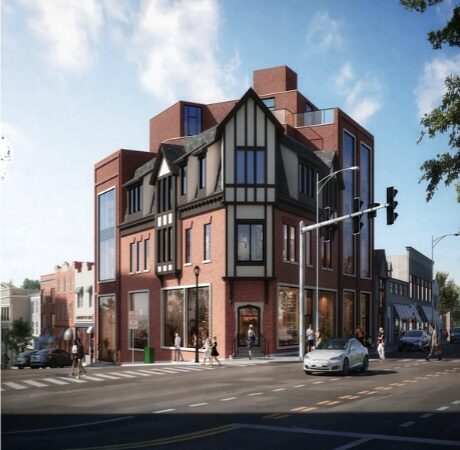
Rendering from applicant’s file on preferred path forward.
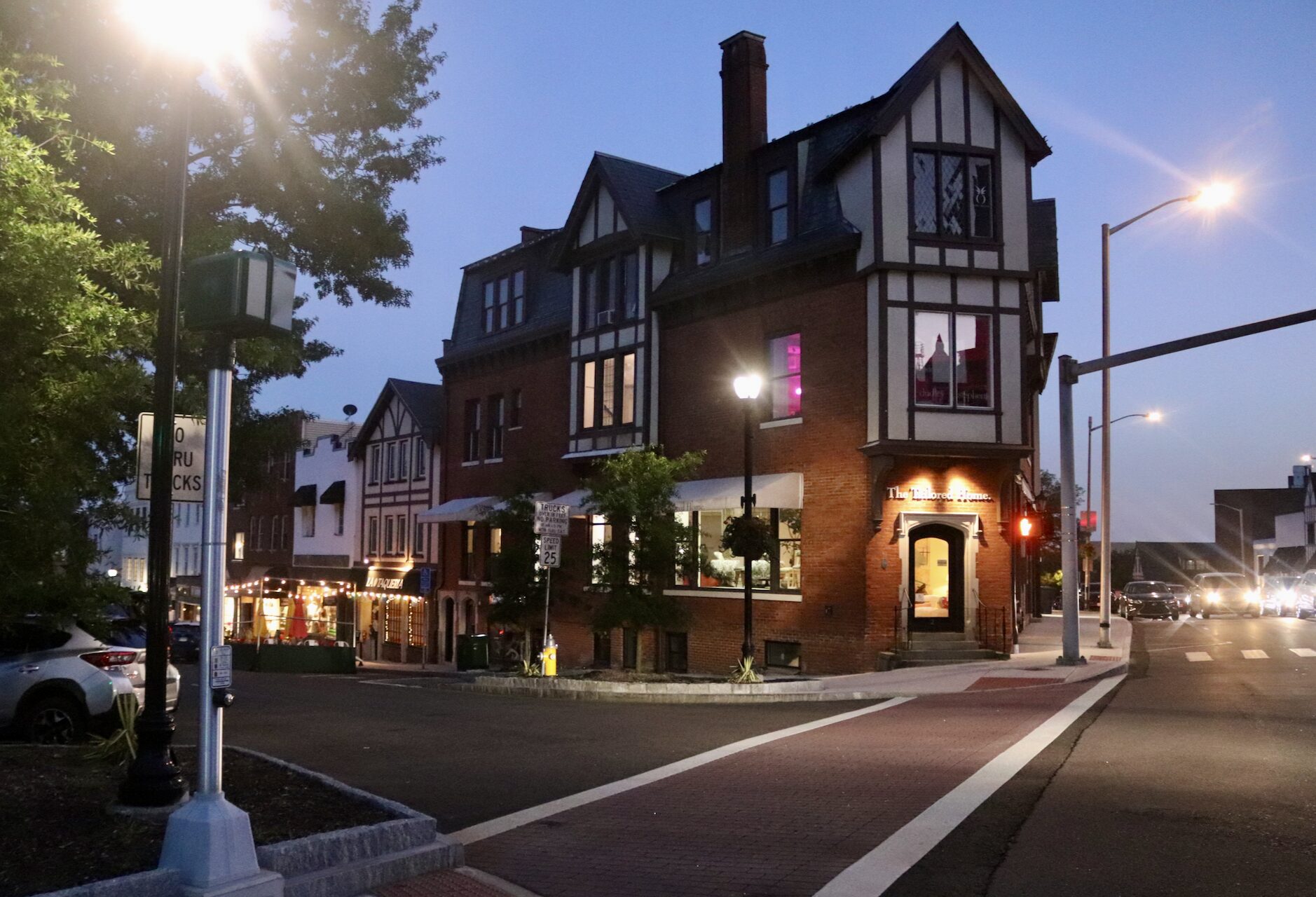
2 Greenwich Ave at dusk on July 8, 2026. Photo: Leslie Yager
While listed on the National Register, the building lacks local protection. That has sparked pushback from residents and town leaders who have escalated their opposition to state officials at the State Historic Preservation Office.
Representing the applicant was architect Jonathan Marcus.
“I think there is a very big misconception of what we’re doing,” Mr. Marcus said.
“The concept of taking it down and rebuilding it in kind was something we felt helped maintain the historical nature,” he added. “For us, it is how to maintain it in a fashion so nobody else comes down the road and tears this down.” 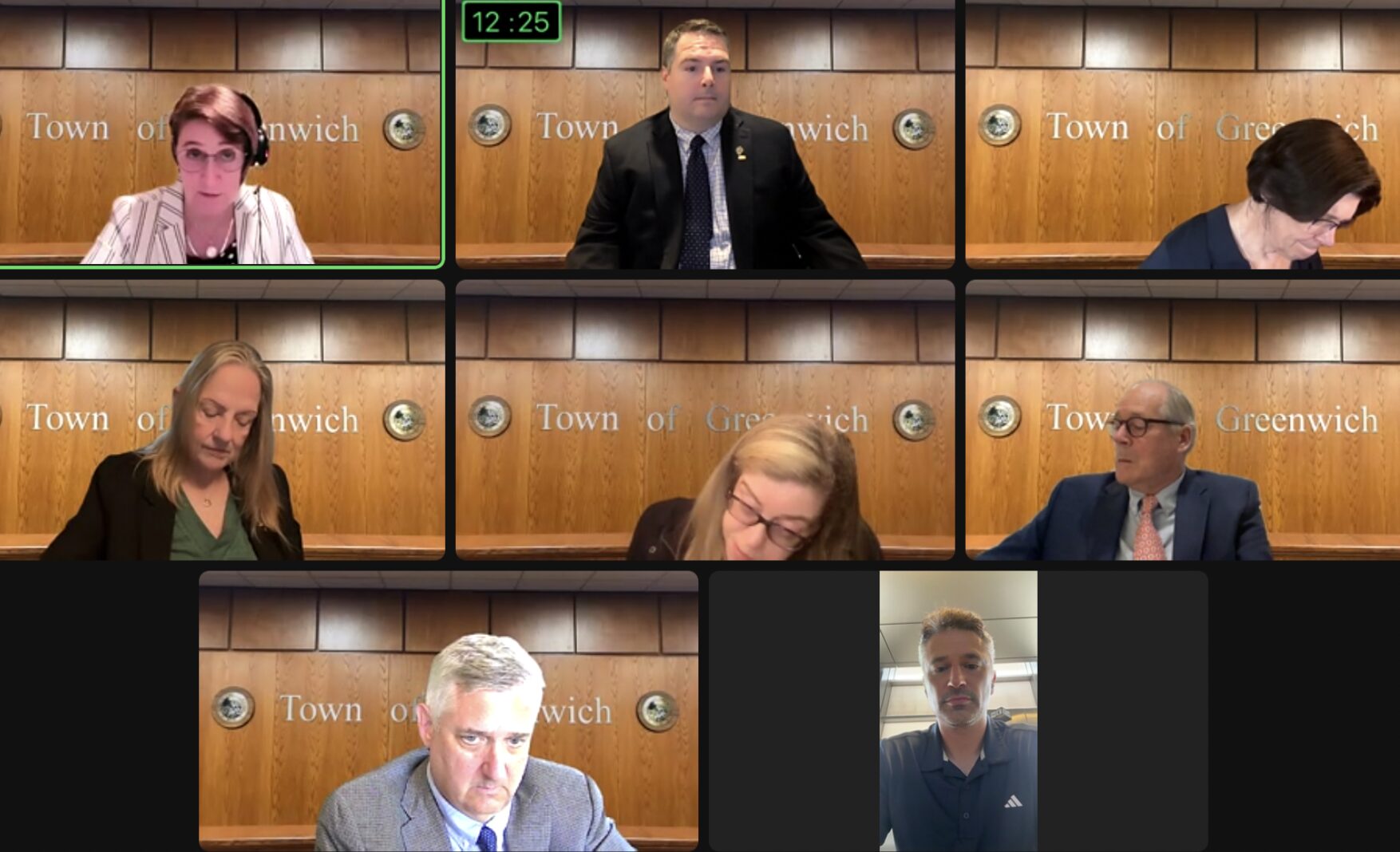 Mr. Marcus said there were systemic problems with the buildings that might prevent saving them, including the seven foot high ceilings, ADA issues, and elevator issues.
“In order to do it in a really nice, elegant way is tearing all the buildings down and rebuilding 2 Greenwich Ave. Our idea was to preserve it in kind with new bricks, new windows and make it look historical,” he said.
Marcus said there were plans in the works for a visit to the property by SHPO’s Todd Levine.
“It looks to me like a Tudor sandwich.” – Commissioner Mary Jenkins
P&Z chair Margarita Alban noted the requested variances for height, story count and FAR, were not up to the P&Z commission and they would not comment on that.
She said the commission wanted the applicant to provide a full detailed civil engineering report to document why the building cannot be saved.
She also said the commission was happy to do a site walk to see for themselves the issues inside of the building.
“Following that, we may pursue speaking with another civil engineer,” she said. She questioned the idea that “demolishing and reproducing the building amounted to historic preservation.”
“You’ve got those enormous, I’d call them space windows, they look like spaceships.” – Arn Welles
“If that is your position, we’d like you to find a historic preservation expert to say that in an official report,” she said. “To use historic preservation is to keep the structure itself, and not demolish it.”
Alban said the P&Z commission recently had a strong debate with the Historic District Commission about an application that proposed to keep just 20% of a historic structure in exchange for zoning bonuses.
“We denied it because we did not see that small amount of preservation as being true preservation,” Alban said, referring to a proposed redevelopment at 49 Sherwood Place, located in the historic Fourth Ward and originally constructed in 1860.
[P&Z Denies Historic Overlay for 49 Sherwood in Fourth Ward: “We’re not seeing enough preservation” Feb 9, 2025]
“When does it stop being preservation and when does it start? It can be a tricky issue.”

49 Sherwood Place. Photo: Leslie Yager Feb 2024.
Each of the commissioners had an opportunity to comment.
Commissioner Mary Jenkins said, “The building there now has sky and space and air around it. And frankly with two distinct, contemporary taller buildings, it looks to me like a Tudor sandwich. Even if you were to continue on this proposal and demolish and restore it, you’re restoring it at a more trivial level than it exists now.”
Commissioner Arn Welles commented on the viewing station and activity room amenity.
“Is this commercial side of this enterprise overwhelming the architectural side?” he asked. Commenting on the two additional buildings, Mr. Welles said, “They seem out of place with the original ones. You’ve got those enormous, I’d call them space windows, they look like spaceships.”
Ms Alban said the building at 2 Greenwich Ave is one of the most photographed in town and it anchors Greenwich Avenue.
“I’m not sure anyone can identify the magic of Greenwich Avenue is, but it has a magic and it is commercially has an enormous amount of vitality, and we want to preserve that because it is a draw,” Alban said.
“Can you explain the engineering behind why you can’t do restoration?” she asked. “You said a reproduction is as good as saving the building. That was a surprise to us so I’d like to know more about that.”
Unreasonable Demolition?
Alban raised the specter of the Connecticut Environmental Protection Act (CEPA).
Under this legislation, historic structures are legally considered environmental resources. The law protects properties on—or eligible for—the National Register of Historic Places by allowing citizens to sue in state court to prevent their “unreasonable demolition.”
“We are not in the business of denying demolitions, but we are in the business of business of following state law,” Alban said. “For us you have to make that case – you have to show us what a civil engineer says and why this can’t be (preserved).”
Alban mentioned a 2021 application for redevelopment in the Fourth Ward, the applicant was unaware of Connecticut Environmental Policy Act (CEPA).
In the proposal, 9 of 11 contributing structures proposed to be demolished were in a National Historic Register district.
The application was ultimately withdrawn.
[WITHDRAWN: Church-Sherwood P&Z 8-30g Application in Historic Fourth Ward June 29, 2022]
The first speaker during public comment was First Selectman Fred Camillo spoke in favor of preserving the iconic building.
“The ironic thing is it’s just feet away from probably the biggest zoning mistake we’ve made in the past 56 years, which was the tearing down of the Pickwick Arms Hotel.” 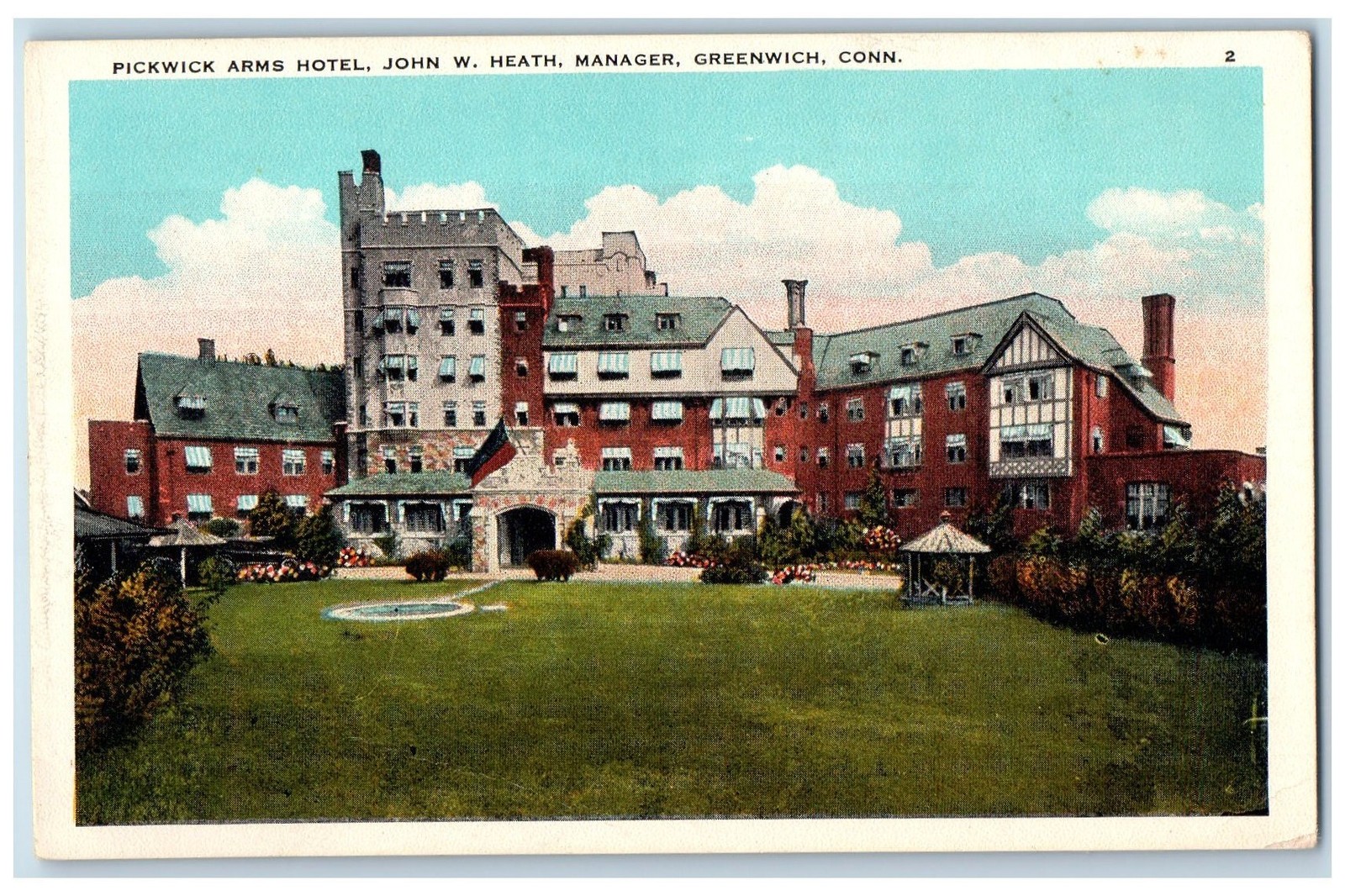 “I’m shocked this one is a target. If you google Greenwich, this comes up. It is a beautiful landmark,” Camillo said, adding that he had reached out to the state to represent the town’s position, which is in favor of keeping the building as it is.
“I’m all for thoughtful redevelopment, but not on landmarks such as this.”
State Rep Tina Courpas (R-149) said she supported a state review.
“What is the public gain from demolishing this building?” Courpas asked. “Usually historical preservation questions are balancing, on the one hand, our history and preserving it, and on the other, supporting growth, expansion and commercial development. In this case there hasn’t been sufficient evidence presented that this project would increase commerce on our main street.”
“We have four sets of options under state standards. Those are preservation, rehabilitation, restoration and reconstruction, which is essentially demolition. Why have we gone to the most aggressive of those four options?”
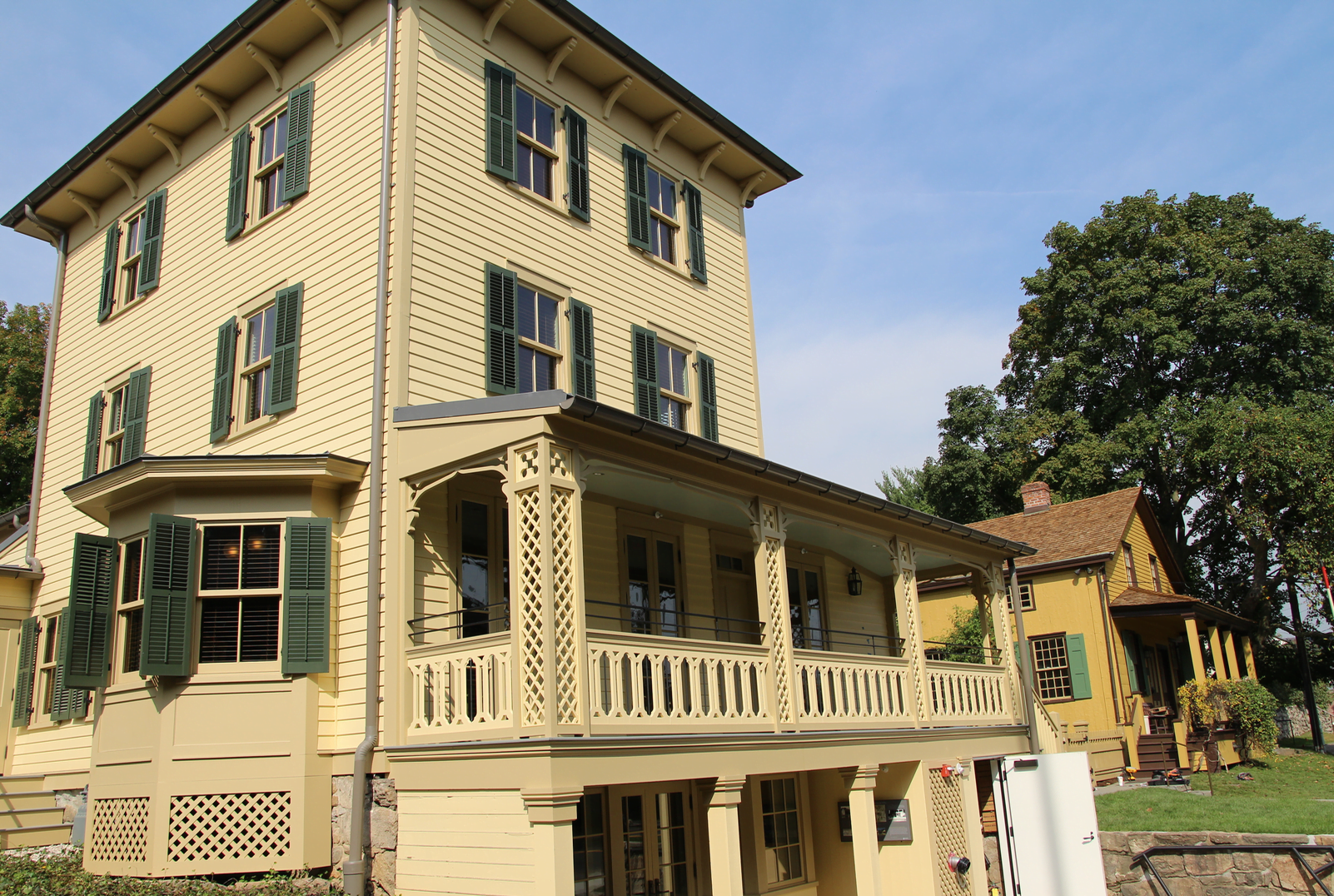
Restored to perfection, the Toby’s Tavern building at Greenwich Historical Society includes a café with wifi and museum store. Oct 4, 2018 Photo: Leslie Yager
Carol Cadou, director and CEO of Greenwich Historical Society, recalled how in the 1950s, when the construction of I-95 threatened the demolition of historic buildings built by immigrant populations, the historical society and townspeople lobbied local and state officials to divert the highway.
“Today the Greenwich Historical Society is headquartered on Strickland Ave in those saved buildings that tell the history of our early Mianus waterfront community. They serve as a point of our collective cultural memory. The Isaac L Mead building is also a significant part of Greenwich’s cultural memory.”

A 1910 post card of Greenwich Avenue is part of Greenwich Historical Society’s “History Is… exhibition in 2019.
Frederick Lee from District 1 said, “A replica is a new building. For authenticity, what’s gone is gone.” Mr. Lee said that the state has opened an investigation under the CEPA, and he had met with SHPO officials last week.
 Subscribe to the daily Greenwich Free Press newsletter.
“Their structural engineer and historic architect will examine these buildings within weeks, with findings going before the state’s historic preservation council this fall,” he said.
Diane Fox from the Greenwich Preservation Network urged a detailed report by a structural engineer, independent of the applicant.
“It is unreasonable destruction of historic structures that is the question at this point,” Fox said. “How it is interpreted is usually left at the state level.”
She said her organization was also very concerned about the two adjoining structures being “out of scale, out of proportion and dwarfing 2 Greenwich Avenue.”
Selectwoman Rachel Khanna said she hoped demolition could be avoided, and described 2 Greenwich Ave as both a landmark and gateway to Greenwich.
She thanked Mr. Marcus for his willingness to engage in dialogue, and said she was pleased he was also in contact with Mr. Levine from the SHPO.
HDC staff member Andrew Melillo confirmed that that SHPO planned to bring a structural engineer and architectural historian to the site in late August or early September to form their own opinion.
Ms Alban reminded the applicant that the Board of Selectmen do not vote on the application.
“If the town wants to turn this into a museum, we can figure out how to do that,” Mr. Marcus said.
Alban said P&Z had received dozens of emails against the demolition, and there were upward of 90 attendees on Zoom during the discussion.
“These are people’s private property,” Mr. Marcus said. “It is very difficult when somebody else is trying to dictate exactly how they manage the property.”
“The public does not need to comprehend that. That is our job,” Alban said. “It would be different if you had not bought a property that was in the National Historic register….It is protected by a state statute.”
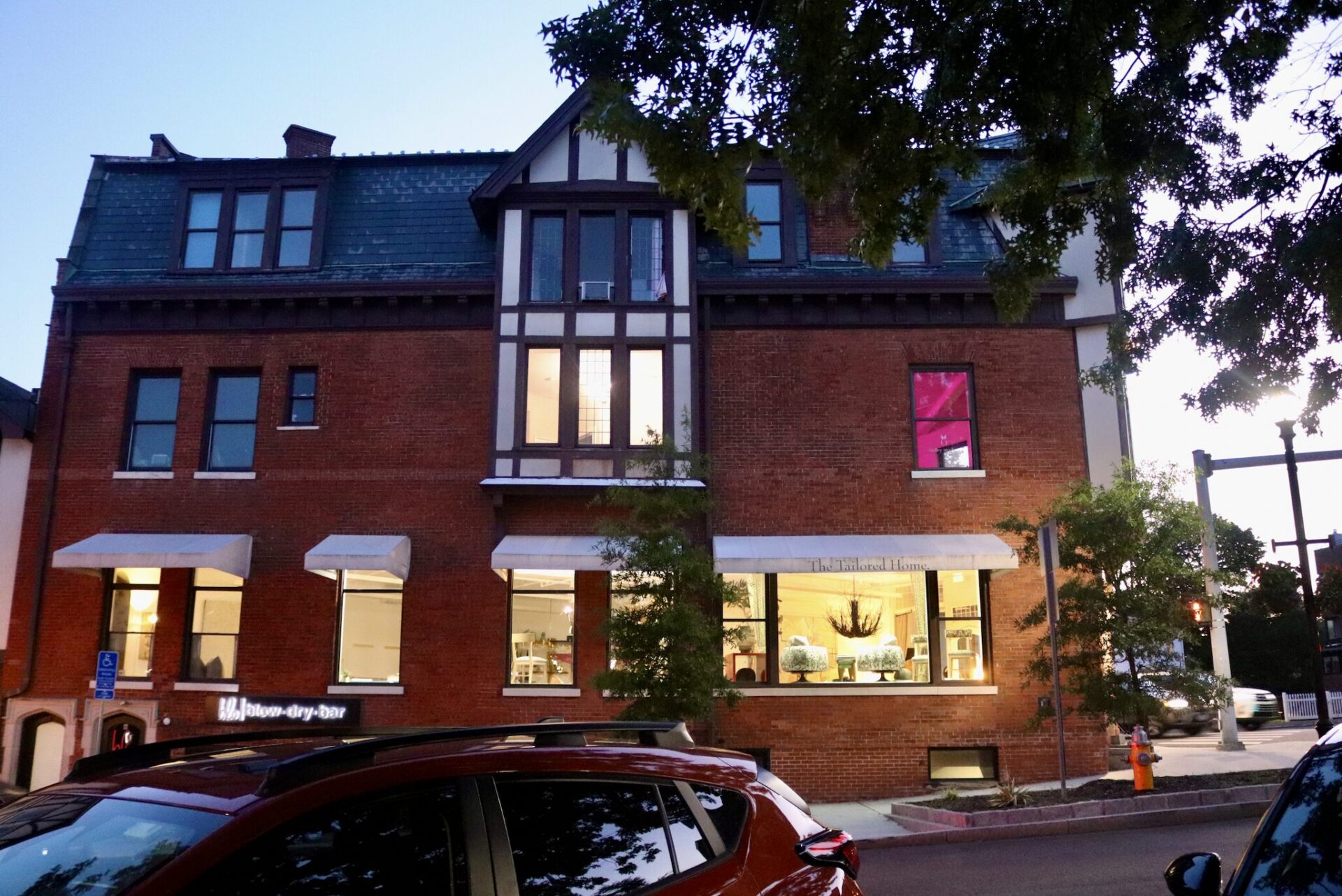
2 Greenwich Ave at dusk. July 8, 2026 Photo: Leslie Yager
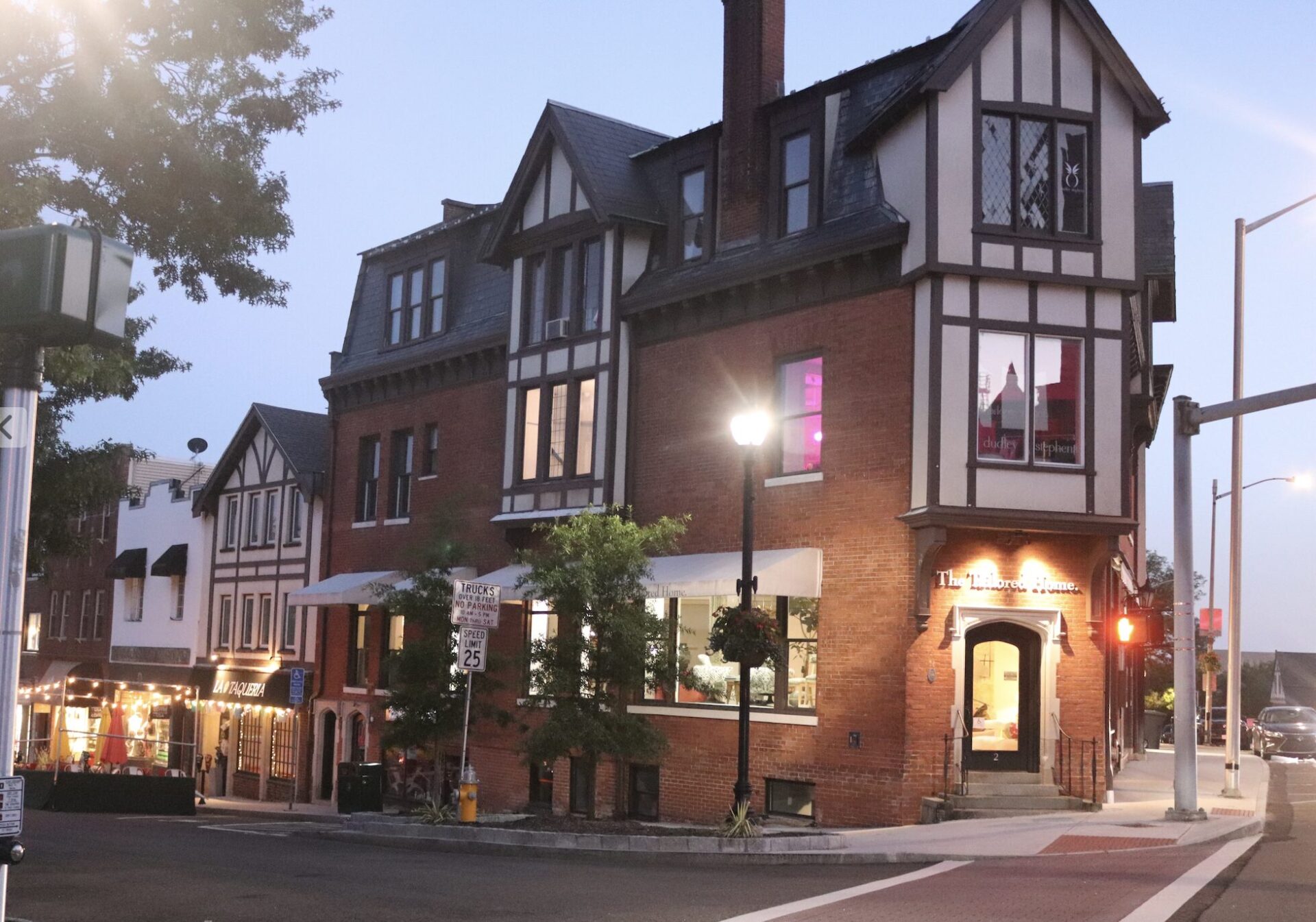
Intersection of Greenwich Ave and Putnam Ave. July 8, 2026 Photo: Leslie Yager
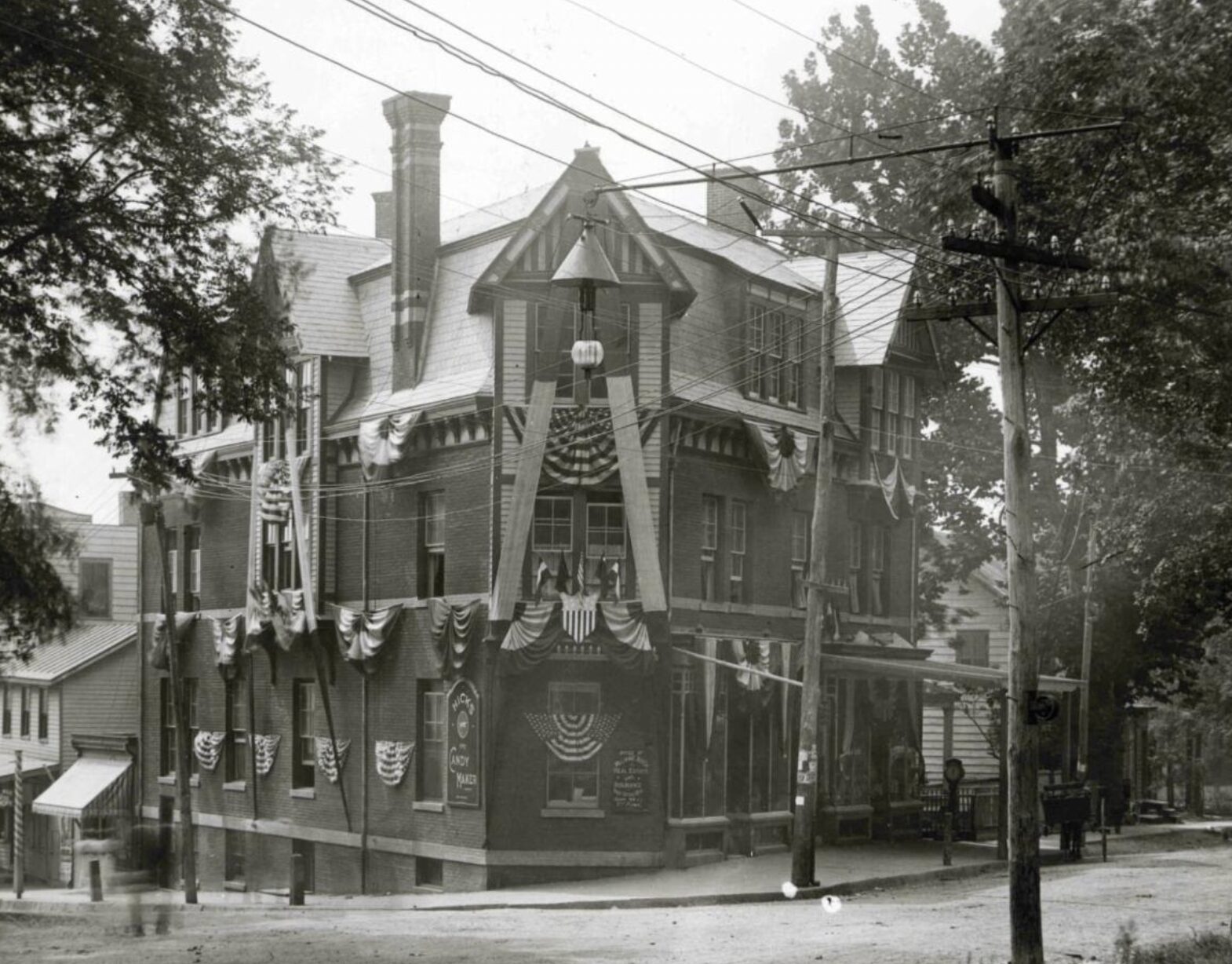
Undated photo of 2 Greenwich Avenue which dates back to 1878. Photo courtesy Greenwich Historical Society
See also:
July 10, 2026