The Round Hill Association’s debates on Oct 7 featured candidates for State Senate in the 36th district, followed by a debate between incumbent State Rep for the 149th district, Republican Tina Courpas and her challenger, Democrat Amiel Goldberg.
The 149th House district includes parts of Greenwich and Stamford. Mr. Goldberg, a Stamford resident, is a member of that city’s Board of Representatives and Water Pollution Control Authority board.
In his intro comments, Goldberg, who lives in Stamford, said having dyslexia had made him a problem solver. Originally from South Carolina, he said his career as a banker took him across the country. He moved to Stamford when he took a job at UBS as a financial services investment banker and later was a risk management executive at GE, and then a consultant at IBM. He ended his career as an executive at BNY Mellon, before retiring three years ago. His wife is an internist at Stamford Hospital. Their two daughters attended Stamford Public Schools. One is an epidemiologist and one is a senior at University Rochester.
Courpas, a Republican took office in January 2025. She described herself as the daughter of Greek immigrants who came to the US with nothing but an education and lived the American Dream. Courpas worked over two decades as a corporate lawyer and investment banker, and then headed a non profit that advocated for women’s and girls’ rights in Connecticut. She has four children.
Courpas said in her first term she addressed affordability and co-sponsored a bill that passed into law that removed 12% the public benefits charge from electric bills. She was named Affordability Champion by CBIA. She was a leading opponent of the affordable housing bill HB 8002 and has vigorously defended local control.
Further, she said she led passage of a bill that allocated a record $110 million to special education, passing both houses unanimously. She serves on the Governor’s blue ribbon commission on K-12 Education Funding and Accountability.
Courpas described Connecticut as “out of balance,” with Democrats controlling the House, Senate and Governor’s office.
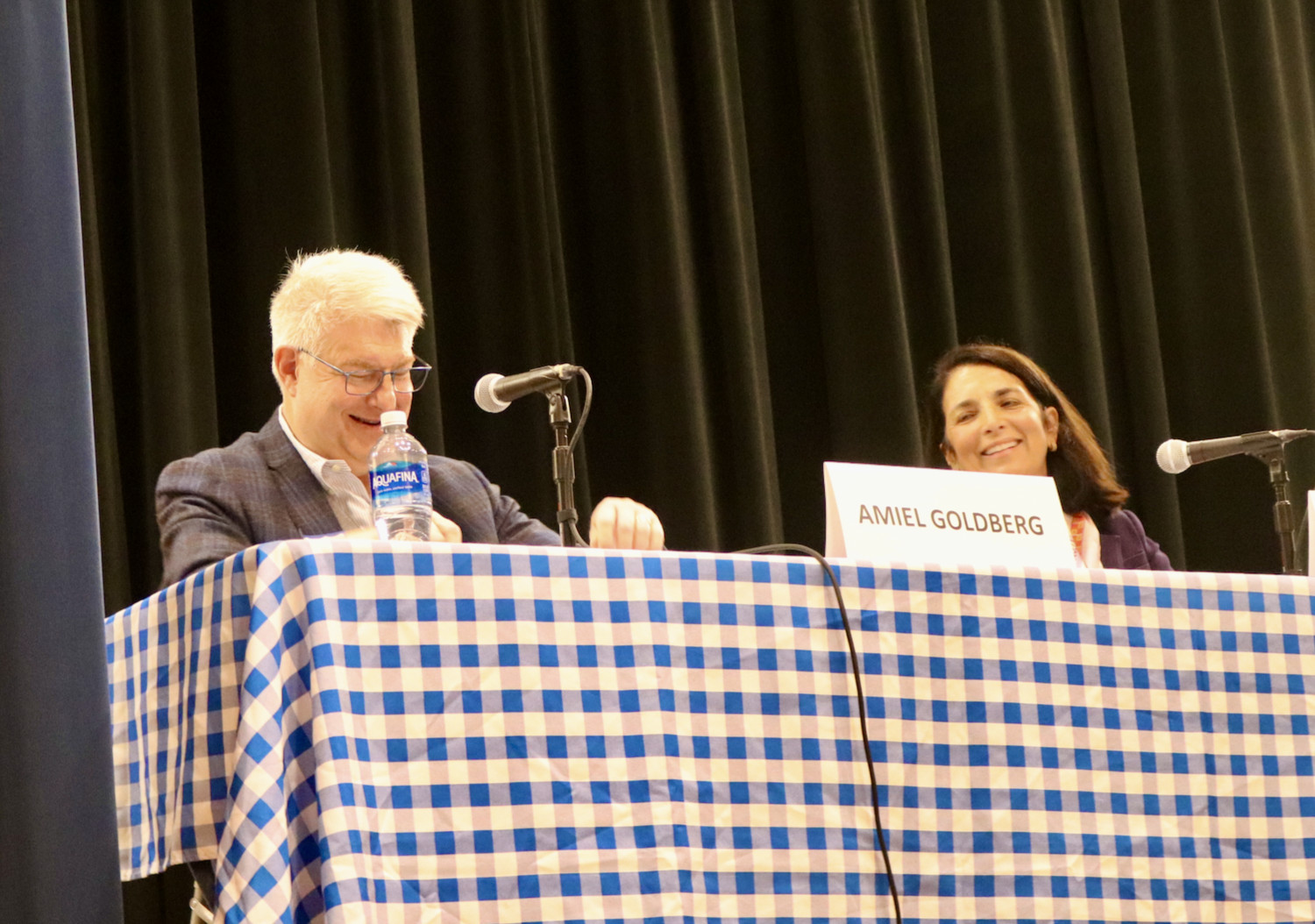
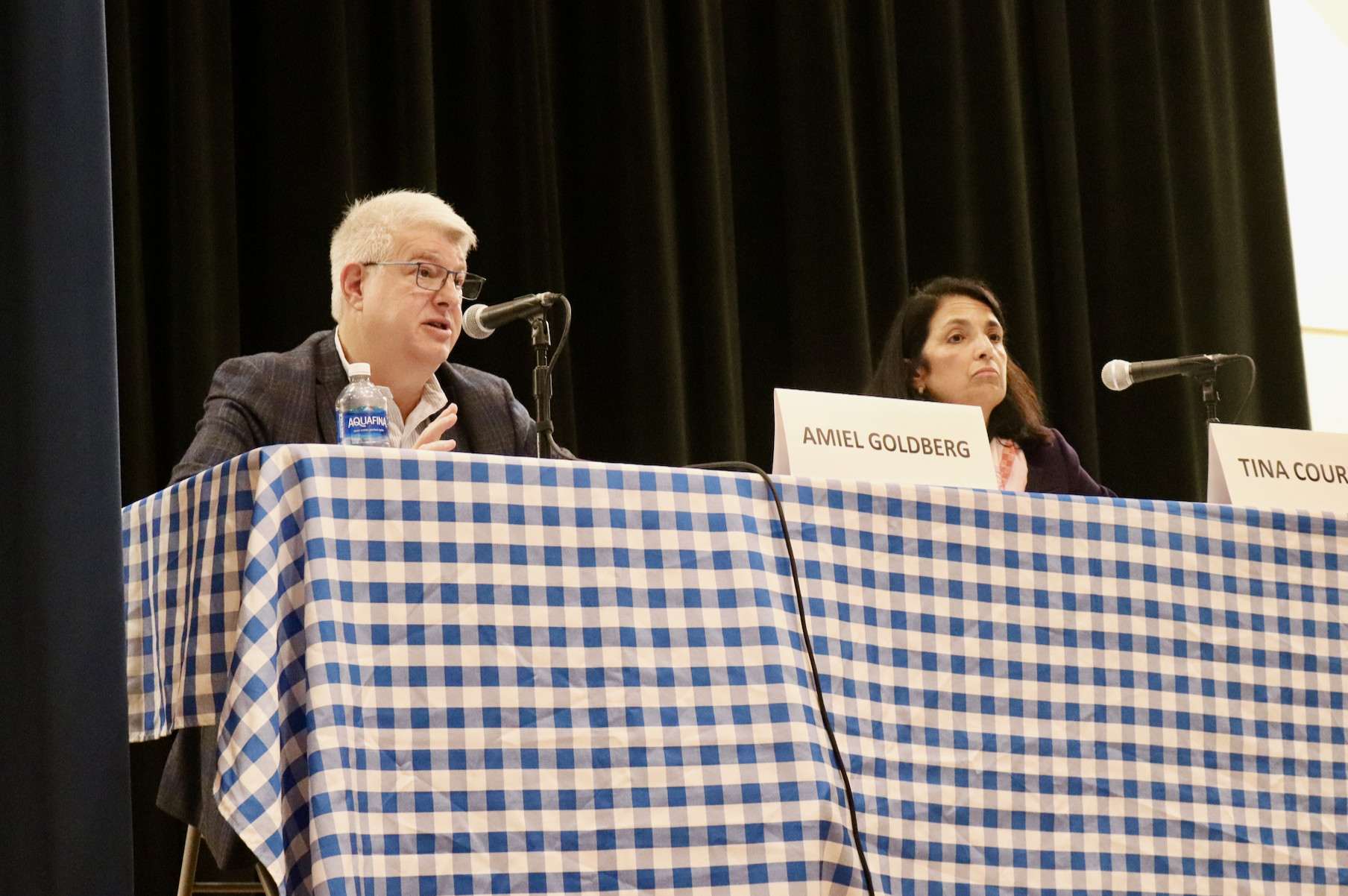
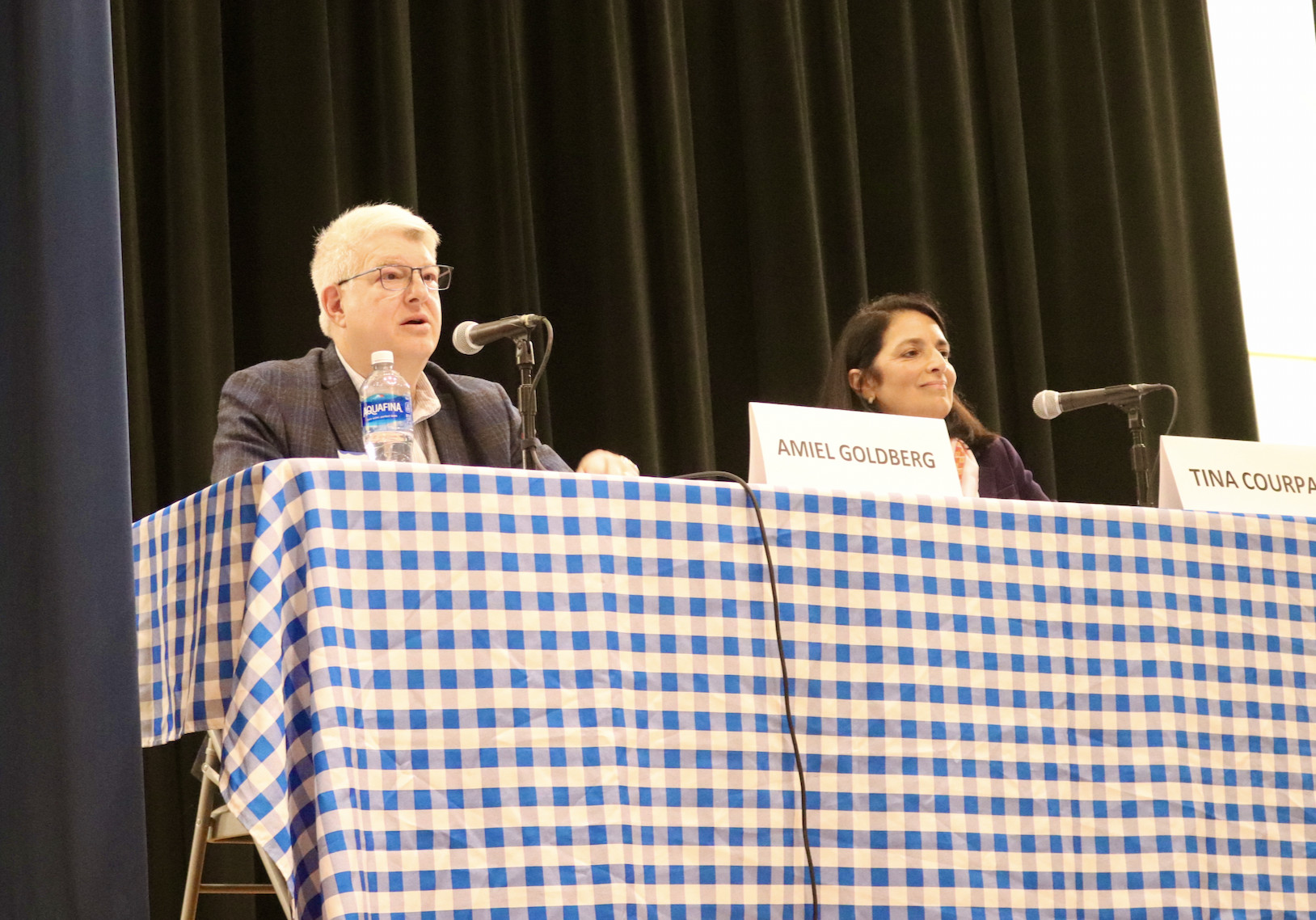
Amiel Goldbert and Tina Courpas debated at Round Hill Community House on Oct 7, 2026 Photo: Leslie Yage
Fiscal Guardrails
Moderator Brendon DeSimone, Round Hill Association’s president, asked about fiscal guardrails. Courpas said the fiscal guardrails had begun to turn around the state’s fiscal ship, paying down unfunded pension debt for eight years.
However, she said, “In 2025 and 2026 the fiscal guardrails were violated and discarded to the tune of $2.8 billion.”
“Is it my position that we should indiscriminately cut and not solve or support the underserved members of our state?” she asked. “Absolutely not. But there is a way to do that responsibly.”
Courpas said the fiscal guardrail violations came almost exclusively from capitol gain revenues, and that the percentage of capital gain revenues to Hartford contributed by Greenwich alone was 24%.
Goldberg said the principles behind the state’s financial guardrails remained sound.
“But good governance requires more than a narrow focus on financial indicators – they are all backwards looking,” he said. “We must measure across multiple dimensions, not just the strength of our balance sheet.”
“We can continue to prioritize the fastest possible reduction in pension liabilities, or we can use some of that financial capacity to take the place of the $2 billion in federal funding that is going to be cut from our state.”
“This isn’t merely a financial discussion. It’s a moral discussion, he said. “History will judge us not by the size of our reserves alone, but by whether we are willing to use our strength to help our neighbors.”
Courpas said having reserves was important, including for support to programs.
“This is not an abstract concept. People who are leaving CT and go to states like Florida are leaving for financial reasons,” she said. “Mismanagement of our state is having a significant and tangible impact across the board.”
Goldberg disagreed. “Focusing on one dimensional answers doesn’t serve you well.”
Energy Costs and Electricity Public Benefits Charge
Goldberg said the public benefits charge ought to be moved to the state budgets and away from rate payers’ bills.
“I do believe that is a hidden tax of sorts. It’s a regressive tax,” he said. “You pay a per kilowatt per hour charge. That hurts the working poor far more than it does those of more significant means.”
Goldberg said CT has an aging infrastructure that desperately needs to be modernized, and an over-reliance on natural gas that spikes in price in winter months.
“What I find the most worrisome is our future fuel mix,” he continued. “We’re going to retire a nuclear power station in the not too distant future. Its life needs to be expanded.”
Courpas said it was important to diversify sources of energy because all forms of energy in CT are expensive.
“We rely on natural gas and there is a pipeline that comes from Pennsylvania that could be expanded. We need to intervene through federal authorities or sue the state of New York, which has been blocking access to a more expanded pipeline.”
Courpas said the state government enters into long term contracts for electricity, locking in rates that are sometimes much greater than the market rate.
“We could do a better job at either locking in shorter contracts or capping the differential of our contracts – market rate versus what we are contracting for.”
Goldberg said as a former risk manager, “The advantage of hedging is that sometimes you do end up paying a slightly higher rate than the open market, but what you’re buying a surety of price, and that has a value.”
“I don’t think it’s smart to critique hedging programs by looking in the rear view mirror,” he said.
Courpas said some contracts had locked in prices up to five times the wholesale price of electricity.
Jobs, AI, Data Centers and the Environment
Goldberg said he had worked at IBM. “So I kind of like data centers.”
He said there was an upstate community near Hartford where IBM left a facility that could be repurposed potentially as an AI data center.
“That brings good paying jobs back here. When IBM closed that site they laid off 20,000 people who made on average of six figures a year. We need those jobs back here.”
Goldberg said AI data centers can be required to generate their own energy.
Courpas she supported an AI bill that created consumer privacy protections, restricting companies’ ability to use AI to target minors in decision making contexts.
She also supported a bill to regulate the use of data and commercial surveillance.
“This restricts a vendor, like a grocery store’s ability to follow you and look at your price patterns and target different prices at 4:00pm because people with deeper pockets shop at that time, than people who shop at 8:00am. Protecting that kind of information against predatory pricing was a worthwhile public safety issue related to AI and I supported it.”
A more controversial bill she did not support was SB5, a bill she described as a mixed bag of AI regulations that the state’s business organizations, hospital organizations, and tech provider associations all opposed.
“That bill placed onerous restrictions on corporations to use AI-driven hiring platforms like an Indeed, and created a liability on part of the employer if it was found that the hiring platform used AI in a discriminatory way.”
Goldberg said with AI, it was important to think about a risk-reward tradeoffs.
“I’m pretty concerned about AI, but at the same time I am super impressed, particularly as a dyslexic, at what it’s able to do to help me write better, to help me to understand what I’m reading. It is a powerful tool. Properly controlled, it will be life changing for all of us.”
Transportation Investments: Tolls? Gas Tax Holiday?
Asked what is the single most transportation investment the state should make and how should it be paid for, Courpas said updates to Metro-North were sorely lacking, especially given the availability high speed trains in other states and countries.
“That would be a large priority for state dollars,” she said.
Coupas said there should also be a recognition of traffic problems on I-95.
“We have the single most congested patch in the country, on I-95 between exit 2 and a bit north of Stamford. This we deal with every day, especially since I95 is not only a traverse through Connecticut, but it’s something we all use to get from Byram to Riverside in our day-to-day life.”
Courpas said transportation projects were heavily regulated and use project labor agreements that demand unionized employment, resulting in high expenses and stalled projects.
“We could be producing more outcome for fewer dollars if we would relax some of those restrictions,” she said.
Goldberg said labor agreements present a similar challenge to building affordable housing.
“Does anybody think it’s fair that when you drive through MA, NY and NJ, they toll the heck out of us, but we give them our roads for free. That is a real asymmetry,” he said.
“When you start to think about how are you going to pay for transportation improvements, you start to think in the back of your mind, well if you’re going to toll us, maybe we should think about tolling you.”
He said with technology, a local driver might pay a different toll from someone in New York.
“I do not support tolls,” Courpas said. “This is an issue that traversed the legislature a while back.”
She said she had joined her Republican colleagues in the House and Senate to call for a gas tax holiday from now until the end of 2026, to be paid for out of the transportation fund.
Goldberg said the gas tax holiday worried him because it results in a loss of $300+ million a year in revenue.
“I don’t know how we’d fill the gap. It’s also kind of a sugar high. If you get a gas tax holiday for a year, what does it really do to structurally change your costs? Wouldn’t it be better to end endless wars and get the price of gasoline down?”
Affordable Housing Legislation and Local Control
Goldberg said the power for local municipalities to regulate housing is vested in the state government, who passes it down to towns and cities.
“Antagonizing people in Hartford over housing policy doesn’t really give them a lot of confidence to let us control our own destiny,” he said.
He said while Stamford has room to build affordable housing, Greenwich is constrained, and that lawmakers have not done a good job of explaining that in Hartford.
Courpas said 8-30g was “child’s play” compared to the omnibus HB 8002 bill that abrogated local control.”
The legislation passed in an emergency session, including elements of goth Fair Share and Live Work Ride. The bill became law effective July 1.
Courpas said that with respect to parking, the new legislation means that if a building contains less than 16 units, the town is not allowed to require parking. She said a development in Bridgeport without parking was “an unmitigated disaster.”
She noted the law allows commercial properties to be redeveloped into housing, as-of-right, with very little review.
She said 8-3og and HB 8002 should be repealed.
Goldberg said there were some good opportunities in 8002, and he could be the “voice in the room.”
Courpas questioned Goldberg’s notion of a seat at the table.
“The notion that one or two representatives from Greenwich is going to move the needle – I have seen no evidence of that,” she said. “And we have had two state reps up there already for about six years.”
Goldberg pushed back.
“The reason we have the legislature we have is because the voters chose it. The constituents of this state in each district choose their representatives. I don’t see an out-of-control majority.”
Courpas said she had developed relationships and friendships with Republicans and Democrats.
“I do think people can be very good friends and disagree strongly on policies.”
In closing remarks Courpas said she was proud of her voting record.
“This election is not about national politics,” she said. “I have seen the state move decisively to the left in the two years I have served. I have not moved to the right or the left.”
She said she continued to stand for fiscal responsibility, local control, excellence in funding of education, reasonable policing and a reasonable balance of the public good and individual freedom.
Goldberg said his commitment was simple: listen carefully, think honestly and act with integrity.
“Government should be a practical force for good. Helping families, respecting workers, protecting your rights and ensuring real opportunity,” he added.
See also:
Round Hill Association Hosts Debate for State Senate 36th District: Joe Kelly vs Jill Oberlander
Oct 8, 2026
On Wednesday, October 14, LWV Greenwich will host debates from 7:00pm to 9:00pm at First Congregational Church in Old Greenwich featuring candidates for Connecticut State Senate District 36 and State Representative Districts 149, 150 and 151. Register here.