Months of hard work has paid off for Ian Tiedemann’s Econ Club members who participated in the Euro Challenge and National Economics Challenge.
“After months and months of learning and practice – this is quite a group,” said club advisor, Ian Tiedemann said during an after school meeting in his classroom this week. “They worked very hard and will get to go to Washington, DC in June.”
Mr. Tiedemann explained that there are two divisions of the National Economics Challenge, so they all get to participate in the online competition. One tier is for students who haven’t studied economics and the other tier is for students who have.
Tuesday gathering was a mix of students from both divisions.
Four students formed the team that took first place in Connecticut, but did not advance to Nationals in Atlanta.
They laughed as they posed with a mini yellow trophy from Mr. Tiedemann that said, ‘You Tried.’
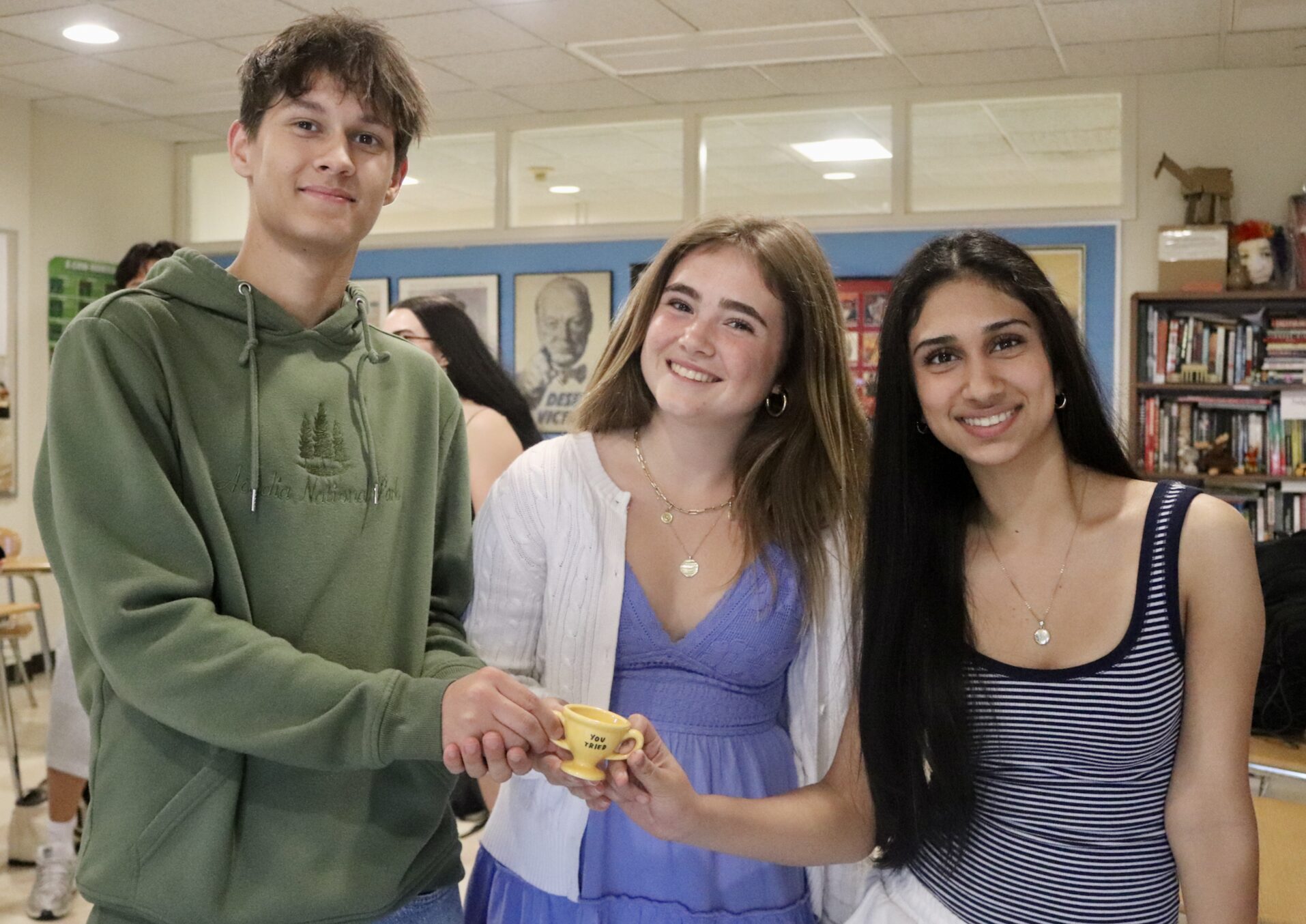
National Economics Challenge David Ricardo Division 1st Place in Connecticut: Daniil Levakin (sophomore), Reilly Anderson (sophomore) and Vanya Kapur (freshman). Not pictured: Alexandra Rothstein (freshman) – finished first in Connecticut in the National Economics Challenge David Ricardo Division. May 5, 2026 Photo
“Eventually they will receive medals in the mail,” Tiedemann said of the tiny trophy placeholder.
“This group finished second in the country in the Euro Challenge and we’ll find out soon about the Federal Reserve competition (for upperclassmen).”
“We have three things going on. It’s hard to balance all of them all year,” Tiedemann said of the National Economics challenge, Euro Challenge and Federal Reserve competition.
While the format for the National Economic Challenge is a quiz bowl, Tiedemann explained that in the Euro Challenge, students select an economic challenge, offer solutions and provide a macro-economic update of the Euro. This team of 9th and 10th graders made a presentation that stemmed from Greece’s demographics and aging population.
“It’s interesting to study because Greece and the larger Euro area and much of the world has been experiencing a demographic cliff – where much of the labor force is on the brink of retiring,” said Pilar Ortuno. “More people will be relying on pensions and social safety nets and fewer people will be working and contributing to the economy.”
“So they have to learn macro,” Tiedemann said. What’s so cool about this is the process.”

Euro Challenge 9th and 10th graders took 2nd place. Their topic: Demographics and Aging Population in Greece. Pictured: Daniil Levakin (sophomore), Jin Cha (sophomore) Pilar Ortuno (sophomore), Raghav Ramji (sophomore) and Eva Csatorday (Freshman). Not pictured: Diego Madrid and Georgia O’Neil. May 5, 2026 Photo: Leslie Yager
Sophomore Raghav Ramji said, “We had to learn a lot of macro and get a general understanding of how monetary policy impacts fiscal policy. Another part was to provide solutions – like childcare, elder care facilities, and health care in terms of how can we be responsible for things including inflation and unemployment.”
The challenge question comes from several options the teams select. There were 5 issues to select from, including climate change, inequalities or AI in the labor market. Then the students select from one of the countries that are on the Euro – for a total of 21 options.
“Different countries have different needs and areas of expertise where they fall short. That’s the challenge of having a single currency and the challenge of the competition,” Pilar said.
“I love this competition,” Tiedemann said. “It requires so much, in addition to teamwork. They’re working with each other really well and practice learning how to make a presentation and how to answer questions on their presentation. And they then had to learn macro and answer questions about that.”
Tiedemann said the team traveled to New York City once for the first round and returned for the second round, and there was an additional second team that made it to the semi-finals.
“We’ve never had a second team before,” Tiedemann said. “They allow two teams but we were the only school in the competition that had two teams move up to the national semi-finals.”
“We have now finished in the top 5 four times, all since 2018,” Tiedemann said. “It’s so hard just to make the top 5. And as a result of this they get to go to DC.”
During last year’s trip to DC, Euro Challenge team studied Germany and were able to visit the German Embassy.
This year they’ll visit the Greek Embassy and present to Greek ambassadors and economists.
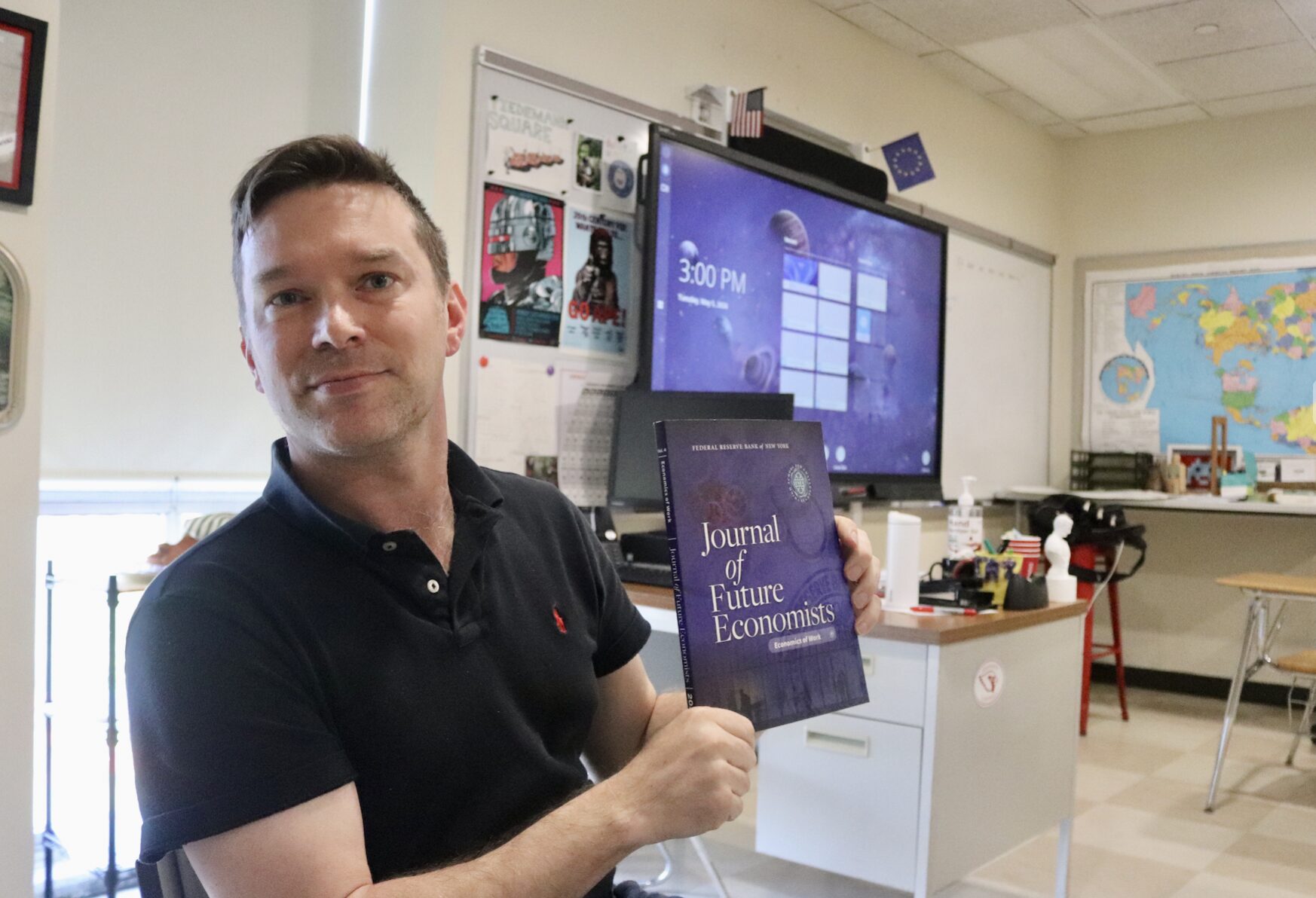
Social studies teacher Ian Tiedemann who is the advisor for the Econ Club and its various competing teams. May 5, 2026
During the club meeting, students talked about some of their solutions for Greece that they will present to Greek ambassadors and economists at the Greek Embassy.
“We had different sectors: housing, tech, healthcare and child care,” Pilar said. “Some of our programs included free daycare, free extended childcare that would include family support and nutrition to support families who are having children and help keep them in the workforce.”
Another idea, Pilar shared was to redistribute education funding to towns and cities instead of from a universal centralized government to better address the needs of each city or area.
Jin Cha shared another solution in response to the aging workforce.
“One of our solutions was to boost productivity by trialing a four-day work week, which is radical and new, but it’s been piloted in places like the UK where it’s shown successful results. Productivity has soared and revenue remained the same under the four-day work week.”
“In industries like tourism, you can’t have all of the workers going on break at the same time,” Jin said. “So you would have staggered schedules to cover all the time slots.”
“A four-day work week would also help families,” he added. “It would obviously give parents more time to care for their children. They’d subsequently spend less on childcare as many days.”
Daniil said talked about transitioning to a more skilled workforce.
“Transitioning Greece to be more of a digital economy was another solution to increase productivity and prepare both children and the aging labor force to be better versed in digital literacy,” Daniil said.
He acknowledged funding would be a challenge.
“All of this needs monetary backing,” he said. “Greece, in the past has also not a very reliable country. They remain to get out of the sovereign debt crisis – because they took on too much debt.”
“Once of our solutions is a long term re-financing operation, which insures that at a lower interest rate, Greece could borrow money and fuel all these programs – which is more sustainable,” he added.
Pilar said yet another one of their suggestions was to add affordable housing.
“Their housing is the second most expensive in Europe and the highest in comparison to income growth,” she said. “For that reason you see people living in their parents’ homes for way longer than other countries in the EU – until an average age of 30.7 years.”
Another idea was to develop tax breaks for rural areas.
“Greece has a lot of concentration in areas like Athens and tourist areas like Mykonos,” Pilar said. “Or do prefab housing to build up and revitalize areas outside major cities.”
“Another idea is renovation,” Daniil said. “People are leaving or to having kids, which leads to a worse economy. Hundreds of schools are closing in Greece. It’s a downward spiral.”
Mr. Tiedemann said while Greece’s challenges are acute, they are shared across the developed world, including across Europe and in Japan.
“It’s going to be a problem in China, he said. “And it’s going to be a problem in parts of our country. It’s a modern economic issue we have to have solution for,” Tiedemann said. “We have 9th and 10th graders engaged in these challenging issues.”
The students said they are in contact nightly in preparation for their competitions, including weekends and vacations.
“The whole club helps,” Tiedemann said. “The older Fed Challenge students help the younger Euro Challenge students.”
“We have club leaders who are juniors and seniors who get them within time, ask them questions and then we do run-throughs in the club on Thursdays.”
The second National Economics Challenge team took on a case study of Spain and AI in the labor force, the country with the highest unemployment in the EU. That team included Aaryan Agarwal, Weihan Chen, Zain Haque, Ethan Kaufman, Vanya Kapur and Alexandra Rothstein.
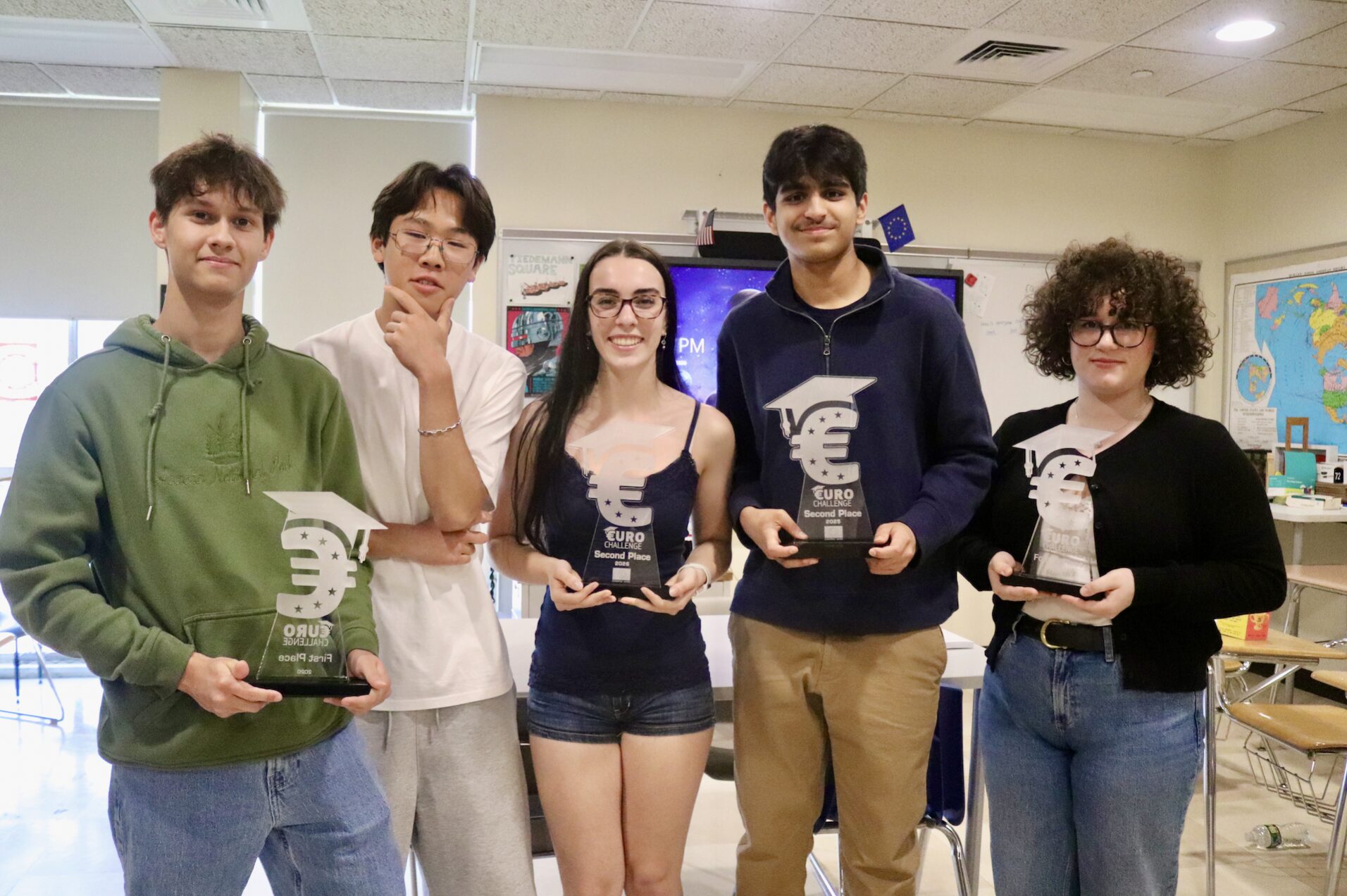
Euro Challenge team: Daniil Levakin (sophomore), Jin Cha (sophomore) Pilar Ortuno (sophomore), Raghav Ramji (sophomore) and Eva Csatorday (Freshman). May 5, 2026 Photo: Leslie Yager