Art and science intersect for an immersive cosmic experience in “Rohini Devasher: Solar Poetics,” on view Aug. 22-Nov. 29 at the Bruce Museum.
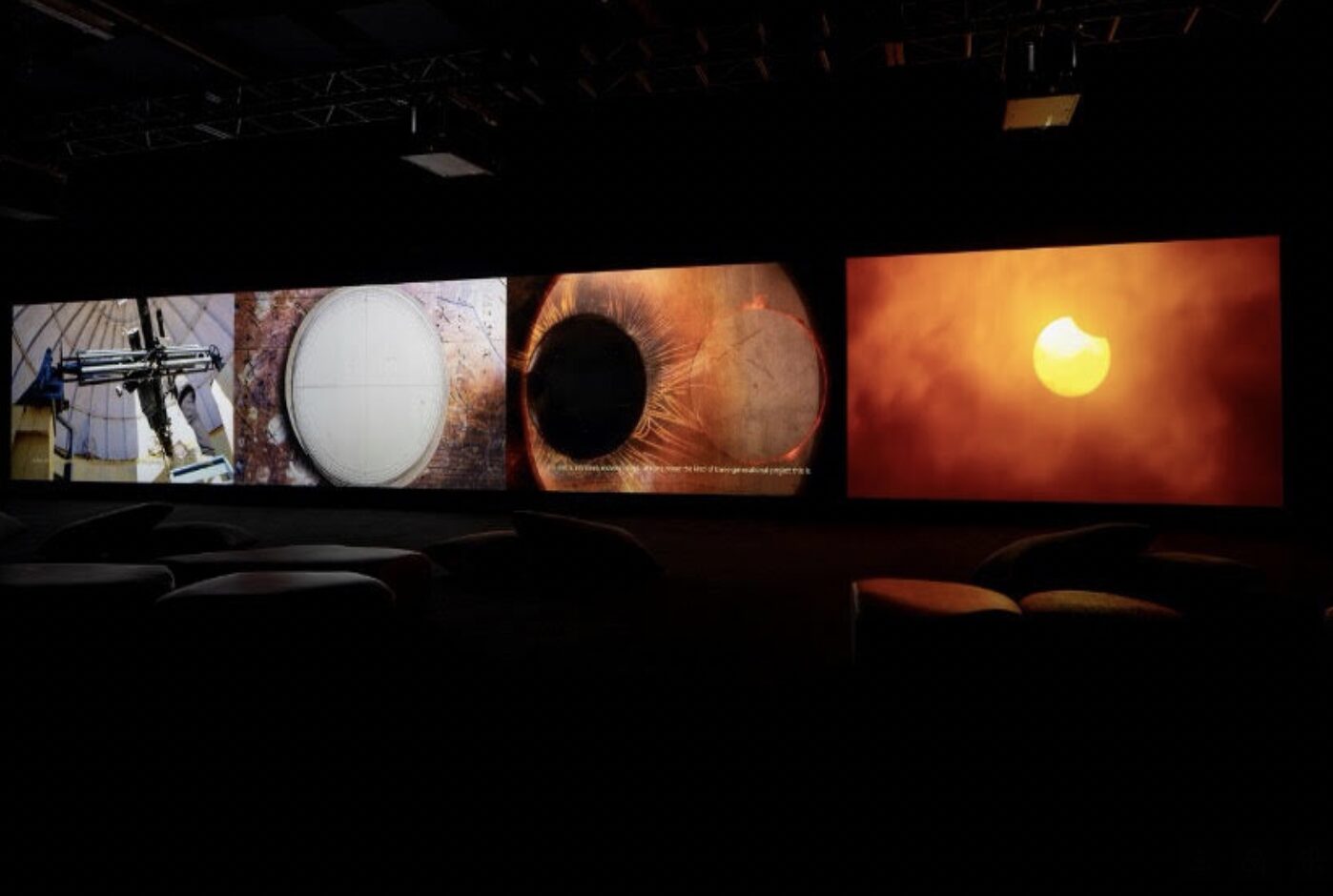
Installation view, Rohini Devasher: One Hundred Thousand Suns, Minnesota Street Project Foundation in collaboration with Gallery Wendi Norris, San Francisco, 2024. Courtesy of artist and Gallery Wendi Norris, San Francisco. Photo by Henrik Kam.
The exhibition, Rohini Devasher’s first solo museum exhibition in the United States, is anchored by the artist’s “One Hundred Thousand Suns” (2023), a four-channel video installation new to the Museum’s collection. The film transports visitors beyond Earth’s atmosphere with imagery tracing a century of solar observation, from drawings and photographic techniques to first-person accounts from eclipse chasers, who travel the globe to witness them.
The film’s title references the Kodaikanal Solar Observatory in India, whose archive of approximately 157,000 sun portraits have been a source of imagery and inspiration for Devasher. “Solar Poetics” pairs the film with the artist’s copper works, showcasing Devasher’s ongoing engagement with astronomy and natural phenomena and affirming the Bruce’s place as a museum where art and science inform one another.
In “One Hundred Thousand Suns,” Devasher (b. 1978, New Delhi) draws on the Kodaikanal Solar Observatory’s historical glass photographic plates and hand-drawn sunspot observations, layering them with contemporary imagery from NASA, global astronomical observatories, and her own data collections. Every day since 1904, weather permitting, the Observatory’s researchers have captured images of the sun, building a monumental archive that spans nearly 125 years or 11 solar cycles.
“What draws me to Rohini Devasher’s work is how completely it joins art and science. She works as a researcher, assembling a century of solar observation, and she shows us that scientists are moved by the same mystery and magic that move artists. In the end, we are all trying to understand our world. That is why the Bruce Museum holds science and art together,” said Mary-Kate O’Hare, Ph.D., the Bruce Museum’s Susan E. Lynch Executive Director and CEO and curator of the exhibition.
“One Hundred Thousand Suns” plays simultaneously across four screens, each a “Paradigm,” Devasher’s term for a distinct way of observing the sun:
- “Site” turns to the Kodaikanal Solar Observatory itself, its instruments, and the people who run it, some of them the fourth generation of their families to record the sun there. “Site” also traces the Observatory’s history to its founding in 1899, when it took over the work of the Madras Observatory, established in 1786.
- “Drawing the Sun” gathers naked-eye observations made by hand at the Observatory between 1902 and 1904.
- “Twin Suns” considers the sun as at once knowable and unknowable, drawing on 19th-century glass-plate astrophotography.
- “Eclipse” offers a meditation on light and memory, with footage of dust captured during an eclipse, caught in a beam of light in the Observatory’s 60-meter tunnel telescope.
Each paradigm carries its own layer of sound, drawn from voices, data, and music. Devasher includes the voices of those who have devoted their lives to studying the sun, among them fellow amateur astronomers, eclipse chasers, and the historian of science Lorraine Daston, Director Emerita of the Max Planck Institute for the History of Science in Berlin, all of whom Devasher interviewed for the film.
“One Hundred Thousand Suns” will be accompanied by a selection of Devasher’s Shadow Portraits (2023) and Sol Drawings (2023)—intimate works on copper created with fumage, a technique of drawing with smoke. Using her kitchen stove and candle smoke, alongside interventions like acid washing and embossment, Devasher creates patterns ranging from solar flares and sunspots to plumage-like growths, their surfaces shifting between blue-purple hues and golden copper. These works reveal her patient, handmade process alongside the monumental film installation.
“Solar Poetics” is organized by the Bruce Museum and will be complemented with a slate of special programming, including an artist talk on September 22, and a family day with interactive planetarium shows and hands-on intergenerational workshops.
Rohini Devasher (b. 1978, New Delhi) is an artist working across drawing, video and printmaking who explores the intersections of art, science, and philosophy. She holds a BFA in painting from New Delhi’s College of Art and an MFA in printmaking from the Winchester School of Art at the University of Southampton in the UK. Her research-driven practice draws on more than two decades of engagement with amateur astronomy, most recently centered on the Kodaikanal Solar Observatory in India, where staff have recorded daily images of the sun since 1901. Devasher is co-represented by Gallery Wendi Norris in San Francisco and Project 88 in Mumbai. She was named Deutsche Bank’s “Artist of the Year” in 2024.
Located in Bruce Park, overlooking the Long Island Sound in Greenwich, Connecticut, the Bruce Museum harnesses the transformative potential of art and science to spark curiosity and connection. Established in 1912 with a multidisciplinary vision, the museum houses a unique collection that encompasses visual arts as well as works of scientific, historical, and cultural significance spanning millennia. With education at its core, the Bruce offers a wide-ranging exhibition and public program, serving as a dynamic laboratory for discovery that welcomes and engages visitors of all ages.
The Bruce underwent a dramatic expansion and upgrade in 2023 with the opening of a new building that doubled its size and tripled its gallery spaces. In its new state-of-the-art home, the Bruce is deepening its role as a vital resource for learning, community building, and connectivity. For more information, visit www.brucemuseum.org.