At the last Board of Estimate and Taxation meeting, assistant director of Environmental Affairs Sarah Coccaro asked for approval to accept a state grant of $15,892 awarded through DEEP’s inaugural Materials Management Infrastructure program (MMI) to Greenwich for a pilot to expand the town’s food scrap recycling program.
DEEP’s inaugural MMI program is a grant to municipalities to develop small to medium waste management infrastructure.
After evaluating more than 20 sites Caccaro said two park locations were selected for the three bins, two in Binney Park and one in Cos Cob Park.

 June will mark the five-year anniversary of the Greenwich’s voluntary municipal food scrap recycling program at Holly Hill designed divert food scraps from the municipal solid waste stream.
That program was the result of collaborative efforts of GRAB, Waste Free Greenwich, Greenwich Green & Clean and the Town.
In response to community feedback, Coccaro said two additional satellite drop off sites were established to increase convenience. Run by volunteers, drop-offs are limited to one day a week, with limited hours and residents have complained there is a shortage of parking.
“This is a petty low risk thing for the town because it is all cloud-based. The information is directly submitted to us. They’re not utilizing the town servers or transmitting through our town system.” – Greenwich DPW commission Jim Michel on privacy concerns about resident data
In June 2021 collections started at the Old Greenwich Farmers Market at the Living Hope Community Church. And in Jan 2022 a second location was provided at Round Hill Community Church.
Since food scrap recycling was established in summer 2020, over 600,000 lbs of organic matter have been diverted from the waste stream.
Unfortunately, despite increases in collections, the amount recycled continues to be a fraction of what could potentially be diverted from the waste stream.
Coccaro said today 7-10% of Greenwich residents participate in the food scrap existing program.
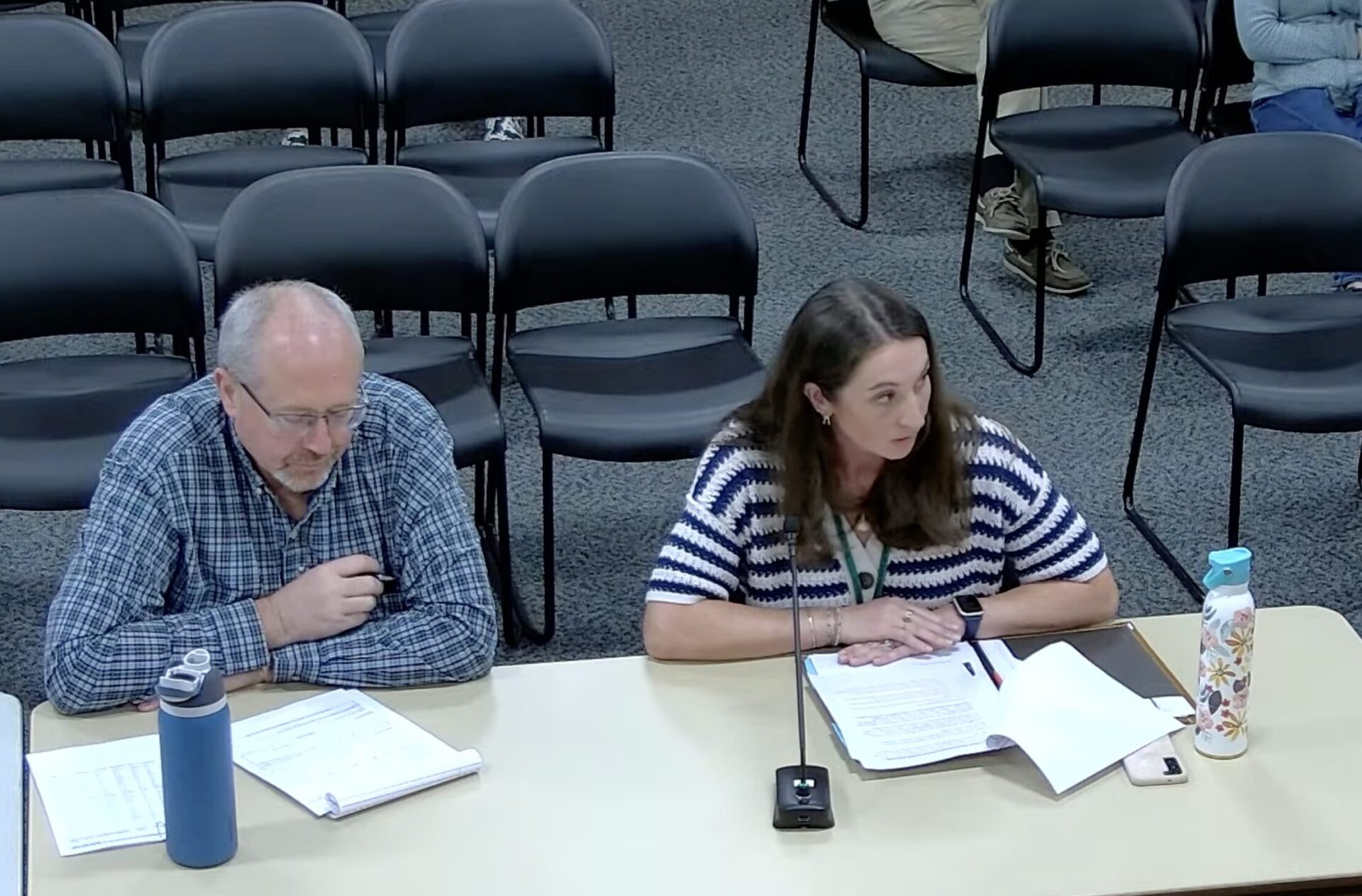
DPW commissioner Jim Michel and assistant director of Environmental Affairs Sarah Coccaro at the BET meeting on May 19, 2025
“Diversion of food scraps is a low hanging fruit,” Caccaro said adding that wasted food makes up over 22% of the waste stream in Connecticut. “Participation in Greenwich’s food scrap recycling program has been growing slowly and steadily.”
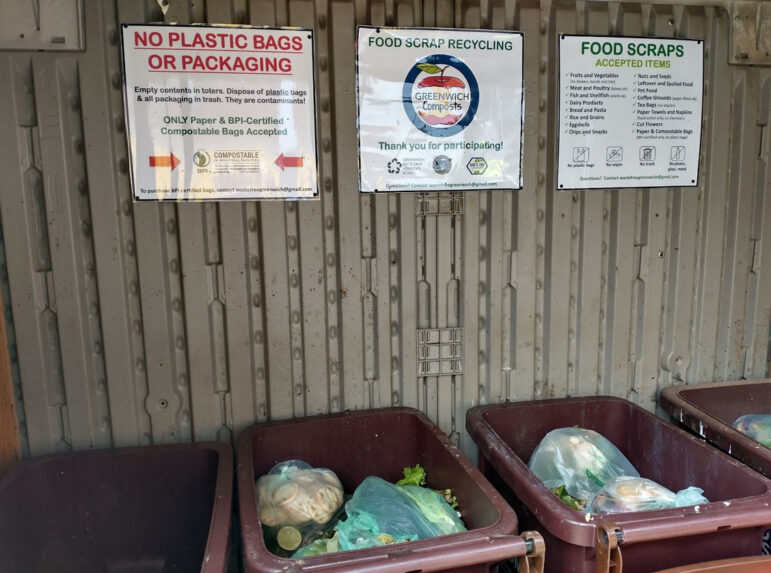
The MMI grant will be used for capital infrastructure – smart bins, concrete pad and installation of units, freight and apps. DPW will cover the cost of hauling.
A separate RFP will be required for the annual operating costs – the hauler to visit the site.
Both the law committee and budget committee voted in favor of appropriating the grant.
Coccaro listed technical features and controls that would prevent overflow or littering, contamination or other misuse: heavy duty construction, locking mechanism, controlled access, strategic placement, education efforts and consistent monitoring.
Competition for the grant was strong. Coccaro said only 9 towns were selected from 20 applications for over $30 million. Using the three smart food collection bins in the two parks, the idea is to have drop off locations with expanded access to secure durable collection units for convenient and easy food waste disposal.
It’s designed to be cost effective alternative to curbside pickup. The diversion of at least 150 households which has doubled the number who participate cutting tipping fees based on the volume of the collection bins Residents download a free app to locate available bins and unlock them.
The hauler will pick up the material 2-3 times a week and transport it to a licensed processing facility.
A web based management system tracks participation and use on a bin by bin basis to provide data reporting such as use patterns and volume collected. The hauler will provide additional data on tonnage diverted. The Conservation dept, with support from Waste Free Greenwich, will monitor the use for cleanliness and conduct information sessions and outreach materials. As for concerns about contamination, misuse and dumping, Coccaro said the bins are reinforced heavy duty units that are fully enclosed and inaccessible to pests. Odors are contained so that animals are not drawn.
The doors lock automatically and only registered users can use the app to unlock and open the unit. there is a foot pedal to allow for touch-free recycling so residents have full use of their hands to place the food scraps into the bins. The app controls the use by tracking users access and creating a time stamp of access allowing for for conservation staff as program administrators to counter any problems. The smart bins will be located adjacent to trash and recycling bins to prevent littering.
The units will be discreetly located in low traffic areas in the park, so participants will need to be intentional when dropping off food scraps.
The hauler will monitor the bins during their pickups, and conservation staff along with Waste Free Greenwich volunteers will also conduct weekly checks on the units and Parks & Rec staff will also keep an eye out especially in Binney Park their operations building is a few step from the units.
The hauler will be responsible for cleaning the bins.
A fill sensor inside measures fullness, preventing overflowing and informs the contractor when and where collection is needed.
And finally, the app is a vehicle to provide educational information and contact for users in case of issues.
Lucia Jansen, BET liaison to DPW, who said she was an enthusiastic food scrapper, had numerous questions, mostly concerning privacy of residents who download the free app. She also questioned how far away the food scraps would be hauled.
Coccaro said that depending on which hauling company is selected – one destination is West Hartford and the other is in Milford.
Ms Jansen said, “We all know when the app is free, the product is you. It sounds that down to the user level, your drop off and your trash may be tracked.” “Who has access to this data? How much is given? Is there a town policy that’s going to be developed around it? Is IT involved in it?” she asked.
“It does mention that data is going to be supplied to Waste Free Greenwich,” she added.
Ms Tarkington said the town had ongoing concerns about cyber security.
Coccaro said the hauler will only see how full the bin will be. Information on the user will be collected by conservation dept. It’s essentially, name, phone number, email address and address.”
She said that information might be used, if for example there was contamination residents who had used the bin in previous two or three days would be notified.
“This is something that personally I would like to see a privacy policy developed,” Jansen said. “It is my understanding that any information that you give to the town is FOIA-able.”
DPW commissioner Jim Michel said when the vendor is selected through the RFP process, the hauler will have to do a cyber security check through IT.
“This is a petty low risk thing for the town because it is all cloud-based,” Michel said. “The information is directly submitted to us. They’re not utilizing the town servers or transmitting through our town system.”
David Weisbrod reminded the group that the Frist Selectmans and the Board of Selectmen supported the program, which Weisbrod reminded the group was a pilot.
Quoting Camillo, Weisbrod said, “It is not only good for the environment. it makes good financial sense as this diverts material from the waste stream and saves the town money.”
Ms Coccaro said she’d be willing to return in six months with an update.
The vote was 10-0-1 in favor because Mr. Kalb was no longer on the call and Ms Tarkington abstained.

The Board of Estimate and Taxation met on Monday May 19, 2025
