By Andrew Melillo
The Morning the Nation Began
The morning of April 30, 1789 broke clear and uncommonly bright over the harbor of New York City. From the steeple of Trinity Church, bells began to peal at sunrise, and one by one, the churches of the young capital answered — St. Paul’s, the Middle Dutch, the German Reformed — until the air above Wall Street trembled with sound. The smell of harbor salt mingled with woodsmoke from a thousand chimneys, and the cobblestones, still damp from the night’s mist, gleamed beneath the boots of soldiers already forming ranks in the streets.
By nine o’clock, the city was no longer a city. It had become a single, breathing crowd. Citizens pressed shoulder to shoulder along Broad Street and packed every window, every balcony, every rooftop within sight of Federal Hall. Ladies in pale silk gowns leaned from second-story sashes, their ribbons fluttering in the river breeze. Boys clung to lampposts and to the iron railings of front stoops.
Old soldiers of the Revolution, some leaning on canes, stood bareheaded in the sun. They had come, many of them on foot from farms a day’s walk away, to witness a thing for which there was no precedent in the memory of any living person: the peaceful birth of a republic’s first chief magistrate.
Federal Hall itself stood newly transformed at the corner of Wall and Nassau Streets. Pierre L’Enfant had refashioned its façade in only a few months — a graceful neoclassical front with thirteen stars cut into the pediment, an American eagle clutching arrows and olive branches, and a long, columned balcony that jutted out over the street like the prow of a ship. It was upon that balcony that history would soon take place. Inside the Senate Chamber, candlelight pooled on polished mahogany. The new senators and representatives sat in nervous silence as a tall figure entered the room — and the silence deepened.
George Washington, fifty-seven years old, weathered by war and the long ride up from Mount Vernon, walked with grave deliberation to his chair. He wore no royal regalia, no foreign finery. His suit was a dark brown broadcloth, plain in cut, with metal buttons stamped with eagles. The cloth had been woven in Hartford, Connecticut, at the Hartford Woolen Manufactory — a deliberate, almost defiant gesture: the first American president would be inaugurated in American cloth, the labor of American hands. White silk stockings, silver shoe buckles, a dress sword at his hip, his hair powdered and tied behind in a simple queue. That was all.
Then came the discovery that nearly stopped the ceremony before it began. As the company prepared to step onto the balcony, someone — accounts vary — realized that no Bible had been provided for the oath. A hurried search began. Jacob Morton, the Marshal of the day and Master of St. John’s Lodge No. 1 of the Ancient York Masons, lived but a short walk away. The lodge’s altar Bible — a heavy King James Version printed in London in 1767, bound in deep brown leather, its pages edged in gold — was sent for with all haste. It arrived in time, its red silk markers trailing, its great brass clasps catching the light.
At noon, the doors swung open. Washington stepped out onto the balcony, and a sound rose from the streets that those who heard it never forgot — not a cheer, exactly, but a long roar, half exultation and half disbelief. Hats flew into the air. Handkerchiefs waved like sails. Men wept openly.
Washington bowed once, then again, and laid a hand upon his heart. Chancellor Robert R. Livingston of New York, robed in black with judicial bands at his throat, stood waiting. Beside him, Samuel Otis, Secretary of the Senate, held a small crimson cushion upon which the borrowed Bible lay open — opened at random, tradition holds, to the pages of Genesis 49 and 50.
Washington placed his right hand upon the open page. In a voice quiet enough that those at the back of the crowd later swore they had heard it on the wind alone, he repeated the words that had never been spoken before in the history of the world:
“I do solemnly swear that I will faithfully execute the office of President of the United States, and will, to the best of my ability, preserve, protect, and defend the Constitution of the United States.”
He bent forward, and pressed his lips to the page. Livingston turned to the crowd, raised his arm, and cried out: “Long live George Washington, President of the United States!”
The harbor cannons answered. Thirteen guns from the Battery. Thirteen guns from the Spanish warship Galveston anchored in the river. Every bell in New York rang together, and the cheer from the streets crashed against the buildings like surf.
It was done. A republic had a president. And a single Bible — borrowed in haste from a lodge two blocks away — had become, in that one moment, perhaps the most consequential book in American civic life.
A National Treasure, Coming to Greenwich
Two hundred and thirty-seven years later, that same Bible — the George Washington Inaugural Bible — still resides with St. John’s Lodge No. 1 in New York City, where it has been carefully preserved as one of the most revered artifacts of the American founding. It has been carried south to bear witness at the inaugurations of Warren G. Harding, Dwight D. Eisenhower, Jimmy Carter, and George H. W. Bush. It has lain in state alongside the body of Abraham Lincoln. It has been placed upon the cornerstones of the United States Capitol and the Statue of Liberty.
And on Saturday, June 20, through the efforts of Acacia Lodge No. 85, A.F. & A.M. — the Masonic lodge of Greenwich, Connecticut — it is coming to Greenwich.
It is no small thing. The Bible rarely leaves the careful guardianship of St. John’s Lodge No. 1 in New York, and its travel is undertaken only on occasions of true civic and historical weight. That it should journey north to Greenwich is a testament to the diligence and care of the Brethren of Acacia Lodge No. 85, who have devoted considerable effort to procuring this national treasure for their hometown — in honor of America’s Semiquincentennial and as a gift to their neighbors.
There is a quiet symmetry in it: the Bible that was first carried to Washington’s inauguration by one Masonic lodge, on behalf of a president clothed in Connecticut wool, will now be carried to a Connecticut town by another Masonic lodge, for the people of that town to see.
In honor of America’s 250th Anniversary of the Declaration of Independence, the George Washington Inaugural Bible will be displayed at the Greenwich Library [Jewel Room] on Saturday, June 20, from 11:00am until 3:00pm.
Visitors will have the rare and possibly once-in-a-lifetime opportunity to stand within arm’s reach of the very volume upon which our first president swore the first presidential oath — the book his hand rested upon, the page his lips touched, the leather his fingers closed.
For four hours, on a Saturday afternoon in a Connecticut town, the founding will not be a story in a textbook. It will be a thing you can see. A thing you can stand before in silence, as those gathered on Wall Street stood in silence two and a half centuries ago, and feel what they felt: that a free people had just done something the world had never seen.
Bring your children. Bring your parents. Bring the neighbors who love this country, and the ones who are still learning to.
Come and stand for a moment in the company of a Bible that has outlived empires, witnessed presidents, and remembered — quietly, faithfully — every word of every oath since the first. And while you are there, take a moment to thank the members of Acacia Lodge No. 85, A.F. & A.M., whose stewardship of this day is itself a small but real piece of American civic tradition — the same fraternal hands that helped begin the republic, helping the republic to remember.
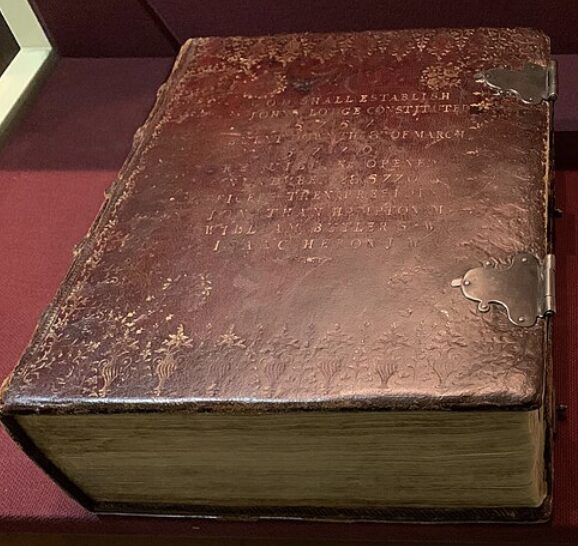
George Washington Inaugural Bible Photo: Wikipedia
THE GEORGE WASHINGTON INAUGURAL BIBLE
Saturday, June 20 · 11:00am – 3:00pm
Greenwich Library [Jewel Room] · Greenwich, Connecticut
Presented by Acacia Lodge No. 85, A.F. & A.M.
Commemorating America’s 250th Anniversary
Free and Open to the Public