The Greenwich town hall meeting room was standing room only for the speed camera hearing Thursday night.
Everyone who wished to speak was given 2 minutes.
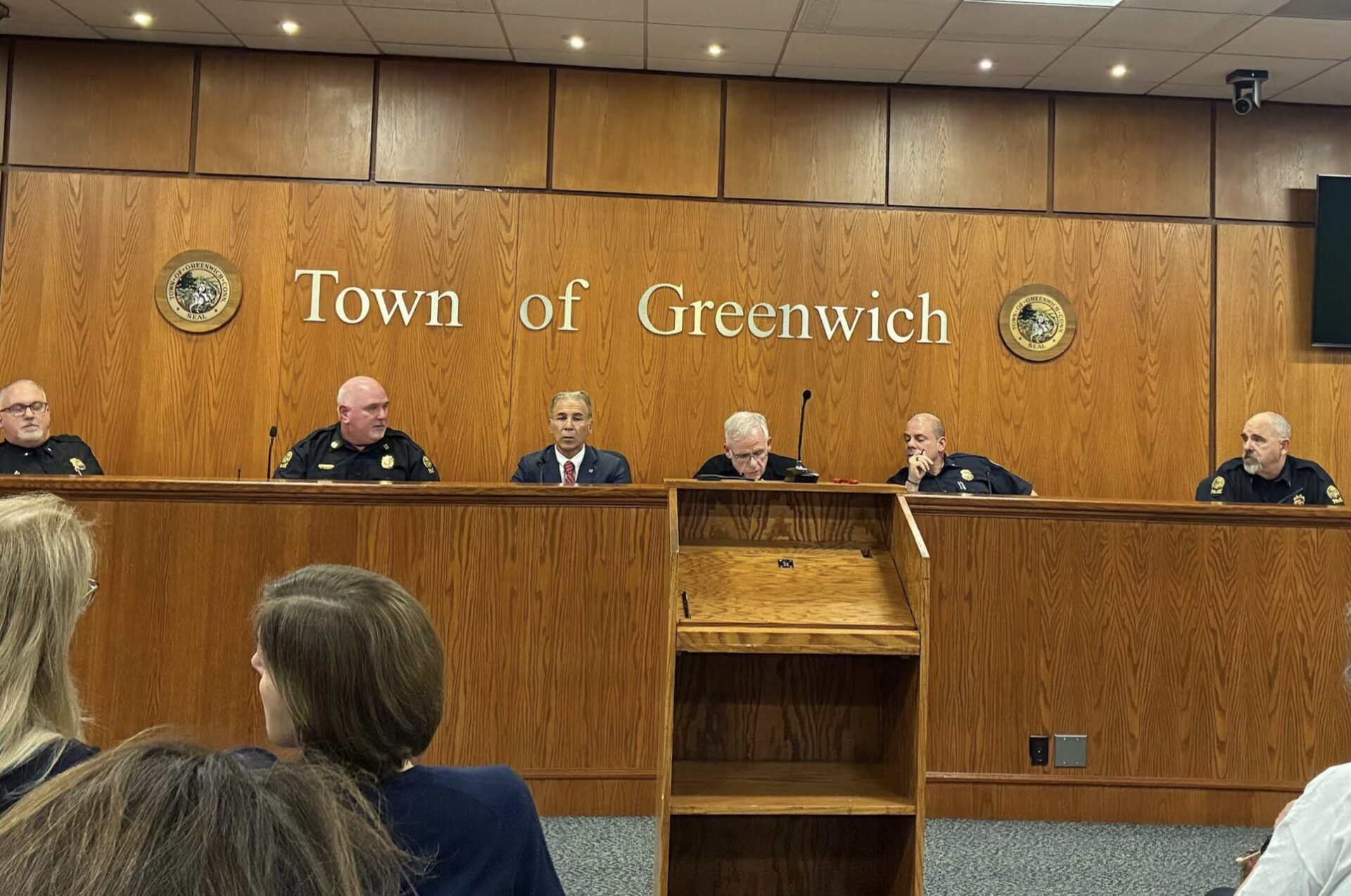
On the dais were Selectwomen Khanna and Rabin, Greenwich Police Deputy Chief Bonney, Captain Smyth, First Selectman Camillo, Chief Jim Heavey, Deputy Chief Zuccerella, Captain Slusarz, Community Impact Officer Sabrina Diaz, Sergeant JD Smith, and Mark Hutchinson, founder and CEO of Blue Line Solutions, based in Chattanooga, TN.
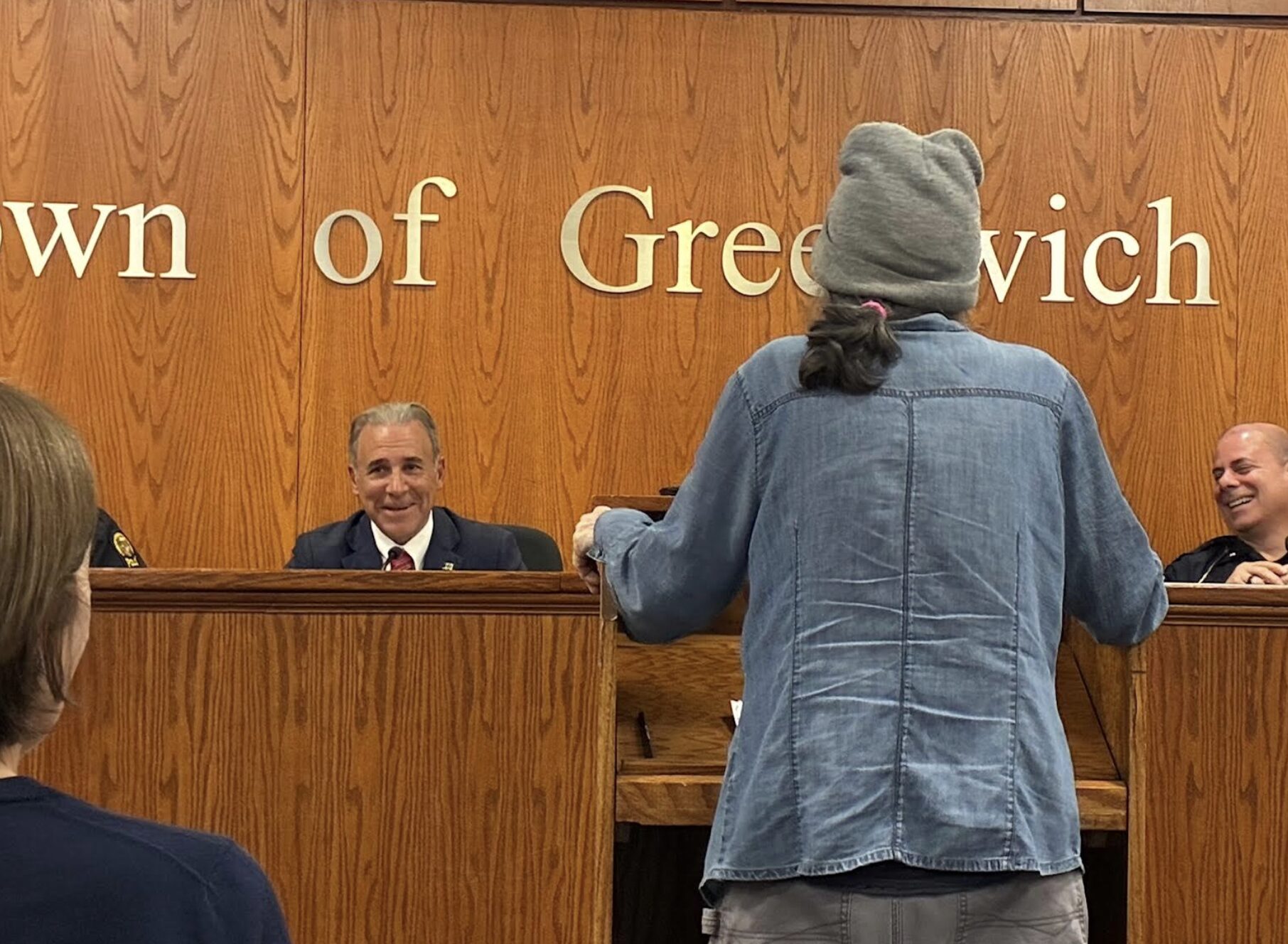
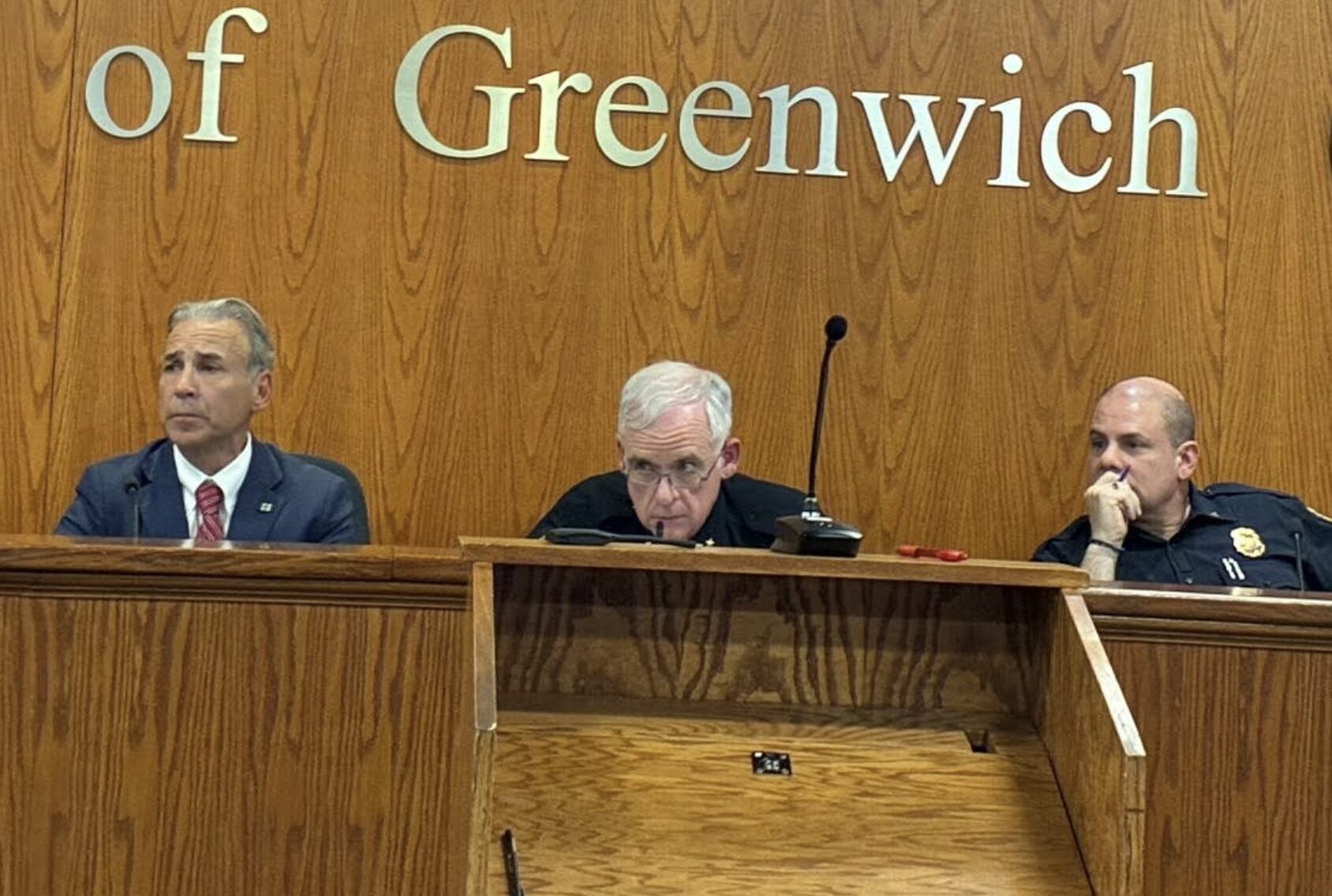
Townspeople were cautioned to be civil, but there were spontaneous rounds of applause for speakers, as well as moments of laughter
About 60 people signed up to speak.
The panel on the dais listened and took notes.
Sergeant JD Smith said speeding was the #1 complaint received by both Greenwich Police and by the Board of Selectmen, and is a primary contributing factor to many crashes.
“We came up with the solution of a data driven, zero cost, automated traffic enforcement program, focused solely on our school communities,” he said. “This also affects people that are biking, dog walking, or just out for their morning walk, DPW and utility workers, and other motorists.”
Smith said the speed camera fine is $50 for first offense and $75 for subsequent violations, plus a processing fee of $3.50 for credit or debit card payments, but there is a drop box in the lobby of the police department.
He contrasted speed camera fees with speeding tickets violations issued by officers.
“If an officer stopped you for doing 36mph in a 25 mph school zone, you’d be subject to a $207 fine which is reportable to the DMV. The fines are set by the state of CT, not the town or the police department.”
As for the 10-day window to appeal, he said police were working toward lengthening that to 30 days.
Smith also said that under the program, which was temporarily suspended on April 2, violations are issued for vehicles traveling more than 10mph over the speed limit.
Smith said while there might not be sidewalks by a school, there may be “behavioral issues” where a child leaves campus.
He noted the program is limited to school drop off and pick up hours – not weekends or evenings.
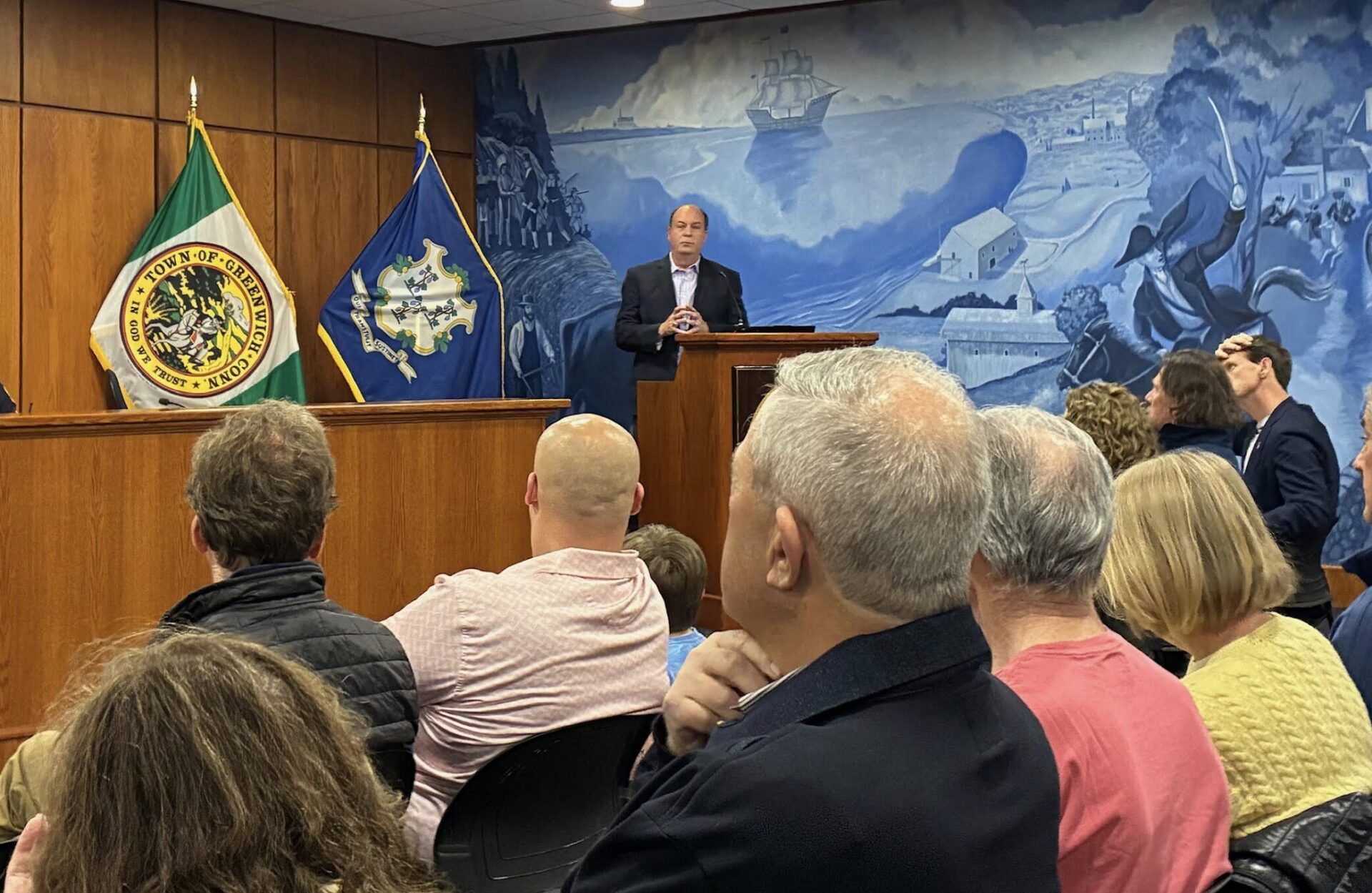
Mr. Hutchinson, CEO of Blue Line Solutions, a retired law enforcement officer, talked about how slowing down saves children’s lives.
He said during before the temporary pause of the program, speeding in Greenwich school zones had been dramatically reduced.
“A child is more 90% more likely to die at 40mph than 20mph,” he said.
Mr. Hutchinson drew laughter when he said, “The program is not designed to be a money grab.”
Some residents said they were grateful to Greenwich Police and would prefer that enforcement be done by officers, even if fines are higher and result in points on a driver’s license.
Speakers also questioned the locations of the school speed cameras, confusion over the signage, especially on Rte 1, and shared concerns about privacy, and potential sharing or hacking of their data.
Danielle Eason from D7 said, “It seems unfair for drivers to have to memorize a complicated timetable of when the speed limit is lower, depending on which school zone they are in.”
Ms Eason shared concerns about privacy.
“Can other government agencies like ICE access the information. Can insurance companies or another FOIA the data? Can another state’s police department or attorney general’s office subpoena the data in a vigilante justice effort regarding women’s health care should someone seek healthcare in Connecticut?”
Maya Tichio from D7 said, “It gives me pause to consider that a for-profit, private vendor is incentivized to choose high volume locations because they are paid per citation. As a result, the locations don’t seem to coincide with pedestrians, but rather the number of cars.”
Former State Rep for the 149th district, Janet Lockton, said the selection of schools for the speed camera program with Blue Line Solutions was based on traffic volume and vendor revenue metrics, rather than protecting students walking to school.
“There are serious legal challenges. All collected revenue from fines must be returned because they were collected under an invalid ordinance,” Lockton said to applause.
Ashley Cole, a founding member of the Hillside Road Safety & Traffic Commission, said the speed camera decision had not been transparent. She said the Hillside group had made recommendations in 2019 and none had been implemented. Further she said they had not been notified despite their having extensively studied the issue.
“There are multiple issues: privacy, data collection, the denial of due process and potential conflicts of interest,” Cole said. “The cameras themselves are ugly, with multiple signs and electrical boxes that add to an industrial feel to our historic residential zone.”
“Real traffic safety comes from advocating for transportation alternatives, building walkable schools and bike lanes as well as improving road designs, such as the crucial second egress to Greenwich High School,” Cole continued. “There is no substitute for good policing. Our Greenwich police are highly trained professionals. I trust them, not a machine,” she said to loud applause.
Elizabeth Dempsey, also of Hillside Road, said she too was concerned with data and privacy.
She said there had been a two month gap between her violation and receiving a ticket on a leased car.
John Eardmann described himself as a disappointed 43-year resident.
“The deliberate narrow focus of tonight’s meeting is something one would associate with autocratic governments like China,” he said. “You do not provide data that validates that school areas are unsafe. You have manipulated statistics to appeal to the heartstrings of parents and teachers.”
“Just because there is a state law that itself is probably at least federally unconstitutional, doesn’t mean this is a good idea. Good governance should know the difference,” Eardmann added. “Less than 20 days ago the state legislature, notwithstanding the speed camera provision you noted, decided not to approve cameras in this year’s transportation budget. They eliminated what is called Section 15 because they recognize this is a toxic issue.”
Burke Dempsey of Hillside Road reminded townspeople of the upcoming bridge project near Hillside and East Putnam Ave.
“There’s not that many people who speed because at drop off and pickup there’s not that much speeding. That could lull us into a vulnerability.”
He agreed with Ms Cole that there is a the larger safety issue related to the single egress from the high school.
Bob DeAngelo, a certified bike instructor with the League of American Cyclists who teaches bike safety in local schools, said “The real culprit out there is the cell phone and people driving distracted.”
Mr. DeAngelo said he feared a fatality in the area of Mallard and GHS where drivers run red lights and speed.
“I think we owe it to the kids to prevent that young boy or girl at GHS from getting hit by somebody driving way fast. And I think the cameras can help slow down the speed on that downhill,” DeAngelo said.
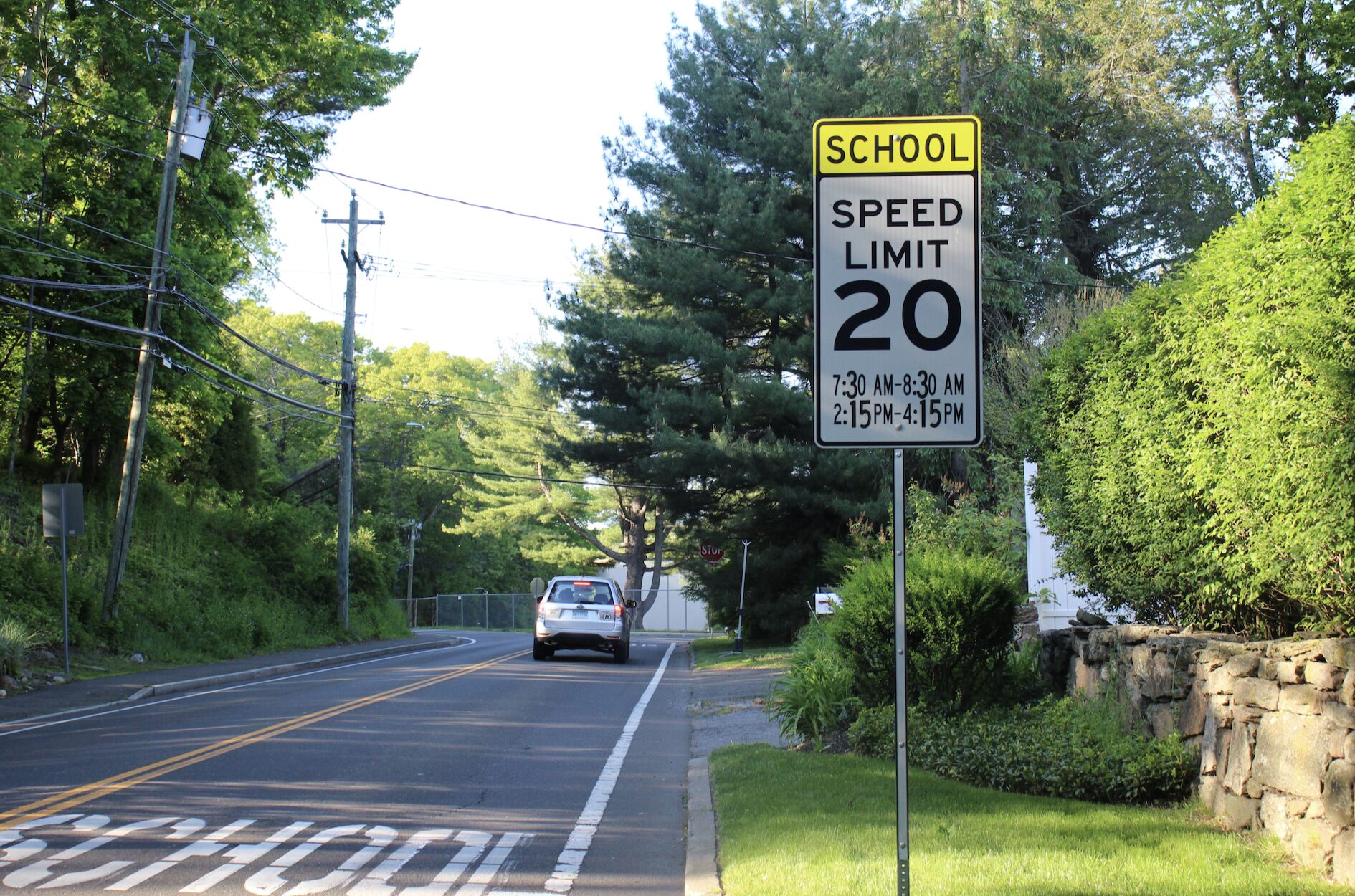
Signage on Stanwich Road heading north, just before the stop sign and intersection with Indian Rock.
Jean Barton talked about confusing signage.
“I’m afraid, since this program began, that I’m more likely to run somebody over because I’m trying to read my odometer. And my GPS shows the speed limit, but it’s quite often wrong”
Pierre Gourdon, who said he worked 20 years in cyber security advising executives and governments, received applause after he explained his concern was for security of data and hackability of speed cameras.
“As recently reported, during the Iran conflict, the Israeli intelligence had the traffic cameras of Tehran, which allowed them to develop patterns of where the regime would be at each point of the day,” Mr. Gourdon said. “My concern not so much on missiles firing on Greenwich, but the capabilities that Israel intelligence is well known to have, are also used by criminal elements.”
Susan Fahey, from district 11, said, “It surprised me and apparently 500 of my closest friends and neighbors when the cameras were first installed, not hearing about them or a public hearing or through our legislative body.”
Fahey said for every supporter of the speed cameras she heard from 100 people opposed. Also, said she heard concerns about ICE and ‘big brother overreach.’
As an example, Fahey brought up the 2023 FOIA request from Andrés F. Ruiz, for permit holders and people wait listed for permits.
Ted Walworth, president of the Northeast Greenwich Association, which includes half of D7 and all of D11, said, “If you find this is not a productive thing for the town, you can terminate the contract in 7 days.”
“Safety and speed cameras can be two separate things and are not necessarily synonymous. We wonder why speed camera sites have been chosen that are up to 400 yards away from drop off points, or in no walk zones. Is it because Blue Line Solutions seeks high traffic areas that can support a high rate of generated revenue?” he asked.
Mr. Walworth received applause when he suggested the cameras should instead be located in denser pedestrian school zones, such as Julian Curtiss, Cos Cob, North Mianus, Riverside, Hamilton Ave School, and Eastern and Western Middle Schools, where children walk to school.
Mr. Walworth suggested Blue Line was owned by a hedge fund company.
“It really looks bad to have to send the payment to Chatanooga, TN,” he said. “It creates a perception that makes one want to call this ‘Speedgate.'”
David Santos said he was the father of five children and supported Greenwich Police. But, he said, “I don’t want to do it through cameras and I don’t want to do it through what I see is a conflict of interest when we hire a company owned by a hedge fund who may sell the company to who knows? It’s in their interest to make as much money as they can. Their interest is not our interest, which is to improve safety in this town.”
Elizabeth Hopley from D11, who is president of the board of the Greenwich Tree conservancy, said the signs were “visual clutter,” hurt property values, and marred the town’s scenic beauty.
“The proliferation of signs around the speed camera program makes the roads more dangerous for drivers and pedestrians. Signs are built to be in the line of sight for drivers and are distracting by design,” Hopley said, adding that she passes 16 signs and two cameras at North Street School.
Leslie Tarkington said when she abides by the speed limit in school speed zones on North Street and North Maple, she has been passed by drivers who cross the double yellow line, creating a terrifying experiences.
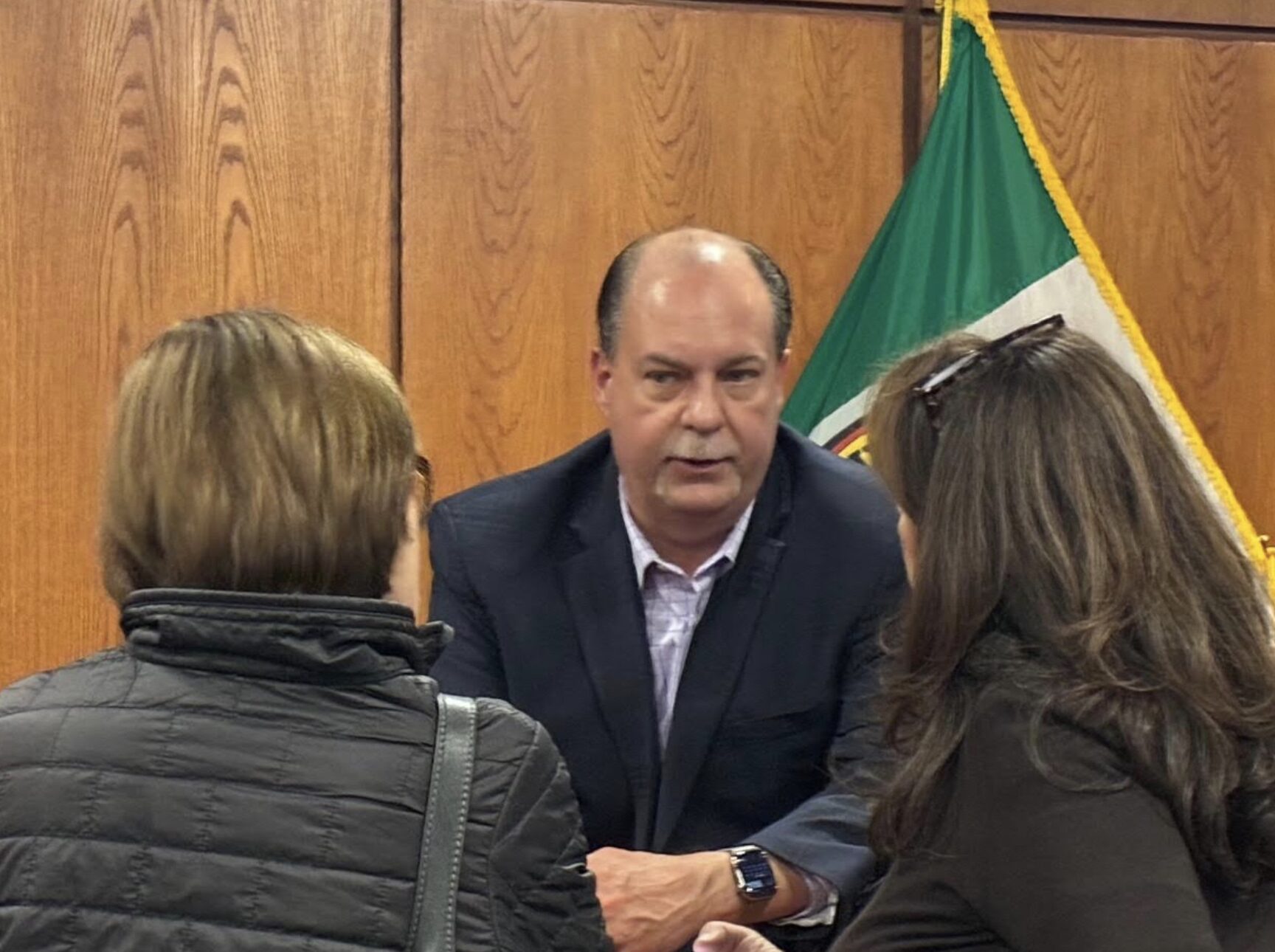
Mark Hutchinson, CEO of Blue Line Solutions, speaks with residents after the public hearing at town hall. May 14, 2026
After public comment, Mr. Hutchinson addressed concerns about hacking and privacy, as well as ownership of his company.
He said security protocols at Blue Line Solutions were as tight as they can be.
“Especially in the world of AI and hacking. If you get hacked, I get hacked. It’s as simple as that. If you lose, I lose. We want to protect your data. It is not our data. The data we handle does belong to Town of Greenwich. It will never be sold.”
And, he added, “I promise you, as sure as God is my witness, a hedge fund does not own my company.”
The next step following the public hearing is for the item to go before the RTM on June 8 for approval.
RAF Companies, a private equity company, lists Blue Line Solutions as one of its companies.
See also:
Speed Camera Update: Issue of Refunds Not Resolved Yet; Hearing Scheduled
April 24, 2026
Greenwich School Speed Camera Enforcement Suspended, Effective Immediately
April 2, 2026