A candidate debate hosted by the LWV Greenwich at First Congregational Church this week included six State Rep candidates and both State Senate candidates.
Last week’s debate hosted by Round Hill Association was limited to the 149th House district and the State Senate 36th district.
For many it was a first look at newcomer Jonathan Goldstein, a Republican challenging Democratic incumbent Steve Meskers who is running for a fourth term representing the 150th district.
Also, Republican candidate for 151st district Mike Mason, who served on the Greenwich BET for 18 years faced off against Democratic incumbent Hector Arzeno in the 151st district where he seeks a third term.
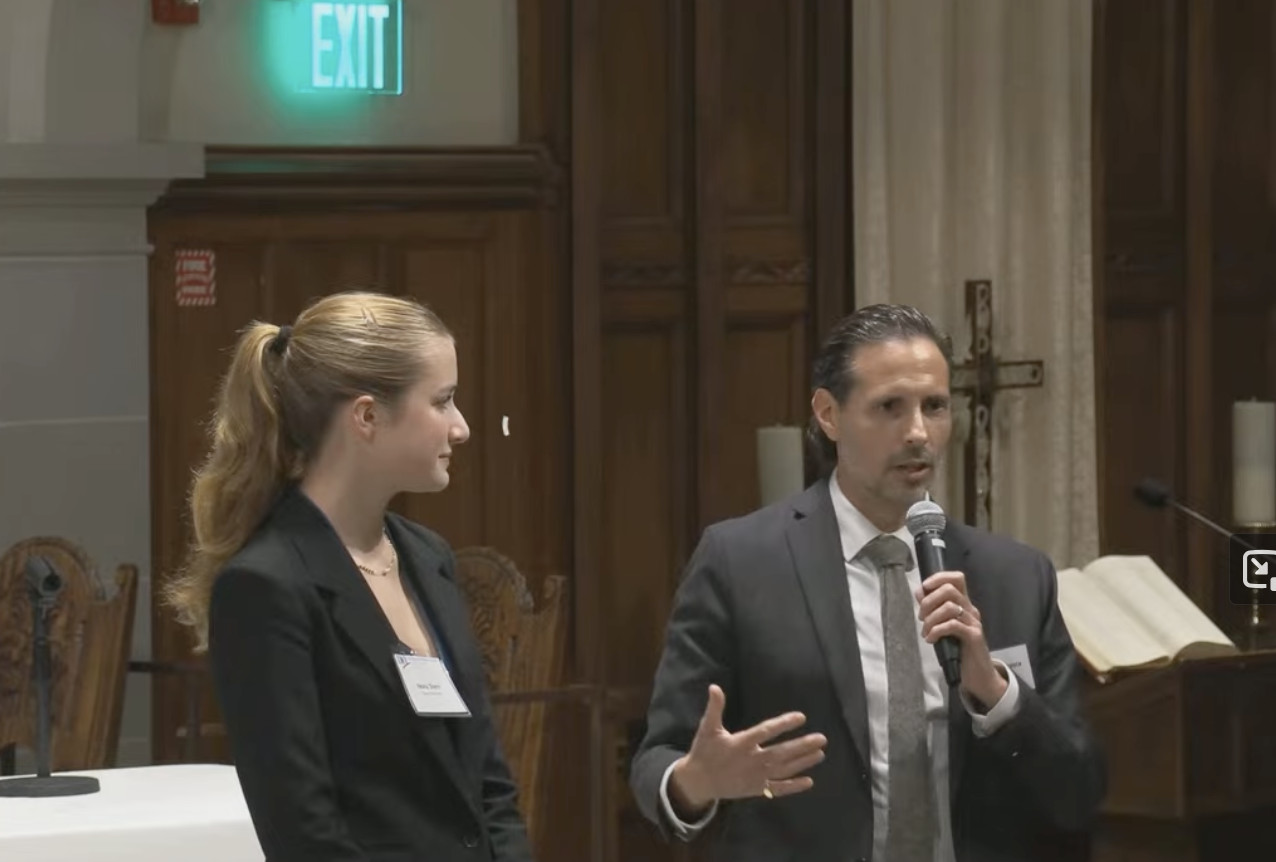
Melissa McClammy of LWV Greenwich welcomed guests and the debate was moderated by Wilton High School Teacher, Anthony Presta, with help from LWV student rep from GHS, Nora Stern.
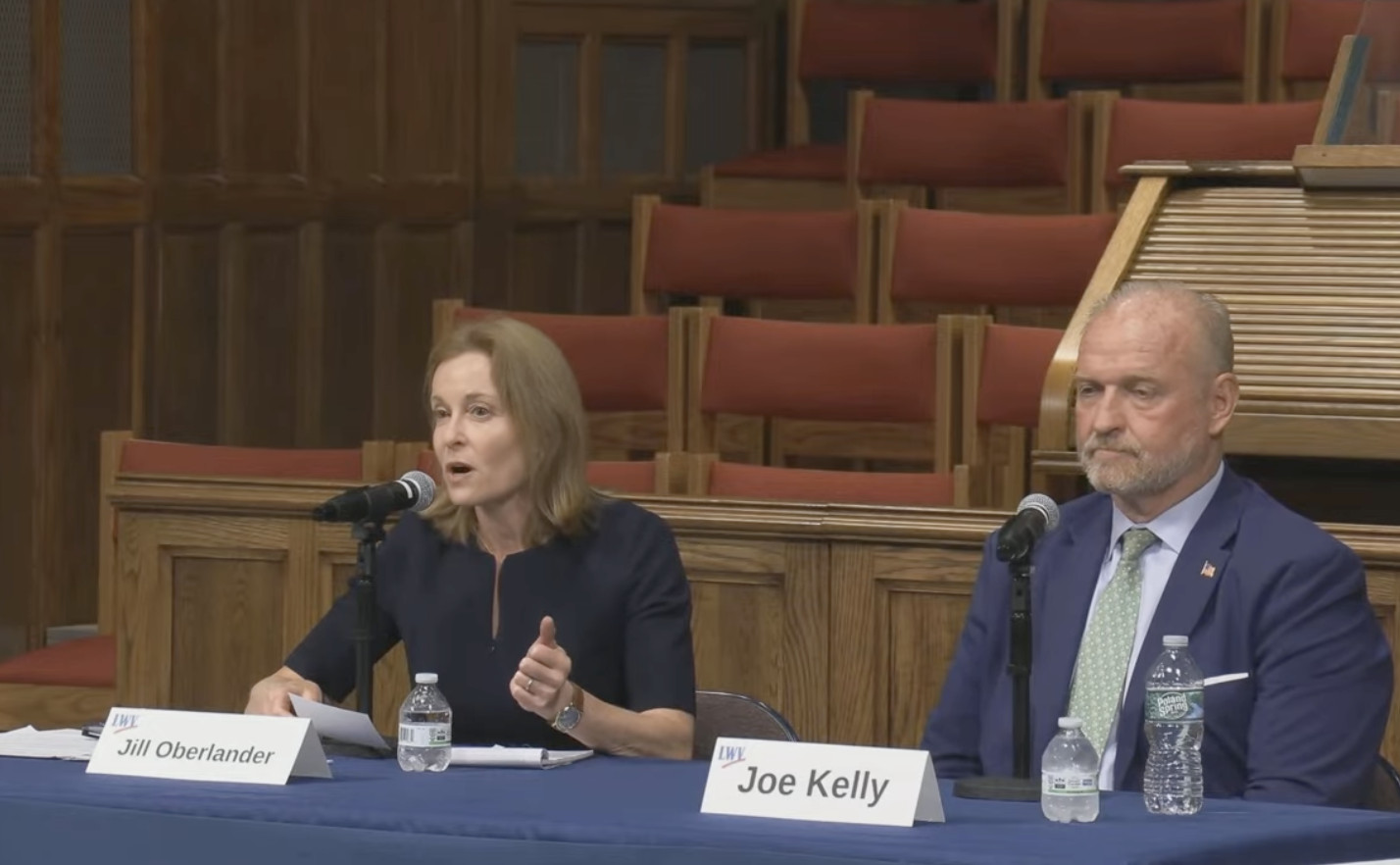
Candidates for State Senate 36th district Democrat Jill Oberlander and Republican Joe Kelly at the Oct 14, 2026 LWV Greenwich debate.
Electricity, Utilities, Cost of living
Mr. Kelly talked about removing the public benefit charge from electricity bills and urged a reduction in taxes to stimulate Connecticut’s economy to attract businesses.
“The people moving out of state are the ones you want to get,” he said. “Revenues will decrease…We pay more to Hartford than we get. That’s unfair.”
Kelly talked about meeting people on his campaign trail who planned to move out of state or have homes in Greenwich, but live more than 183 days in another state to avoid Connecticut income taxes.
Oberlander said, “What I won’t do is make promises that can’t be implemented – like cutting taxes or public benefit programs that shift programs from one pocket to another.”
She vowed to audit the public benefit charge on electric bills and strive to protect assistance programs for the elderly and vulnerable.
Oberlander said while campaigning, voters had expressed concern about affordability in a broad sense, including health care, cost of food, cost of gas, and increasing inflation.
She talked about the financial and emotional costs of caring for seniors living in facilities.
“It’s important for people to age in communities where they have built their connections and where their friends live,” she said.
Mr. Kelly said, “You have to cut the taxes. We’re on a slippery slope right now. We’re in a time of prosperity, but we’re suffering,” he said.
On the topic of taxes, Oberlander said, “People often often ask me how do I differentiate myself from Joe. It’s not that I don’t want to reduce taxes…But what programs would get cut?”
“I would work hard to bring money back to our district and I would not support new taxes,” she added.
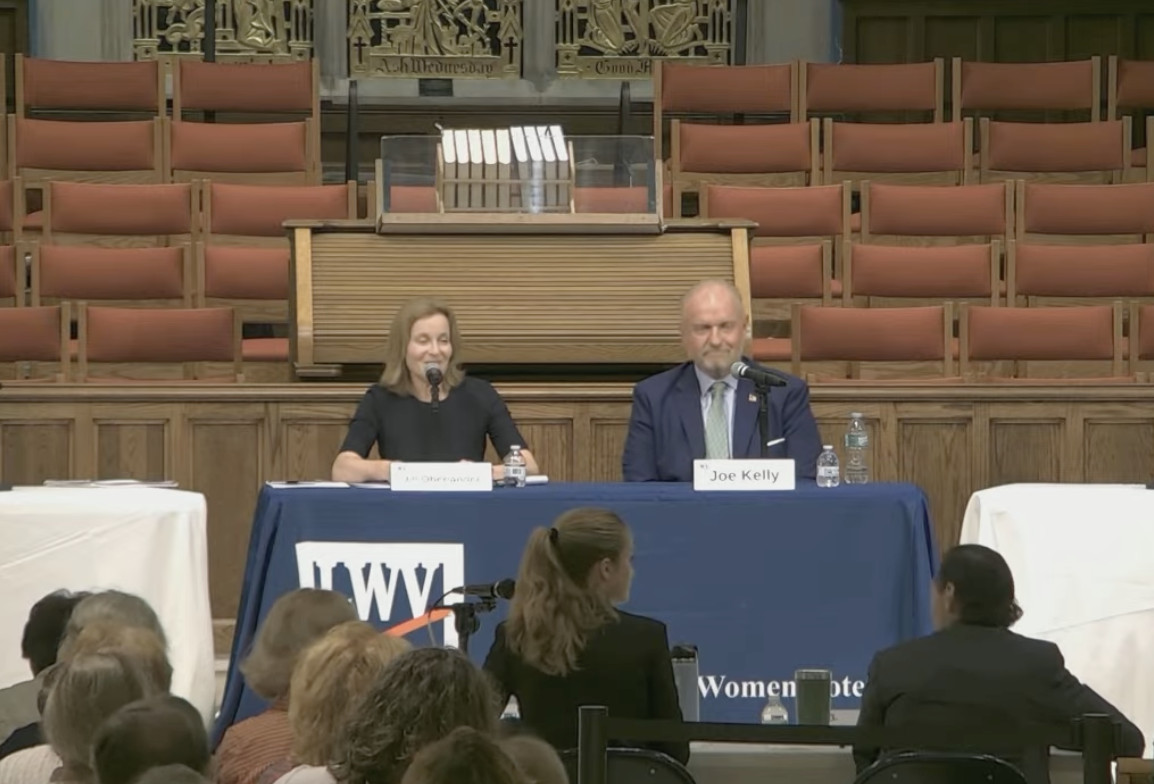
Though this week’s debate had some duplicate questions from last week’s Round Hill debate, there were unique moments in the debate between Oberlander and Kelly.
Reproductive and Abortion Rights
Kelly and Oberlander were asked about reproductive rights and abortion.
Back in 2020 when Mr. Kelly challenged Mr. Meskers for State Rep in the 150th district, he said he had not made up his mind on abortion rights.
Two years later, in June 2022, Roe was overturned.
On Wednesday, Mr. Kelly said his opinion was in favor of abortion rights.
“I’m pro-choice,” he said, adding, “I was brought up as a Catholic with 16 years of Catholic education. I have three strong daughters and a strong wife. There’s no way I can argue any other way.”
Ms Oberlander said her father was an OB/GYN and family conversations about reproductive rights and abortion took place at the dinner table.
“These days it goes beyond saying, ‘I support the right to choose,'” she continued, adding it was also important to support doctors, healthcare providers and access to services including prescriptions and counseling.
Gun Safety Legislation
Last year Public Act 26-41 (House Bill 5043) passed, prohibiting the sale and importation of pistols that could easily be converted into automatic weapons with the addition of an illegal attachment often referred to as a Glock switch.
The law was set to go into effect on October 1, 2026.
Glock and others filed a lawsuit, and on September 30, 2026, US District Judge Kari A. Dooley agreed with the plaintiffs, blocking the law from going into effect.
Oberlander said she would have voted in favor of the legislation.
“And I will vote that way for any gun violence prevention bill. Anything that will keep our children and residents safe from gun violence, I will be a strong supporter of.”
Mr. Kelly, in stark contrast to Senator Fazio and State Rep Courpas, said he also would have voted in favor of the legislation.
“If a device is going to turn a handgun into an automatic weapon, that is bad. We should not vote in favor of that,” he said. I don’t want a device that will turn a handgun into an automatic weapon.”
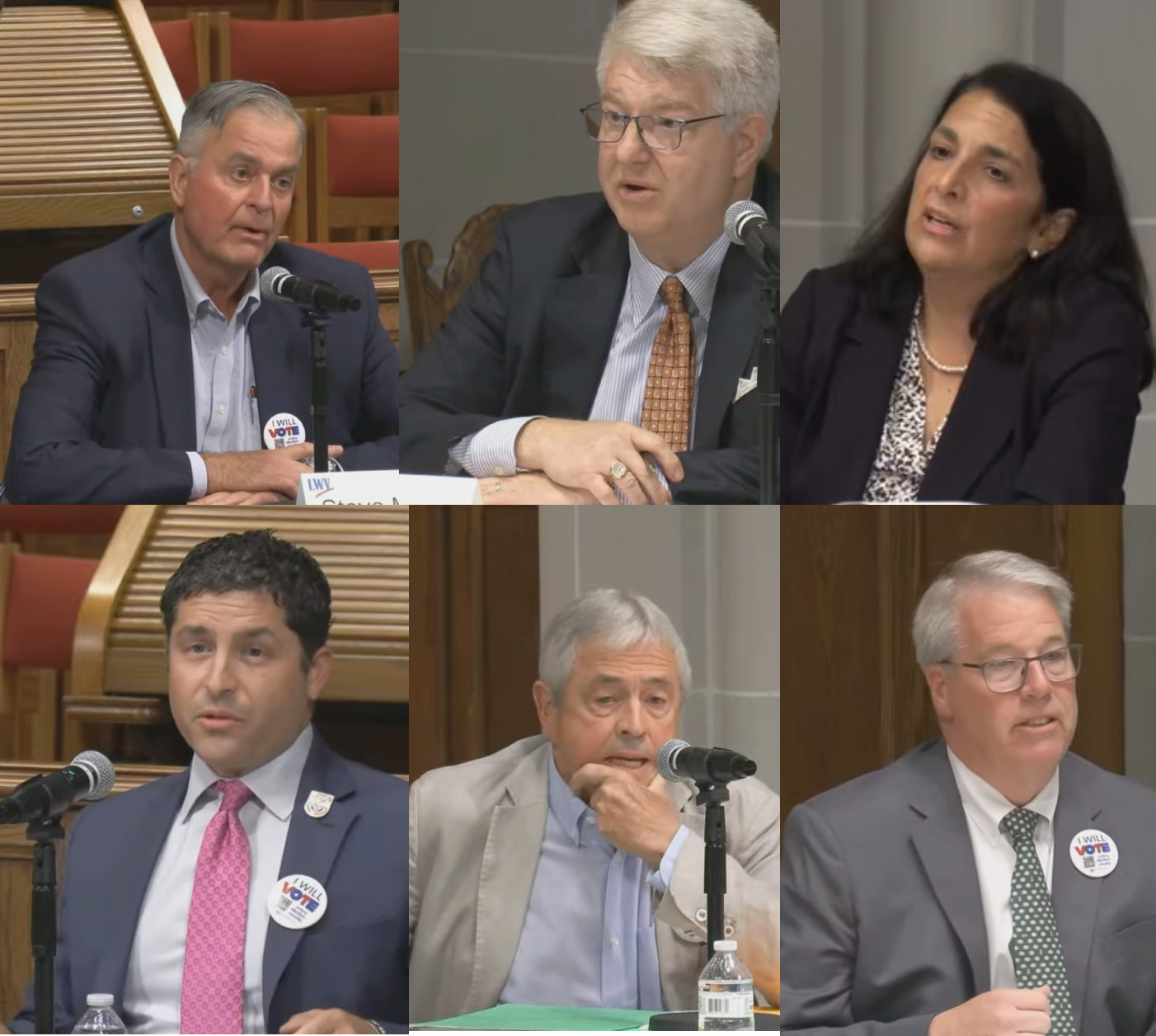
Six candidates for State Rep were included in the debate: Incumbent Steve Meskers (D-150) and Republican challenger Jonathan Goldstein, incumbent Hector Arzeno (D-151) and Republican Challenger, Mike Mason who had not debated the previous week at Round Hill. Also debating were Republican incumbent Tina Courpas in the 149th district and Democratic challenger Amiel Goldberg.
In his opening remarks, State Rep Meskers (D-150), running for a fourth term, said it was not lost on anyone that having the debates inside a church “combined the sacred and profane.”
Jonathan Goldstein, who grew up in Greenwich, said he is an attorney who works in construction and project management. He said his campaign focuses on affordability, beaches and local control.
Goldstein said during door-knocking voters had expressed concerns about cost of living, beaches closed for sewage in Long Island Sound, traffic, and “buildings forced on us by Hartford.”
“Hartford keeps telling us what to do without giving us the resources to address the consequences,” he said.
State Rep Hector Arzeno (D-151) said uncertainty and unpredictable, erratic actions at the federal level concerned him.
“I believe Greenwich deserves thoughtful and consistent decision making at home, locally,” he said.
“Making sure our children are learning from an early age – which pays dividends – that we are paying down debt with bipartisan budgets, providing accessible healthcare and ensuring your access to vote.”
Mike Mason said he was a lifelong Greenwich resident and businessman who served on Greenwich’s Board of Estimate and Taxation.
“This election will come down to one question. Do we want more of the same from Hartford, or do we want a representative who will stand up for Greenwich?”
He talked about a Democratic “supermajority” and Connecticut’s high taxes, rising costs, state mandates, and policies that remove local control.
“I will fight for reasonable spending, lower cost, respect for our guardrails, public safety, parental rights, and local control.”
State Funding for Capital Projects: Infrastructure Needs, Including Schools
As a member of the Stamford Board of Reps Fiscal Committee, Goldberg said he had worked to help get generous support from Hartford to build Westhill High School and Roxbury K-8.
“Part of it is demonstrating a municipality’s willingness and availability to do its part. The City of Stamford has saved nearly $60 million toward our building program. That was a huge incentive to get the state to say: you’re in; we’re in.”
Tina Courpas said Greenwich was a net payor of taxes to the state.
“If you look at the state income tax rolls, the Town of Greenwich counts for 11% of the total income tax. Twenty thousand filers from the Town of Greenwich are responsible for 10-11% of the entire income,” she said.
“If you look at capital gains revenue, the source the supermajority used to go on a spending binge truly of $2.8 billion in the last two years, the Town of Greenwich alone counts for 24% of those revenues.”
Meskers said he had worked tirelessly with his colleagues for the past eight years for higher state reimbursements for capital projects.
“The principal problem we’ve had is getting projects approved through the local budget,” Meskers said. “The battles to get projects approved were onerous.”
“Once the projects were approved, in many cases we had to get an exception to apply for reimbursement outside the normal course of business,” Meskers said, thanking Rep Arzeno for his hard work toward that end.
Meskers described the infrastructure needs of Greenwich as mighty, but the capital plans as lacking.
“We’re sitting now with a sewer plant that is about 83 years old,” he said. “It’s hard to get a reimbursement when a project doesn’t come before me.”
Goldstein said the House delegation had brought home “the bare minimum.”
“We could do a lot more. We need more people up in Hartford fighting for those dollars,” he said, going on to mention that upcoming GHS projects that will need funding.
Arzeno said when he was elected in 2022, “The winds were against us” for the Central Middle School project.
“I remember when we met with the building committee, after we got the reimbursement, the answer was, ‘You got the trifecta,'” he recalled.
“We not only doubled the expected reimbursement, but the project was out of time for that fiscal year, and, third, they hadn’t adjusted the square footage as per the formula that Administrative Services applied.”
“We got $22 million when in public they said they expected zero,” he added. “Furthermore, when Old Greenwich (School) came, we secured a 35% reimbursement – 20% for renovation and 15% extra for early childhood classes.”
“On top of that, for capital investments, in the last four years we secured over $9 million for our non profits,” he added.
“If I am re-elected, Riverside School is the next project. We have a meeting with the building committee and are ready to fully support them,” Arzeno said.
Mr. Mason said it was the understatement of the evening that Greenwich sends more to Hartford than it receives.
“The state’s Education Cost Sharing at one time – in 2016 the town got $3.8 million. This year we get $1 million.”
Second, he said, “Our residents work very hard and pay a lot of taxes. Why has not a single legislator proposed to change the 2013 school reimbursement construction rates?”
“It’s legislative and can be done.”
High Cost of Utilities
Mr. Goldstein said Eversource’s Facebook ads were paid for by the public benefits charge, and that fee needs to be eliminated.
“We have a weak energy program in the state. We’re starving for natural gas and being deprived of it by New York.”
“Nuclear is the greatest green energy source we do have and we need to support and increase that infrastructure. Bringing in more energy makes more affordability happen.”
Meskers said the cost of living, affordability and electricity prices across the country all make headlines across the entire country.
“In the majority of the country, we stopped planning about 50 years ago,” Meskers said. “Infrastructure is woefully under-invested in the state and in the country.”
“I believe the public benefit charge needs to be looked at to see what can go to the general account,” he said, adding that the public benefit charge on his current electric bill was a negative dollar amount.
Meskers said the issue of infrastructure will be painful and expensive. “We’re going to need federal help…It’s going to be a national issue.”
Mr. Mason said he objected to the public benefit charges.
“I’ve not seen anything in the legislature to prohibit these common charges from being added to our utility bills,” Mason said. “I will attempt that when I get to Hartford.”
“To show you how important this is – in an attempt to reduce the electric common charges there was an additional $300 million borrowed – approved by the governor and the legislature,” Mason said. “Of that $300 million, there was $13 million sent to Bridgeport for their operating budget annually.”
He said during his time on the BET he supported photovoltaic roofs and geothermal wells.
Arzeno said customers were seeing credits on their electric bills for the public benefit.
“The world can no longer afford to cherry pick energy,” he said about energy, adding that an an “all of the above” energy strategy was ideal.
Arzeno said the US has been a net exporter of energy, charging a premium for shale oil and natural gas.
“The future is not rosy,” he said. “Eagle Ford and the Bakken have reached maximum output and are declining in production.”
As for residential use of energy, he said Connecticut is moving in the right direction.
“There is a sector where renewable and nuclear can play an important role. In solar energy, Connecticut is securing 63.2 megawatts from New Hampshire and Maine, 54 megawatts of other solar projects under study since 2022, 71 megawatts of solar capacity have come online. And last month CT and two other states signed for 102 megawatts extra.”
Arzeno said one megawatt provides electricity to 700 homes.
“Revolution Wind’s 65 turbines – if the federal government lets us finish the project because they have been doing everything possible to stop it – will deliver 704 megawatts and provide electricity for 350,000 homes in Connecticut and Rhode Island.”
Courpas said the public benefits charge was the result of the power of transparency.
“Nuclear is extremely cheap. It’s very safe and they even have portable nuclear reactors that can be moved around. It’s an excellent source of energy for us for the future,” she said.
Courpas talked about her support for a gas tax holiday.
“We are all paying 25¢ a gallon to the state every time we fill up our tanks. If you get diesel fuel, it’s 49.9¢ a gallon.”
Amiel Goldberg said the public benefits charge was regressive and would be fairer ALICE families to be moved into the general account.
He favored an “all of the above” energy approach and since he does not have the option of natural gas at his home, he instead heats his home with expensive purchases fuel oil.
Above all, Goldberg said it was very important to modernize the grid.
High Cost of Living
Arzeno said the legislature considers all possible solutions to tackle needs that reflect high inflation, high interest rates, cost of energy, and high cost of housing.
He said, year to year, Neighbor to Neighbor saw an increase of 13% of families seeking help with food and the increase had gone up 14% last month.
“That is not encouraging,” he said. “The budget we’ll be facing over the next two hears will have a lot of challenges due to the cuts from the federal government and the needs that will come up for our neighbors.”
Mike Mason said he was concerned about impacts of the economy on the next generation.
“Looking at our economic situation in Connecticut from a business point of view, from a tax point of view, it seems like the supermajority is trying to spend its way into prosperity,” he said.
“I’m afraid that the future generation is going to be looking at a statewide property tax. I believe you’re going to see a volatility tax rate increase. I believe you’re going to see a general income tax increase.”
Goldberg said affordability goes beyond housing. “It’s about bending down the health care cost curve. The childcare cost curve. That really impacts young families.”
He said he liked the concept of Accessory Dwelling Units and how they allow people to age in place.
“ADUs move the affordability issue and build a strong community through multi-generational family units,” he said.
Courpas agreed a statewide property tax was a real possibility, and someone with a $3 million house might see an additional $3,000 tax.
“It’s like a second mortgage on people,” she said, adding that for young people owning a home is more and more prohibitive.
Mr. Meskers said the cost of living and cost of construction were increasing across the country.
“We’re fighting with Canada – tariffs on steel and on all the construction goods. If you think of major movers in terms of machinery, a lot of them are on diesel which is up to $6 or $7 a gallon. The cost of construction is going to be a big one.”
He said $700 million had been invested in an early childhood educational trust fund.
“The revenue from that will provide for free and reduced early childhood education,” he said. “That will impact both the ability to stay in the state and provide for a better workforce.”
Today, he said childcare can cost parents $24,000 to $30,000 a year.
“Everyone is campaigning on affordability and I’m waiting for someone to give me that magic bullet, but there is no magic bullet,” he said. “It’s insurance, healthcare, and advanced education has gone through the roof.”
Mr. Goldstein said college students leave the state when they graduate.
“Affordability means opportunity, not a subsidy,” he said. “When it comes to housing we have to build intelligently.”
He said HB 8002 talks about creating regional housing.
“I think the endgame with the supermajority not just regional housing. It is regional education sharing. It’s statewide property taxes,” Goldstein said. “It all goes back to local control. It’s having Greenwich maintain its destiny which it lost through a supermajority.”
Arzeno said while the upcoming state budget will be a challenge, the state had delivered 8 years of economic surplus and paid down $8 billion of debt.
“Our rating agencies have upgraded Connecticut five times, making Connecticut investment-grade,” Arzeno said.
He mentioned the state’s $4.5 billion rainy day fund, and said, “I think despite all the challenges we will be facing, Connecticut is in a very good economic situation.”
Meskers said when he was first elected eight years earlier, unfunded pension liabilities were funded at 36%.
“Now we’re at 70% funded on those pension liabilities. We have made tremendous progress. You can hear a lot of bad stories, but four credit upgrades and this type of financial performance, and I’m having trouble understanding why I’m on the Titanic when I think we’re doing fine.”
Courpas said, “I see a completely different financial picture.”
“We have the number one highest debt per capita among the 50 states. We’re the third most taxed state in the US. We have the third highest electric bills. We rank 47th for business friendliness. Our pension funded ratio ranks us 46 out of 50 states,” she said.
See also:
Round Hill Association Hosts Debate for State Senate 36th District
Upcoming debate: Lower Fairfield County Leagues of Women Voters are hosting a candidate debate for U.S. Representative for Connecticut’s 4th Congressional District (CT-4).
The event, scheduled for Monday, October 19, 2026, from 7:00-8:30pm at the Westport Library, will give voters an opportunity to learn more about the three candidates – Jim Himes (D), Michael Ted Goldstein (R), and Benjamin Wesley (I) – and their positions on issues relevant to the district.
Leagues of Women Voters Partner to Host Candidate Debate for CT’s 4th US Congressional District