Wednesday night’s League of Women Voters Greenwich legislative recap featured the entire Greenwich delegation, who reflected on the recently concluded legislative session and a view to next year.
Panelists each shared their accomplishments and disappointments, and answered questions posed by LWV president Melissa McClammy.
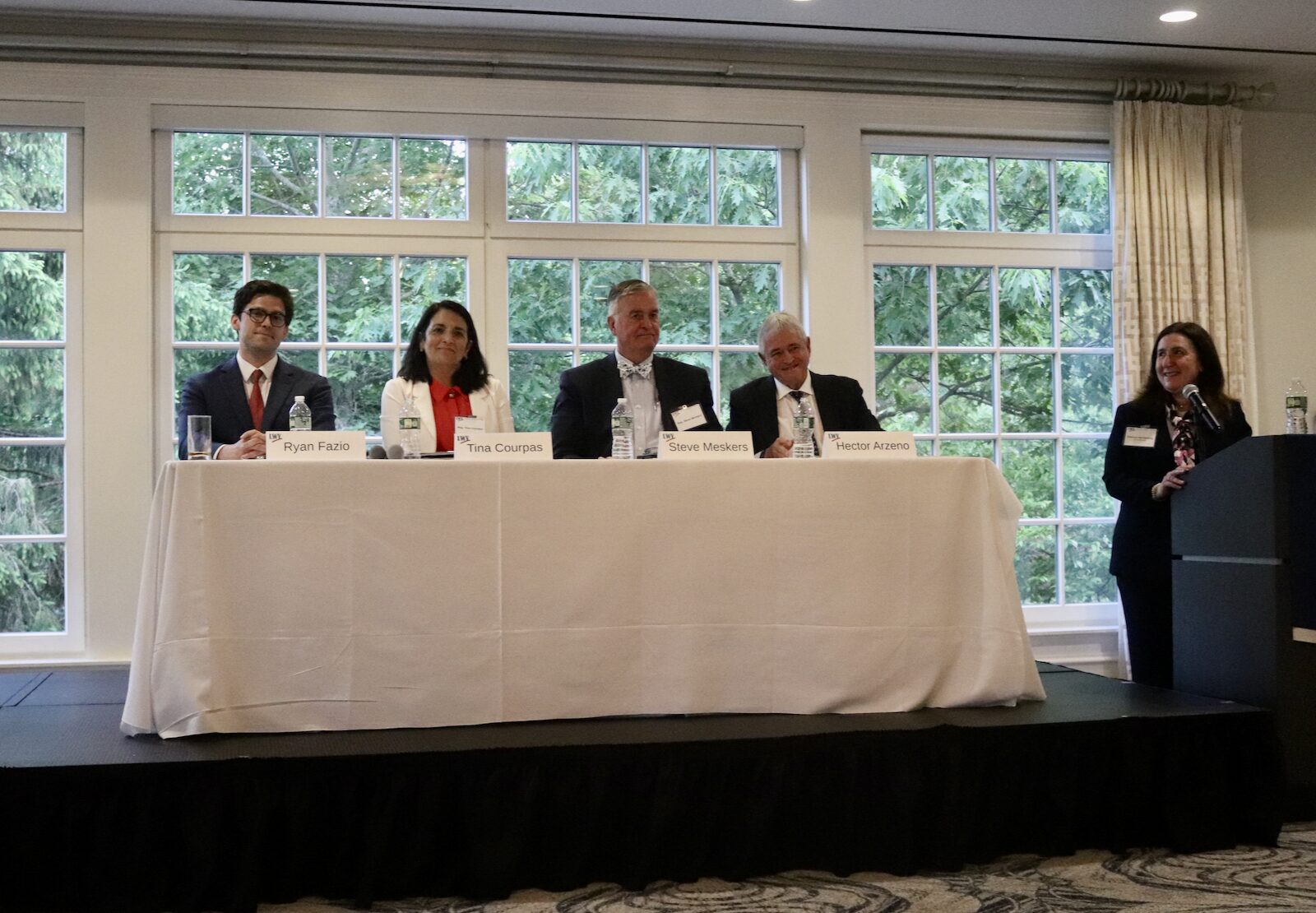
LWV president Melissa McClammy posed questions to the panel. The event was organized by Cathy Steel, the LWV’s VP of Voter Services. From L to R: State Senator Ryan Fazio (R-36), State Representatives Tina Courpas (R-149), Stephen Meskers (D-150), and Hector Arzeno (D-151) at the LWV Greenwich legislative de-brief at Burning Tree Country Club. May 27, 2026 Photo: Leslie Yager
Fazio, who was first elected in a special election in 2021, is ranking member of the Energy and Finance Committee. Today he is the Republican nominee to challenge incumbent Democratic Governor Ned Lamont next November.
Fazio said he was most proud of participating in legislation that became law including co-authoring SB 4 to reform energy policy in Connecticut.
“That reduced public benefit charges on a permanent basis by about $1,000,000 per year into the future, but unfortunately that is only a 10% cut to the overall public benefit charge into the future. I’d like to see more done to provide relief, not just to families, but to our job creators and industrial sector generally.”
He said this year he was also proud to co-introduce an amendment to the budget that would allow municipalities to take some of their state funding and use it to offset their local property tax burden.
He noted that while Greenwich enjoys a very low mill rate of around 10 or 11, taxpayers are burdened with what amounts to a second mortgage in towns like West Hartford (46.77 in fiscal year 2026-2027) and Hamden (51.88).
Fazio and Rep Courpas described the past session as “a mixed bag,” with less bi-partisanship than the previous session.
Courpas, first elected in 2024, said her 149th district comprises Pemberwick, Glenville, back country, North Stamford and Westover. She serves on the Appropriations, Housing and Education Committees.
“As someone who cares deeply about fiscal prudence, it was a disappointing session because I felt as though we turned our backs on a proven policy and fiscal guardrails, and essentially threw that out the window,” she said.
She said an omnibus bill was passed in 2025 that reformed special education.
“I was pleased to see that rather than pass something and move on to the next shiny topic, the work continued this year – reforming that bill…and edited and tweaked and revised it so the bill passed in 2025 can get better in 2026.”
State Rep Meskers’ 150th district covers the Greenwich shoreline from Stamford to Port Chester, NY.
He has served in the House for 8 years, and today is the chair of the Commerce Committee and is a member of the Human Services Committee and the Insurance and Real Estate Committee.
Meskers said the most important piece of legislation passed in the session was continued funding of the Early Childhood Trust Fund, a permanent savings account established by the state to provide sustainable funding for child care and early education
“The additional $300,000,000 we put into that bring us up to $600,000,000,” he said, describing early childhood education and early childcare as important in the context of the state having 70,000 unfilled jobs.
“This is one of the most important investments for the future of our state and our children, he said.
Arzeno, a Democrat who represents the 151st district that includes central Greenwich from near the Merritt Parkway to the Post Road. He serves on the General Assembly’s Environment Committee, Transportation Committee and Education Committee. He is currently running for a third term, having been elected to office in 2022.
Arzeno said the budget included not just the $300,000,000 for early childhood education, but also $162,000,000 for the state’s education cost sharing formula that will be reviewed in the next year.
Disappointments or Missed Opportunities
Meskers was disappointed a bill for Association Healthcare Plans that the Insurance and Real Estate Committee had pushed for, never saw the light of day.
He explained that bill would essentially have allowed small businesses, sole proprietors and non profits to pool their risk, lower premiums and result in more affordable healthcare.
He said he hoped the bill would make it over the finish line in the next session.
Arzeno said there are times that a bill requires several sessions before passing, and some bills that pass in one session come back to be cleaned up and amended.
Fazio said Connecticut’s bipartisan fiscal guardrails passed in 2017, reflecting a budgetary compromise that included a spending cap, volatility cap and debt cap requiring the state government use any excess funds to pay down the billions of state debt and cap state spending.
Like Courpas, he said he was disappointed the guardrails had “essentially been eviscerated over the past couple of years.”
“Today we’re back the bad old days – the tax and spend policies of the past,” he added.
Courpas agreed.
“The cracks have already started to show,” she said.
Explaining why she did not vote in favor of the state budget she said, “big aircraft carrier” bills often have rats tacked on, and otherwise might have unanimous approval.
She said House Bill 5044, An Act Establishing Connecticut Vaccine Standards, signed into law by Governor Lamont this spring was an example.
The law strengthens the exemption ban and clarifies that the state’s Religious Freedom Restoration Act does not apply to immunization requirements for public schools, private schools, higher education institutions or child care centers.
Courpas said the CDC decreased required vaccine suggestions from 17 to 11, and is only suggesting a vaccine protocol, and the state took steps to establish its own vaccine protocol.
“I thought that was a good policy, she said. “I believe in vaccines and I would have supported it.”
However, she explained her no vote, saying, “When Connecticut eliminated the religious exemption for vaccines in 2021, several families sued the state based on the state law that protects religious freedoms. The bill I was talking about repealed the very section of that law that a pending lawsuit is based on. So, the legislature was putting its thumbs on the scale and ensuring that the family lost the case, and the government won the case. That, to me, was a big rat in the bill.”
In a follow up to GFP, Arzeno said, “The bill does not mandate vaccines for seniors or companies, or create any obligation for people. We have to be ready to follow science.”
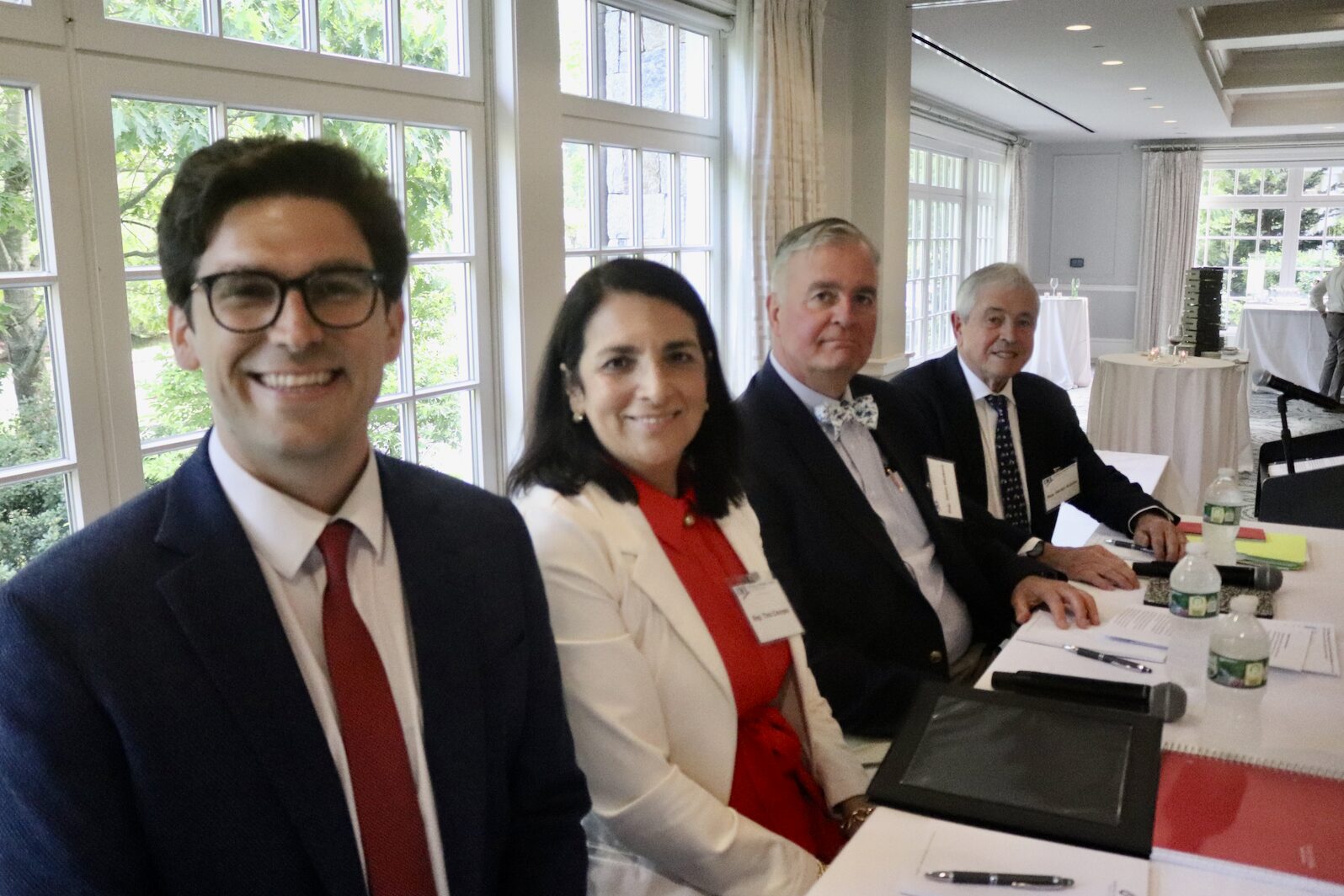
Left to right: State Senator Ryan Fazio (R-36), State Representatives Tina Courpas (R-149), Stephen Meskers (D-150), and Hector Arzeno (D-151) at the LWV Greenwich legislative de-brief at Burning Tree Country Club. May 27, 2026 Photo: Leslie Yager
Arzeno emphasized that the budget passed on a bi-partisan basis.
The State Senate passed the package 30-6, with 5 of the chamber’s 11 Republicans joining the Democratic majority in support. State House of Representatives voted to pass the bill 127-31, with 27 of the 49 House Republicans voting alongside the Democratic majority.
Arzeno said the state’s significant pension paydowns and AAA credit rating were signs the economy is in good financial health. He added that Connecticut had the biggest economic growth of the 50 states in 2025
Specifically, in this cycle, he said $1.1 billion went toward paying down Connecticut’s unfunded state employee pension debt, moving the pension liability that was 36% funded eight years ago to 55% funded today.
Also, he said, the budget included the addition of $250 million to the state’s “rainy day fund” (Budget Reserve Fund) that now holds over $4 billion, a record among New England states.
As for the $300 million for the Early Childhood Education Endowment, Arzeno noted it was protected as a permanent, interest-bearing fund, with annual draw-downs capped at a certain percentage.
“We all know that if there is an economic crisis, the funds are there,” Arzeno said.
Regarding the volativity cap, he said, per statute the General Assembly and the Governor can move the threshold up or down as needed.
“It’s not a fixed number that is broken,” Arzeno said. “That’s not the case.”
Fazio said if the volatility cap was changed, it could be used to reduce taxes on overburdened Connecticut families.
“Instead we raise the volatility cap to increase spending in the third highest taxed state in the country,” Fazio said.
Courpas said she had wanted more state investment in education, to decrease the percentage paid for by towns.
“The state is not doing its job in helping municipalities in education,” Courpas said.
She said revenues from a volatile stock market was the “engine of overspending.”
“What happens if stock market revenues go down for the programs we’re funding with those volatile revenues?” she asked.
Meskers said from the time he’d been in office, the rainy day fund moved from 15% of operating revenue to 18%.
“If the volatility cap is not properly set, and the revenue declines, there is a rainy day fund while we look for an adjustment, maybe a downward adjustment on the volatility cap,” he said.
“One thing we did this session was to put more money to our towns for education and early child education,” Meskers said, noting that 95% of education costs are labor, and the other component is spiraling healthcare costs.
“A living wage is important to the quality of life of the state and the economy of the state. We’re making the transfers that should ease some pressure on municipalities and indirectly reduce the tax burden for our citizens.”
State Reimbursement for School Construction
Arzeno said, initially the Central Middle School building committee wasn’t working properly, creating challenges for the Democratic house delegation seeking reimbursement from Hartford for construction.
“But we did it, and I’m proud of that,” he said.
He said today both the Central Middle School and Old Greenwich School building committees were working extremely well.
He explained that based on a bill passed last year, initially OGS did not qualify for reimbursement, but that was fixed in the construction bill that passed as part of the budget, and the OGS project is now eligible for an additional $8 million because early childhood classes are included in the project.
Fazio said he was grateful to the Democratic House delegation for the funds they brought back to Greenwich for the school project.
“We send a lot of money to Hartford in our tax dollars. To get some of them back is a good thing for our district,” he said.
Gun Laws
The final question was about HB 5043, a firearms bill signed into law on May 26, 2026 that targets firearms capable of being modified into semi automatic weapons.
The bill goes into effect on October 1, 2026.
Meskers, who voted for the bill, asked, “Will it solve the problems with illegal guns sold in straw sales or come through countries where we watch people die needlessly? I don’t think so, but, at the margin I thought it was helpful.”
Fazio, who voted against the bill, said there were proven policies like background checks that are effective in taking guns out of the hands of people who are a danger to society.
“It is already illegal in the state to have a switch, which is the device in question, to manipulate the handgun in question.”
Fazio said he also supported consent searches and ending criminal justice policies like automatic parole.
Courpas, who also voted no on the gun bill, said, “Our legal system does not operate on a what if. It doesn’t outlaw a glass bottle because you could break it and hit someone over the head.”
“It is already illegal to alter a gun,” she added. “It is illegal to scratch a serial number off a gun. It is illegal to change any identifying marks on a gun.”
Arzeno, who voted in favor of the bill, said the manufacturer of the Glock postol, the most popular in the country, already sells the same pistol in Germany and other states altered to it cannot be convert to a semi-automatic pistol.
“They already do it,” he said. “The intention of the bill is for the manufacturer to comply with what they already do in other states and other countries.”