Over the past year, hopes were raised and dashed for animal welfare advocates hoping Connecticut would follow the lead of numerous states including New York and ban the sale of cats and dogs in retail pet shops, allowing them to instead partner with animal shelters for adoptions.
The legislation was driven by concerns about what animal welfare advocates say are abusive conditions in large scale commercial breeding facilities, “puppy mills,” that supply pet shops.
In 2025 GFP covered lengthy Connecticut General Assembly committee hearings on HB 5112 “An Act Prohibiting Pet Stores from Purchasing or Procuring Dogs, Cats and Rabbits” and HB 6832 “To authorize municipalities to adopt ordinances to prohibit the sale of dogs, cats and rabbits in pet shops” – two of three bills that had aimed to ban the retail sale of dogs, cats and rabbits from large scale commercial breeders or empower local governments to pass their own bans.
A lengthy CGA Planning & Development hearing in Hartford on Feb 3 included testimony on HB 6832.
Typical of pet store owners selling puppies and kittens was Gary Nudelman, owner of CT Breeder in Norwalk, who said his investment into the business was over $1,000,000 and the store employed over 15 people. He said it was not possible to change his business model and work with rescues because customers seek small dogs that do not shed.
“There’s no guarantee they can find that from a rescue,” he told the committee at the hearing. “And you can’t protect them from an unregulated internet source, and you lose the sales tax. They’re flying in puppies from out of the country and buying them from auctions. These are not Connecticut dogs that they have.”
Nudelman talked about the importance of consumer choice. “There is a place for rescues and shelters and we support them, but your constituents deserve the choice.”
The General Law Committee held a lengthy hearing in Hartford on Feb 10 that included testimony on HB 5112. The legislation included language to allow pet shops to work with shelters and rescues on adoption events, which rescue volunteers said was a model already followed by PetSmart in Stamford, for example, who are partnering twice this months with Adopt A Dog.
During hours of testimony, speakers in favor of the legislation were pitted against pet shop owners defending their livelihoods and saying they already worked with “responsible breeders.”
In the end, Connecticut legislators did not pass a statewide ban on pet shops in 2025.
In Greenwich, there were rumors that pet shops were seeking to open in town as a response to New York State’s ban that went into effect Dec 15, 2024. The town’s Planning & Zoning commission discussed this topic at their Dec 22, 2024 meeting and agreed that the town’s definition of retail use already excluded the sale of puppies, kittens and rabbits.
Meanwhile in Stamford, the city’s Board of Representatives passed local Ordinance No. 1321 in November 2025 banning the sale of dogs and cats in pet stores.
The vote was with a 35-1-1.
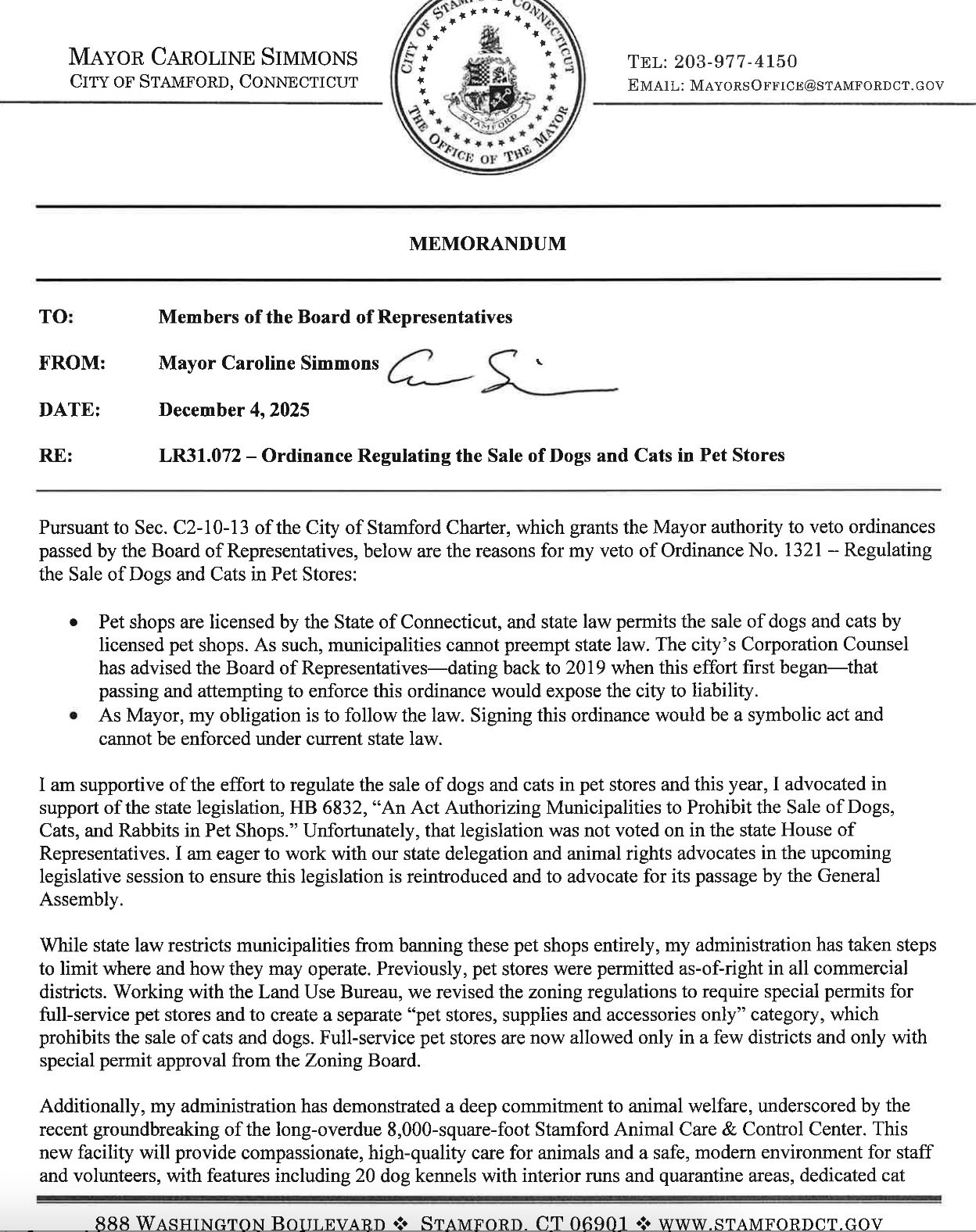
The ordinance was subsequently vetoed by the Mayor Caroline Simmons on Dec 4, 2025 due to her concerns over “state preemption,” citing potential legal liability, as current state law allows licensed pet shops to sell these animals.
The city’s legal department wrote to the Board of Reps in 2024 saying they were not authorized to regulate the sale of puppies.
Simmons wrote to the Board of Reps on Dec 4, saying she supported and advocated for animal welfare measures that strengthen protections for animals and improve care standards across Connecticut.
She pointed to the city’s recent opening of a new 8,000 sq ft animal control center as evidence of her administration’s commitment to animal welfare.
Now, Stamford’s Board of Reps is considering a vote to override Mayor Simmons’ veto, and social media is buzzing in anticipation of the Monday, Jan 5 Board of Reps meeting where a potential override is on the agenda.
The agenda includes, “Regarding the Mayor’s Veto of Ordinance 1321: Regulating the Sale of Dogs and Cats in Pet Stores (originally LR31.072).”
Desmond’s Army Animal Law Advocates urged Stamford residents to write letters to the Board of Reps at [email protected] to express support for the override.
On Facebook Desmond’s Army posted, “Here’s why overriding this veto is CRUCIAL: Connecticut has NO statewide legislation to stop puppy mills—so municipalities taking a stand is our BEST chance to protect innocent pups, kittens, and families from scams, sick animals, and heartbreak! …. the Humane Pet Shop Ordinance! Stamford has home rule authority to pass this.”
In an op ed published on CT Examiner on Dec 6, 2025, former Connecticut State Rep David Michel, who served the 146th district and co-chaired the CT Animal Advocacy Caucus, wrote, “The veto message echoes the Dept. of Agriculture’s long-standing claim that municipalities ‘cannot’ act in this area. But the department is not an objective stakeholder. It is the agency that licenses the very pet shops that obtain animals from large-scale commercial breeders whose histories include repeated Animal Welfare Act violations.”
Mr. Michel had testified extensively at the Feb 3, 2025 hearing on HB 6832, saying, “A lobbyist for the Stamford pet shops called a former fellow lobbyist who had just become Commissioner of CT Dept of Agriculture warning the commissioner that if such an attempt were to pass, the pet shops would have to close, which is inaccurate.”
Lucky Dog Rescue of Stamford submitted a briefing to the Board of Reps that also talks about home rule authority.
“Connecticut operates under home rule, meaning municipalities may enact local ordinances to protect residents, consumers, and animals unless the state explicitly prohibits them. There is no Connecticut statute that prohibits municipalities from regulating or restricting the sale of animals in pet stores. State licensing establishes baseline requirements; it does not preempt local regulation.”
Their briefing talks about how commercial breeding establishments, “puppy mills,” prioritize profit over animal welfare.
“Dogs are often kept in crowded cages, bred repeatedly, and denied proper veterinary care, exercise, and socialization.”
The briefing goes on to talk about USDA Licensing and the Horrible Hundred, an annual report published by Humane World for Animals.
“Some have pointed to USDA licensing as evidence that puppy mills are regulated and therefore acceptable. This is misleading. USDA standards represent minimum legal requirements, not humane care. They allow continuous breeding, small wire cages, limited exercise and enrichment and minimal social interaction.”
The Horrible Hundred identifies USDA-licensed breeders with repeated serious violations, including: Sick or injured animals, Filthy conditions, Dead puppies and Failure to provide veterinary care.
“USDA inspections are infrequent and not conducted daily. Conditions may temporarily improve during inspection periods and deteriorate afterward.”
As for the City’s new animal control facility, the lucky Dog briefing says, “The new Stamford Animal Care & Control Center is a significant and welcome investment. However, shelter capacity addresses symptoms — not root causes. Without preventing the source of harm, shelters will continue to receive animals affected by commercial breeding and irresponsible sales practices.”
The Monday, Jan 5 Board of Reps meeting is at Stamford Government Center, 888 Washington Blvd, 4th Floor (or virtual – agenda and link here: https://boardofreps.org/Data/Sites/43/userfiles/agendas/2026/260105.pdf) (agenda, page 9)
See also:
Feb 6, 2025
Feb 11, 2025
Jan 23, 2025
Screenshot
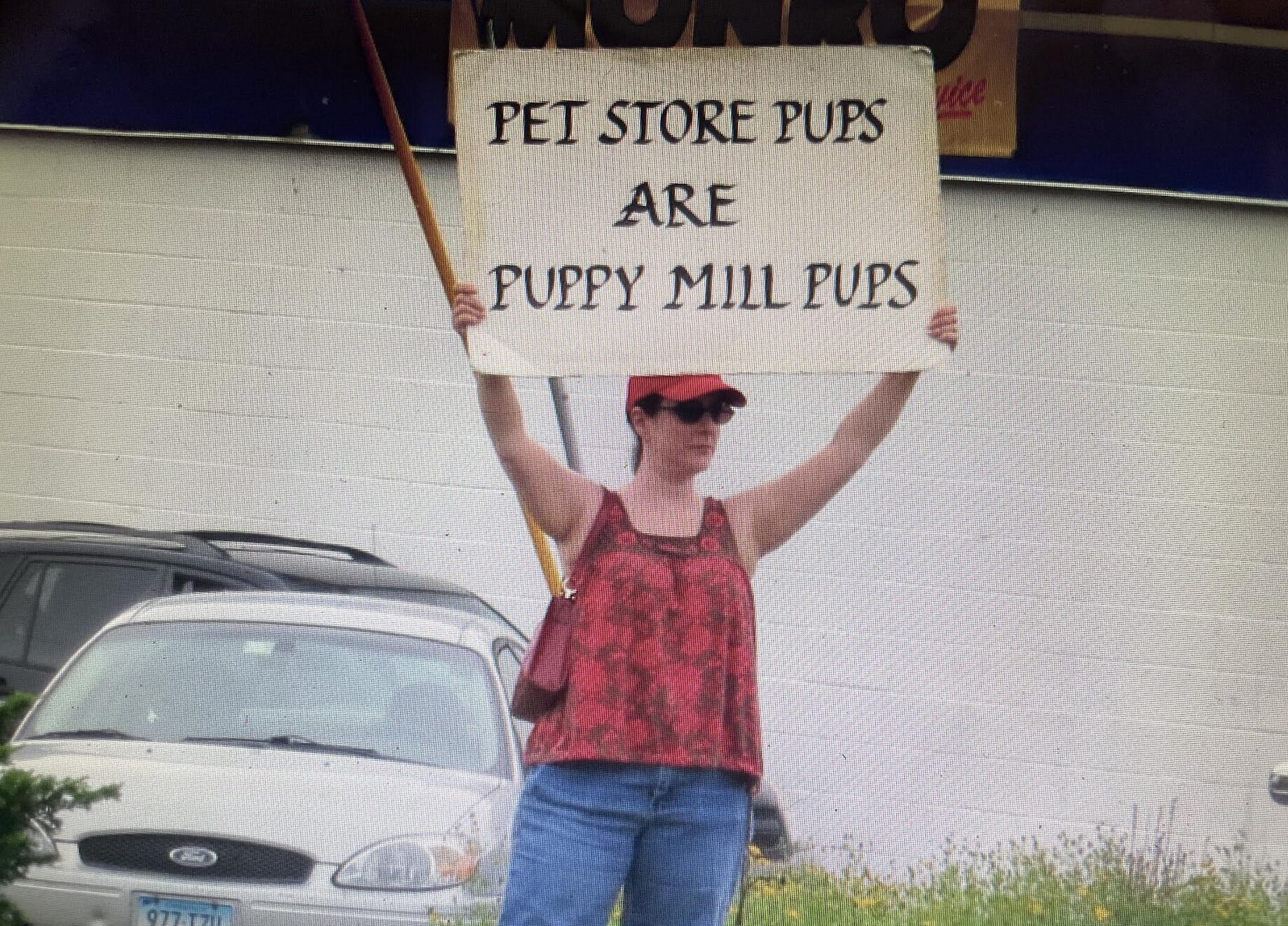
Protester outside now defunct Puppies of Westport. Photo: Leslie Yager