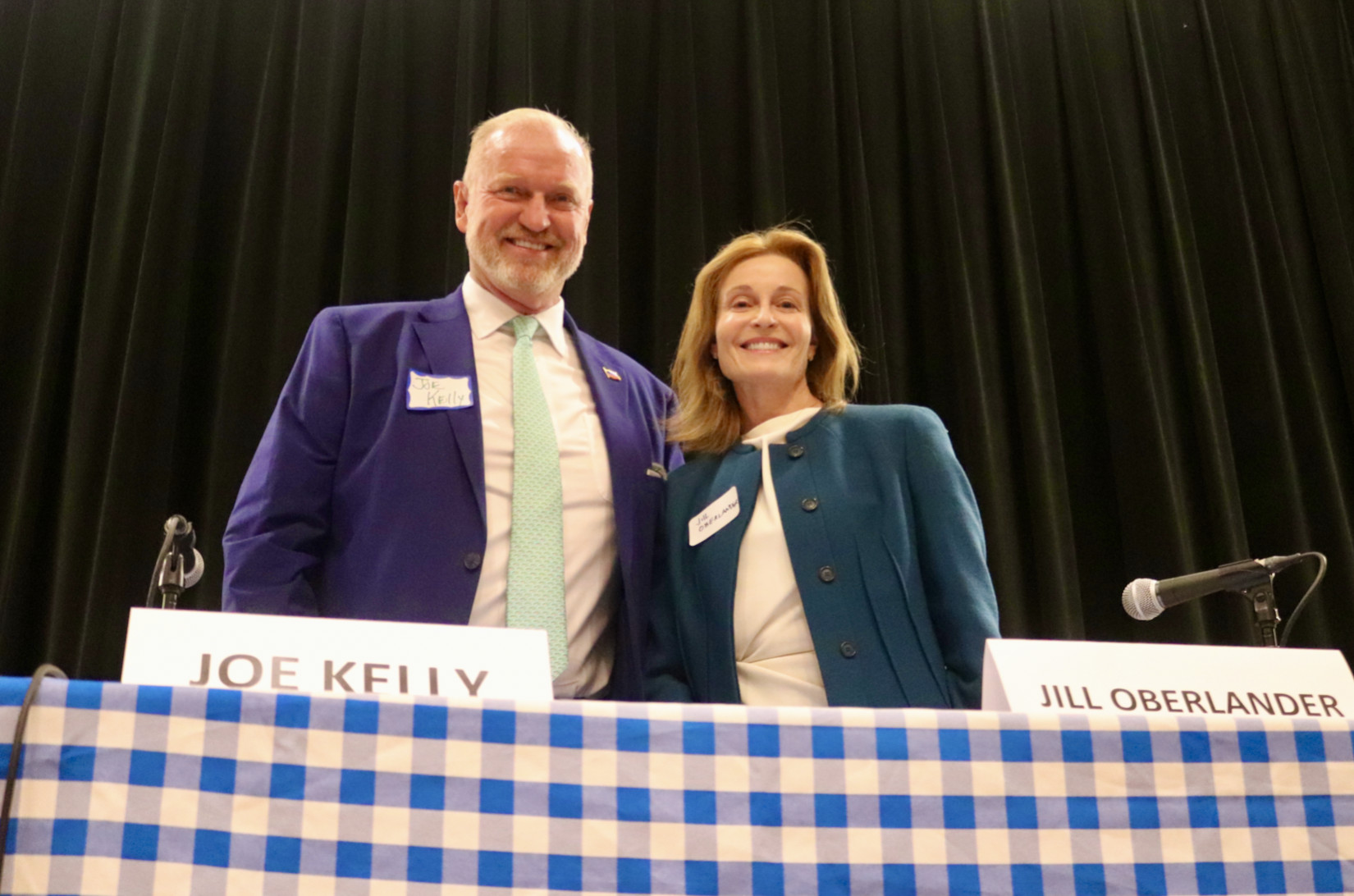
Wednesday night’s Round Hill Association debate in back country Greenwich featured candidates for Connecticut’s 36th State Senate district, Jill Oberlander (D) and Joe Kelly (R).
The district covers all of Greenwich, parts of Stamford (including North Stamford and Westover), and western New Canaan.
Later in the evening, candidates for State Rep in the 149th district had their own debate.
Kelly and Oberlander agreed on several topics, but there were some perceptible differences.
Job Opportunities, AI, and Data Centers
“I think New York has the right approach. I think we should pause consideration on any data center,” Oberlander said. “I haven’t met anyone here who is interested in a data center.”
“We have an electricity crisis right now, and data centers utilize way too much electricity,” she said, adding that jobs for the next generation were very important.
She said AI regulation was something the state legislature is looking at closely.
Mr. Kelly said building a data center would only create temporary construction jobs, since data centers employ few permanent workers.
“AI scares the hell out of me,” he said. “We should take it slowly and understand it. Very smart people are saying some really concerning things about AI.”
CT Unfunded Pension Liabilities
Oberlander said the state’s fiscal guardrails had helped channel excess revenue to pay down unfunded pension debt in Connecticut.
“Over the past 8 years the state has been able to increase its funding from a very low level, to about 30%, to about 70% funding now. We still have work to do, but I’m proud of the progress we’ve made, and I think we need to continue along that course.”
“Our better funding ability has also increased our credit ratings, and by paying down some of the unfunded liability, we freed up about a billion dollars in state operating funds that we’re able to use for our budgets.”
Kelly said Connecticut had a “spending problem.”
“We need to control our spending, then we’d be better off and able to pay down some of the unfunded liabilities,” he said.
“We have to take bold moves in order to fix that by stimulating business. How do we do that? By lowering taxes,” Kelly said. “It sounds strange if you want to take care of unfunded liabilities, you ask for less from the taxpayer, but we have to make it comfortable for businesses to be here.”
“Jobs are leaving, we can’t have that. We have to stimulate the state by making it more attractive,” he added.
“The idea of cutting our spending is great, but the devil is always in the details,” Oberlander replied. “And I want to know what programs are being cut when you cut our spending.”
Escalating Health Insurance Premiums
Kelly said he had lived for 8 years in a country with nationalized health care, but did not believe the US government should run health care.
“Healthcare should be a right, but I can’t have health care be run by the government because the government doesn’t run things well.”
Ms Oberlander said one idea was for businesses and non profits to have the ability to pool together to negotiate reduced costs.
Also she said she would push for health care reform to reduce costs and use legislative ability for oversight on companies to make sure residents are represented.
Federal funding cuts for healthcare and education
Mr. Kelly said schools must be funded and Greenwich schools must be number one in the state.
He said when he served on the school board, he moved capital projects along.
“We do have to make sure we fund our schools. It’s primarily important for me, whatever is going to happen with federal funding, we have to have to make up for it with the state, because we can’t put our schools at risk,” Kelly said.
Ms Oberlander said tough decisions were in the offing.
“We’ve seen over he last year the impact of the withdrawal of federal funds on a range of things – on food stamps for needy children, on healthcare premiums support for people across the state facing increasing costs, and we’ve seen a cap at the state level on the educational cost sharing (ECS) funds, which help fund the public schools throughout the state,” Oberlander said. “I’m a strong advocate of supporting our schools and supporting our vulnerable populations.”
“I’m a strong believer of living within one’s means,” she said. “When I was BET chair we lived within our means. We brought in town taxes at the lowest rate they had been in the prior decade.”
Affordable Housing Legislation
Asked what he would change about 8-30g and recent housing legislation, Kelly said the state should absolutely not have mandates on municipalities.
“I think 8-30g has created an adversarial relationship between the municipalities and Hartford,” he said. “I’m often concerned when Hartford is making decisions about what we can do within our town. They don’t understand what our town needs. Our town knows what we need. We know our schools. We know our parking. We know our sewers. We know our infrastructure.”
Oberlander agreed local officials who know their towns should make these decisions on what kind of housing they need and where to put it, and the State should be a partner, providing data, resources, funding, help with infrastructure.
“In Hartford, I want to be the liaison between the municipalities and the State to ensure we’re getting the support we need and to push back and fight against overreach on the part of the state.”
She said other ways the state could help towns is to help work to lower the cost to build housing, help fund infrastructure upgrades, and to support housing authorities.
“What I won’t do is give into pressure to support bills that aren’t good for our community. I will be an advocate for our district and our local zoning laws.”
Kelly had a short rebuttal.
“We’d vote it out,” he said of 8-30g. “Why it’s in place, I have no idea.”
Oberlander said she also supported local control and described 8-30g as a law that had past its prime and was not working.
“Eighty-five percent of towns don’t comply with its provisions as it’s written,” she said.
“I wish I had a fairy wand and could say, ‘Overturn it,’ but unfortunately there haven’t been the votes in Hartford to do that. Either one of us would take that position, but we have to work collaboratively.”
Fiscal Guardrails and Political Rhetoric
The candidates had one flashpoint disagreement when asked by moderator Brendon DeSimone to describe a “hard call” made by the legislature that could have gone either way.
Ms Oberlander thought for several seconds before saying she would go “off script” and replying that the fiscal guardrail vote had been a difficult decision for everyone including local Democrats.
“Critical decisions were made to support our most vulnerable residents: to provide them food, to respond to the federal cutbacks, to fund early childcare and address some of the problems we’re facing in the state as a result of the federal withdrawal of funds.”
“I would have voted the way they voted – and I support the fiscal guardrails. Completely consistent with the fiscal guardrails which were adopted with the idea that there are going to be difficult decisions made.”
“I’ve heard during the course of this campaign that Democrats violated the fiscal guardrails. That is actually not the case. The case is there is legislative authority to make a one-time decision – but I think that was a tough decision.”
Mr. Kelly talked about the busting fiscal guardrails.
“We were making some headway in a robust economy to pay down some of the unfunded liabilities, but we went through our disciplines. We busted the fiscal guardrails,” Kelly said.
“Like at home, you budget your groceries, budget for your car, budget for groceries. You budget your mortgage. You don’t blow through otherwise you can’t go on your vacation. You have to stick with your disciplines. You can’t because of an event outside your control, just break the budget. I know that at home I don’t blow the budget. I only spend what I’ve earned. I’ve earned a lot of money, so I can spend a lot of money.”
“That is the biggest thing we should have not done,” he added.
Ms Oberlander said when knocking on doors, voters had said they were tired of partisan rhetoric and vitriol.
“I think language like, ‘They busted the guardrails. They violated the guardrails. They broke the guardrails.’ That is some of the same partisan rhetoric that is upsetting people throughout the district.”
“You have to read the legislation and the fine print,” Oberlander continued. “It was always anticipated in the legislation there could be an unusual special circumstance where the governor and the legislature would vote to spend money otherwise, and that’s exactly what they did.”
On Wednesday, October 14, LWV Greenwich will host debates from 7:00pm to 9:00pm at First Congregational Church in Old Greenwich featuring candidates for Connecticut State Senate District 36 and State Representative Districts 149, 150 and 151. Register here.
Also, the Lower Fairfield County Leagues of Women Voters candidate debate for U.S. Representative for Connecticut’s 4th Congressional District (CT-4) is scheduled for Monday, October 19, 2026, from 7:00-8:30pm at the Westport Library, will give voters an opportunity to learn more about the three candidates – Jim Himes (D), Michael Ted Goldstein (R), and Benjamin Wesley (I) – and their positions on issues relevant to the district.