The revised regulation would require any new development with more than 5 units to make 20% of units “below market rate.”
The proposed definition of “below market rate” would include 2 types:
• moderate, based on average town employee salary
• affordable, based on 80% of the State median income
Under the existing regulation (in moratorium), developers are required to offer 20% of their units at below market rate if they use incentives.
The revised regulation would require that any new development with more than 5 units be required to make 20% of units “below market rate.”
“This is a big change from the existing regulations,” said town planner Katie DeLuca.
Ms Alban said the commission was aware that increasing housing diversity would result in more density. But, she said there is also a greenscape taskforce working simultaneously on pocket parks, improving traffic islands and finding other places to “green up.”
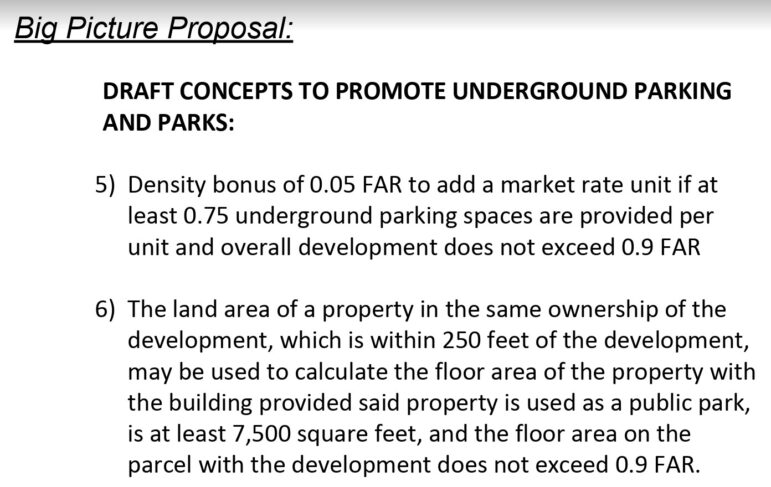
With an eye to promoting green space, the draft of the amended 6-110 reg has incentives to promote underground parking and encourage creation of pocket parks.
“There is a very strong desire to have underground parking. There is also a very strong desire to have green space throughout the community,” DeLuca said, adding that in exchange for underground parking there might be an extra FAR bonus for market rate units that don’t count toward the total number of units used to determine the 20%.
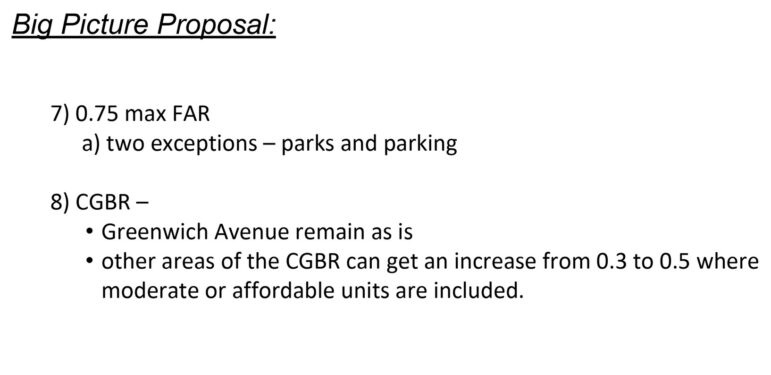
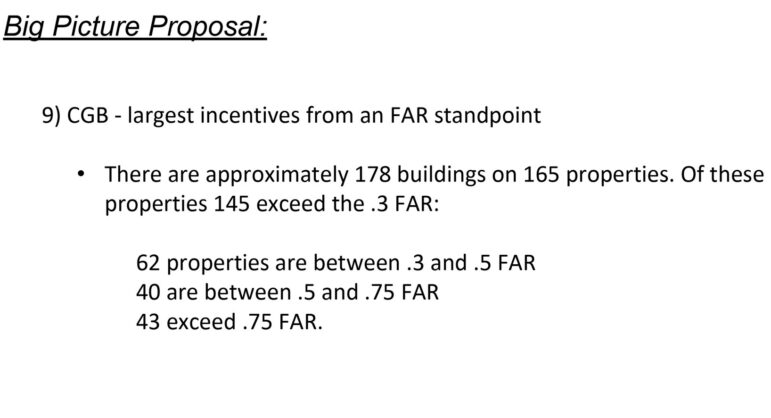
Second, if you have land near the development it can be put toward increased FAR, up to .9, as long as the site is at least 75,000 sq ft and it is used as a pubic park. Otherwise the maximum FAR would be .75.
During public comment, Rick Margenot said he was worried a push for underground parking would disturb the watercourse and impact the water table.
“In some cases you’re chopping into deep slopes, depending on the grade and people get up in arms about doing that,” he said.
Ms DeLuca said, if approved, developers might propose underground parking with a park on top, which was proposed by Joseph Tranfo on Benedict Court a couple years ago.
“I think you’re going in the wrong direction,” Margenot said. “You have to create more incentives for more FAR so the developers can afford to build the moderate and affordable housing. If you’re going to reach that 10%, (the state subjects towns to 8-30-g unless they have 10% of their housing stock designated affordable) you have to do more for developers.”
Margenot said he liked the idea of more FAR in exchange for a park, but suggested P&Z “go big,” possibly with a 1.0 FAR.
Land use attorney Chip Haslun suggested that if a park were created in exchange for added FAR, park ownership be transferred to the town for maintenance and for reasons of liability.
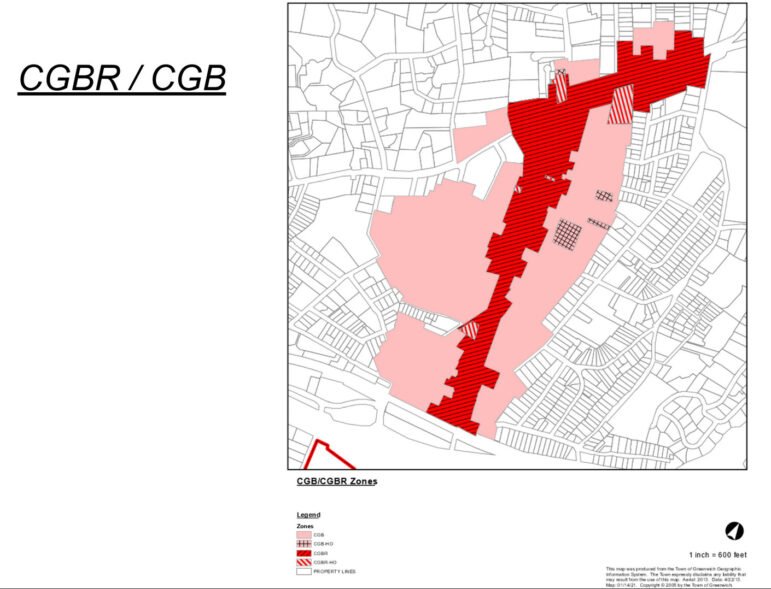
DeLuca said there are no proposed incentives for the CGBR zone, which includes Greenwich Ave and the stretch of Putnam Ave that includes Asiana and Mitchell Gold.
“We’d like to retain the look and feel of those areas,” she said. “Greenwich Avenue is a beautiful historic area where you can go up to.9 FAR under certain circumstances having to do with proposed uses. None of that is changing.”
She said the idea is not to change the central Greenwich business district and downtown core.
“We’d like to keep Greenwich Ave with its beauty and grandeur, but promote housing within the downtown, particularly mixed use housing and we think providing FAR incentive is a good way to do that,” DeLuca said.
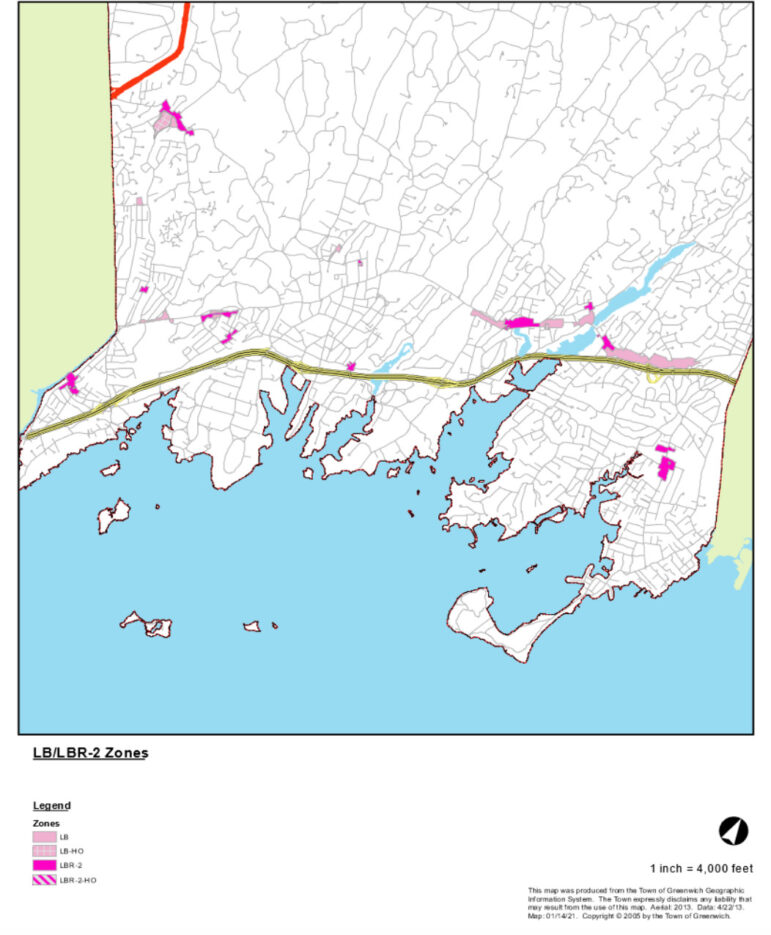
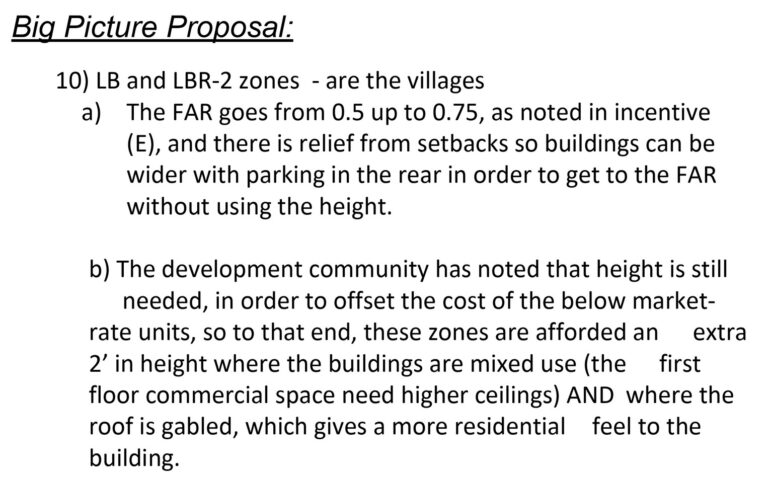
The zones with proposed incentives are in the town’s villages, including Cos Cob and Old Greenwich.
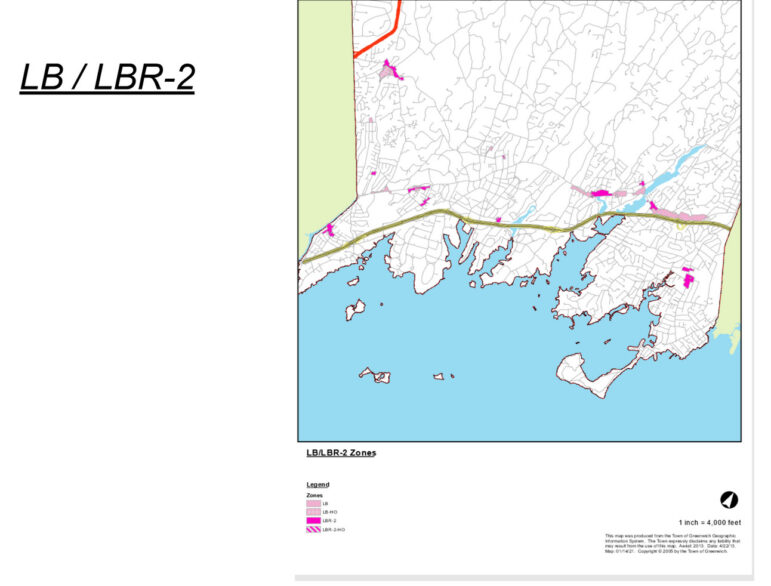
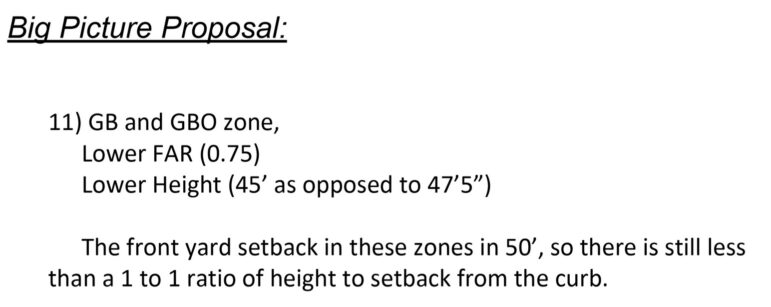
“The concept from the commission is, we’ll give you a box, and in some areas – like the villages in LB and LBR2 – we want that box to have a peaked roof and have more of a residential in feel,” DeLuca said, adding the goal is to create diverse housing options in Greenwich and increase the number affordable units, but continue the residential feel in the appropriate areas and give the density in the appropriate areas.
Ms Alban and Ms DeLuca said the proposed updated regulation is not unique to Greenwich. Inclusionary zoning, which is when a town’s regulations require a share of new construction to be affordable by people with low to moderate incomes, is not new.
Inclusionary zoning stems back to the 1970s when policies were first created in response to exclusionary and often racially segregated zoning.
Haslun, who has experience with both 8-30g and 6-110 projects in town, said his concerns were about unintended consequences of scaling back incentives.
With the requirement that developments with more than 5 units make 20% of units “below market rate,” land use attorney Chip Haslun said he feared more developers would bypass 6-110 and go straight to 8-30g.
“Are you really providing incentives for developers to use your 6-110 regulation?” he asked.
Alban noted that 8-30g has a higher affordability component (30%) versus just 20% for the revised 6-110.
Also, the previous version of 6-110 only reflected the town median income. The new reg proposes a part at 80% of state median income, which is lower.
Haslun pointed out that the State 8-30gs are deed restricted for 40 years, while 6-110 stay in place in perpetuity.
Architect Richard Granoff said that instead of focusing on affordable component, the POCD calls for not just affordable housing, but also “a diverse housing stock” which is interpreted as multi-family housing.
“I can say emphatically that the demand for multi family housing is voracious,” he said, adding that to keep empty nesters in town there needed to be multi-family housing. “That’s not just affordable. That’s luxury condos and market rate apartments.”
Granoff said the proposal would result in a disincentive to build multi family housing in Greenwich. Ultimately, he said, it would result in more 8-30g projects, which can be 4, 5, or 6 stories high and have less parking.
Ms Alban noted that inclusionary zoning in Westport (gives incentives) and Darien, where no incentives are offered, is attracting proposals.
She did note that Greenwich’s real estate is more expensive.
“Let’s look around and see what works for you guys,” Alban added. “Reach out to people in your field to other architects builders and tell us how to fix this. …We want to do something that mandates below market housing because we’re not going to make Greenwich more diverse unless we do.”
Susan Foster said she loved the incentive for additional parks, but didn’t think the incentive went far enough, especially given that a number of apartment buildings are in the works along Putnam Ave in Riverside. She said the new families who move into those new apartment buildings don’t have a public park to visit.
During public comment, Trish Clark said she knew a teacher living in moderate housing who turned down a summer job because it disqualify them from her housing. She asked if there was a way not to disincentivize people working second or third jobs.
“And then you wouldn’t quality because, of course, you are not in the lower income population,” Alban said. “You’ve changed your economic status.”
“How do we deal with moonlighting,” commissioner Peter Lowe asked.
Ms Alban said people would not be asked to leave in the middle of their lease if their income went up, but rather, at the end of their lease.