By Andrew R. Melillo, Greenwich
It began with English wool. In July 1640, on a salt-bitten neck its Wiechquaesqueek inhabitants called Monakewego, Robert Feake and Daniel Patrick traded “twentie five coats” for the land between two brooks.
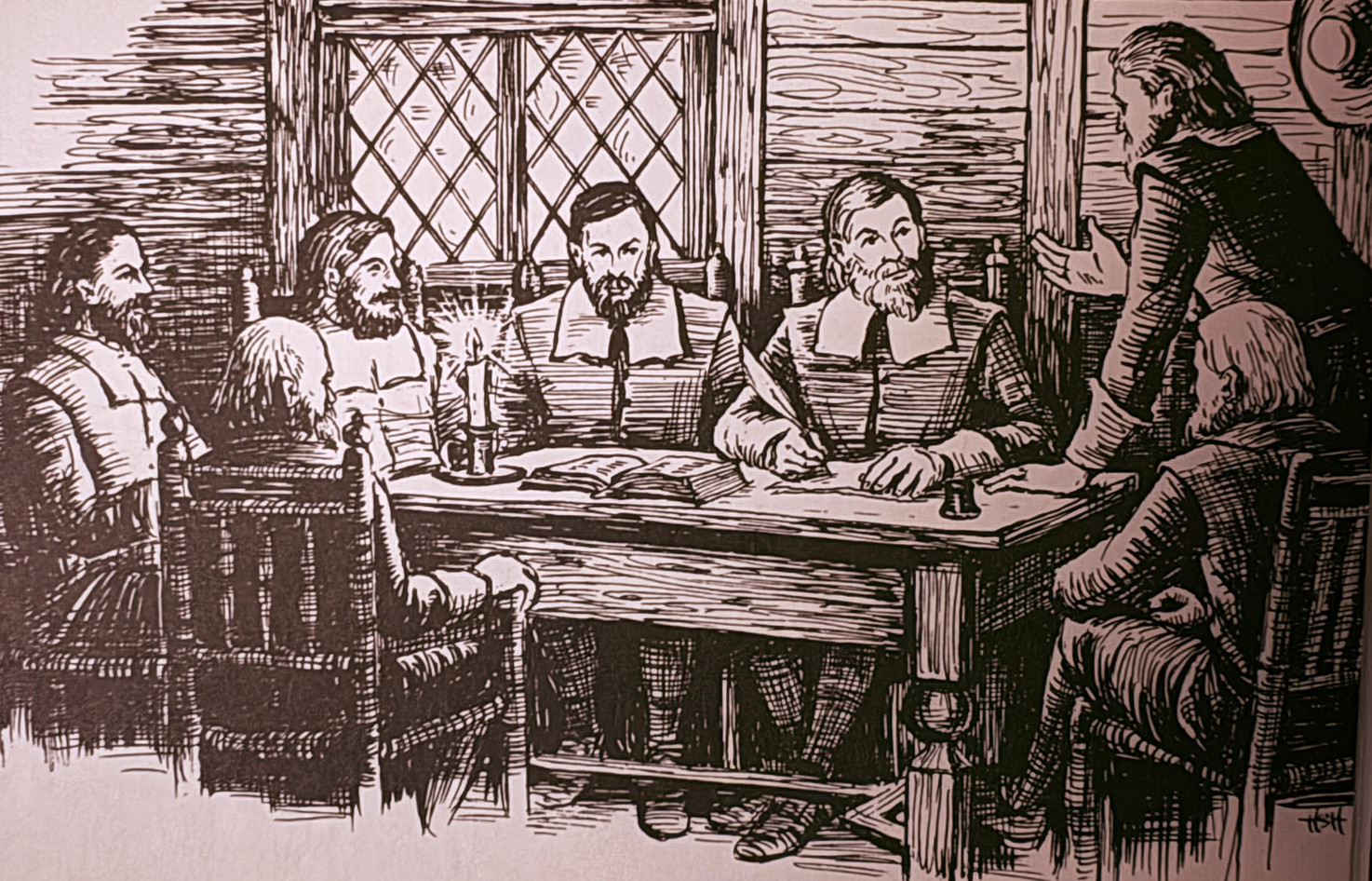
Original proprietors laying out town rules and ordinances for the government of the settlement of Greenwich.
Within months the Dutch at Fort Amsterdam claimed it for “their High Mightinesses.” In 1656 New Haven took the town, and the Greenwich men, “absolutely refused to submit.” Then, in 1662, [after carefully crafted duplicity with John Winthrop, Jr’s cousin, Sir George Downing, Ambassador to Holland for St. James’ Palace], a royal charter folded everything into Connecticut, allowing each town up to two deputies in its General Assembly. It ensured the regicide-harboring New Haven Colony would die a quick, but bloody death by a thousand betrayals.
Under that charter, power climbed upward from the town. Any householder admitted as an inhabitant could speak and vote in town meetings, but only a freeman could vote for the colony’s officers or sit in its Assembly. To be made free a man had to be twenty-one, hold land worth forty shillings a year or an estate of forty pounds, and be “of a quiet and peaceable behavior, and civil conversation,” approved by his own selectmen. Representation was counted by towns, not by heads: little Greenwich sent its two deputies exactly as Hartford did. A very equal form of representation for very perpetually jealous New England men.
Government in Greenwich was something you did with your hands. A man walked the frozen lanes east of Longmeadow brook for sixpence a time, knocking on doors to warn the next meeting. Later the notice was nailed “upon ye oak tree between Willem Rundle’s & Thomas Marshall’s,” [between No. 14 and 16 Lockwood Avenue in Old Greenwich today]. The town met even on Christmas Day, for good and true Puritans kept no Christmas: in 1689 the men stamped snow from their boots, steamed by the fire, and chose “John Mead Senior for a moderator & to put to vote town acts.” In wartime the call was a drum, and every man had to be at the townhouse “within half an hour after ye drum is beaten.”
What they voted on smelled of the barnyard. Hogs to the pound at sixpence a head. Fences marked with each owner’s initials. Sheep folded in hurdles and rented by the night for their manure, so long as the renter kept them “from being devoured by wolves,” with eight shillings paid for every wolf killed.
On a May morning in 1687 the clerk wrote a single line: “ye cow keeper William Hubbert went forth with ye herd.” You can hear the bells and the clanging down the cart path to Cos Cob.
Nobody grew rich serving. Office was a neighborly duty laid on a man for “the year ensuing,” and the pay, where there was any, was a fee for labor: sixpence to warn a meeting, half a crown a day to view fences, a few pounds bid by whoever would collect the rate most cheaply. Some refused outright. “Both refused to accept,” the clerk wrote of two men chosen constable in 1778, and in 1785 Thomas Hobby gathered the town rate “having agreed to have nothing for collecting it.” Even the colony counted the cost: in 1661 it halved the deputies each town might send.
That same autumn the colony itself nearly vanished. King James II meant to fold all New England into one Dominion, and on the last night of October, 1687, Sir Edmund Andros sat in a Hartford tavern with armed soldiers at his back, demanding Connecticut’s charter. The parchment lay on the table. The argument ran past dusk; tallow candles guttered; the room was thick with wet wool, pipe smoke and anger. Then, all at once, the candles went out. In the dark came the scrape of a chair, a banging door, running feet. When the lights were struck again the charter was gone, carried, the legend says, by Joseph Wadsworth to the hollow of a great white oak. For two years the Assembly did not sit, and Greenwich men drove their herds knowing the colony above them had been swallowed whole. Andros’ fall from power coincided with Marlborough’s carefully coordinated putsch of James II from the throne. When the Dominion of New England fell, and the charter government returned, the town was in no mood to be ordered about. Asked in 1691 for money said to be “due to ye country,” it answered in one line: “neither will we pay any such monies.”
When Greenwich’s fathers built the meeting house in 1694, “thirty two feet long & twenty six feet wide,” every family brought shingles, and men were chosen “to cull & count” them. The air was sharp with fresh cedar. The State reimbursed them for the shingles cost. Twice a year the town reached beyond itself: after 1701 the Assembly met in Hartford each May and New Haven each October, and May opened with an election sermon and, in time, election cake. A Greenwich deputy rode north over “a cracked bad road,” carrying the grievances of “a frontier town next [to] Her Majestys province of New York”: Rye hogs loose on Horseneck, Stamford men cutting Greenwich timber. Taxes went in “provision pay” of wheat, corn and pork.
Choosing the men above them was a slow, solemn ritual. Twice a year the freemen gathered to name their deputies, as they had since 1639, when deputies were chosen by whoever had “the greatest number of papers written for them.” Selecting your representative was an extremely personal affair. Each autumn every freeman nominated twenty men for the Council; each spring, as each name was read aloud, he handed in his ballot. The list ran by seniority, so a councillor might sit, as one observer put it, “until they resign or die.” John Adams called Connecticut a state “always governed by an aristocracy.” Greenwich was no different: in the century after 1776 nearly a third of its seats in the Assembly went to a Mead. The days where Greenwich was governed by its founding families, have gone.
By 1774 the farmers spoke the language of revolt. Boston, they resolved, was “Suffering under the Iron Hand of Despotic Power,” and gunpowder had “Doubled” in price. Soldiers took the Town House “for a guard house” and built a chimney in it. On 26 February 1779 General Tryon’s redcoats came up to Horseneck. Israel Putnam spurred his horse down the steep hill by Knapp’s Tavern to escape, and the saltworks burned along the shore [yet David Bush’s property a stone’s throw away remained remarkably intact]. The town minutes are silent about it. Afterward the Town House was sold for paper money at “12 for one,” and the poor were bid off to board by the week. Through it all General John Mead and Captain Jabez Fitch rode to Hartford for the town.
Independence changed less than one might think. In October 1776 the Assembly simply declared that the old royal charter would continue as the constitution of the new state, and it did, with the same freemen, the same two deputies per town and the same twice-yearly ride, for another forty-two years. Only in 1818 did Connecticut write a constitution of its own: the Council became a Senate, the governor left the legislature and gained a veto, judges were made independent, the Congregational church lost its official standing, and the vote passed to white men who paid taxes or served in the militia. Greenwich kept its two seats.
Peace came quietly. On 12 November 1787, in a hall that had always voted by voice and raised hands, “the Town voted by ballot,” sending Amos Mead and Colonel Jabez Fitch to ratify the new Constitution. Slips of paper fell into a hat, and a century and a half of neighbors walking in from the fields became part of a nation.