On Friday the newly formed task force to determine the next use of the historic building at 100 Arch Street, longtime home to the Teen Center, convened via Zoom.
First Selectman Fred Camillo led the meeting which culminated in the election of chair, vice chair and secretary.
“I spoke with two well known architects in town that would love to speak with us,” Camillo said. “They have have great ideas about the building – how we could really take advantage of what’s there now, but also to marry it with being on the water.”
“Kate (Kate Buch, town administrator) and I spoke yesterday. We’ve going to add a BET and P&Z liaison to the committee,” he aid.
As for access to the building, Camillo said, “Believe it or not because the judge gave Kyle Silver (teen center director) another month to clean out – it’ll be 4-1/2 months to clean out his personal storage – we actually have to ask him for permission. Basically he’s got squatters rights right now, which is pathetic, but it’s the law in Connecticut.”
Camillo said he could request permission for the task force to tour the building, but otherwise it would be necessary wait until the teen center items are removed.
Task force member Steve Waters asked Mr. Camillo, “What kind of time pressure is your preference in terms of how long we take and what you’re trying to do?”
Camillo replied, “I’d love to see us start right away and I think within 60 days we should be able to have an idea of what we want this RFP to look like.”
He noted that the organizers of the May Greenwich Town Party would like access to parts of the building for a staging area, and other organizations have similar requests.
“I don’t think this one should be that long – it’s not as tangled up as the Havemeyer project is,” he said.
Sabine Schoenberg, a realtor and home-building expert who is the liaison from town’s Greenwich Energy Management Advisory Committee, noted that the building has an open floor plan.
“There’s a lot that can be done easily on both floors,” she said. “What kind of uses have been discussed so far?”
“There’s a real desire to have some kind of restaurant or café maybe on the first floor,” Camillo said. “We only have one other public restaurant on the water and it’s very expensive. And you have a captive audience there, whether it’s in the summertime with concerts or people waiting for the beach boat.”
“Ideas ranged from some kind of public type of performance or theater – things that engage the public,” he continued. “I don’t think we want to put a governmental entity back in that building – that would be a waste…People are excited about somewhere they can go enjoy the water 12 months a year.”
Camillo said there was an opportunity for the use to generate revenue for the town and noted there is “tons of parking.”
Scott Frantz said, “I see for the benefit of the town and taxpayers the potential for a private sector group to go in there and pay some pretty healthy rents to the town.”
“The other thing that could work there is a health club of some sort,” Mr. Frantz added. “The second floor has a ton of room and you could put all kinds of workout equipment there. The third floor – which already has a well equipped kitchen – there is room for tables – you could have a health club / healthy eating kind of establishment. Just an idea.”
“How quickly do we get the public involved?” Icy Frantz asked. “There is a lot of public interest. What’s the process? I want to make sure the public feels like they’ve been heard and seen and listened to.”
Camillo said the Hamill Rink task force and Havemeyer building task force both held a public hearing.
“We should have at least one public hearing,” Camillo said. “Maybe in the beginning of March, so they can have a crack at it.”
Stacey Sears Higdon asked if the public hearing come before or after an RFP is issued.
“We could do two,” Mr. Waters suggested. “We can have an early brainstorming one and then when we have responses to the RFP, tell the public this is what we’ve got so they have some input.”
Waters asked whether the Skatepark would be impacted.
The Junior League of Greenwich developed the Greenwich Skatepark as a safe, supervised facility for local youths age 6+ to skateboard and inline skate. The Junior League raised funds for and gifted the original Skatepark to the Town in 2003.
“There is no plan to take that away,” Camillo said. “And there’s got to be parking for that….the big parking across the street and Horseneck Lot down the road have helped with overflow for parking.”
Higdon asked if the goal was to find an organization to pay for the building renovation, rather than the town.
“Yes,” Camillo said. “I think a public-private partnership works here. The town as the landowner, you do a ground lease. That would be the goal because right now the renovations are north of $1 million, maybe more, according to Luigi Romano (Greenwich’s Superintendent of Building Construction & Maintenance).”
“We also have a lot of capital projects in the budget and I don’t know if there is appetite to adding another one,” Camillo added.
Mr. Waters asked how the project would relate to Camillo’s proposal for changes to Roger Sherman Baldwin Park, which he recently proposed to the BET.
Camillo’s proposed capital budget included $10 million for design and construction at Roger Sherman Baldwin Park on Greenwich Harbor, including relocation of the Parks & Trees buildings (pictured below) and creating a new park gateway, green spaces and walking paths.
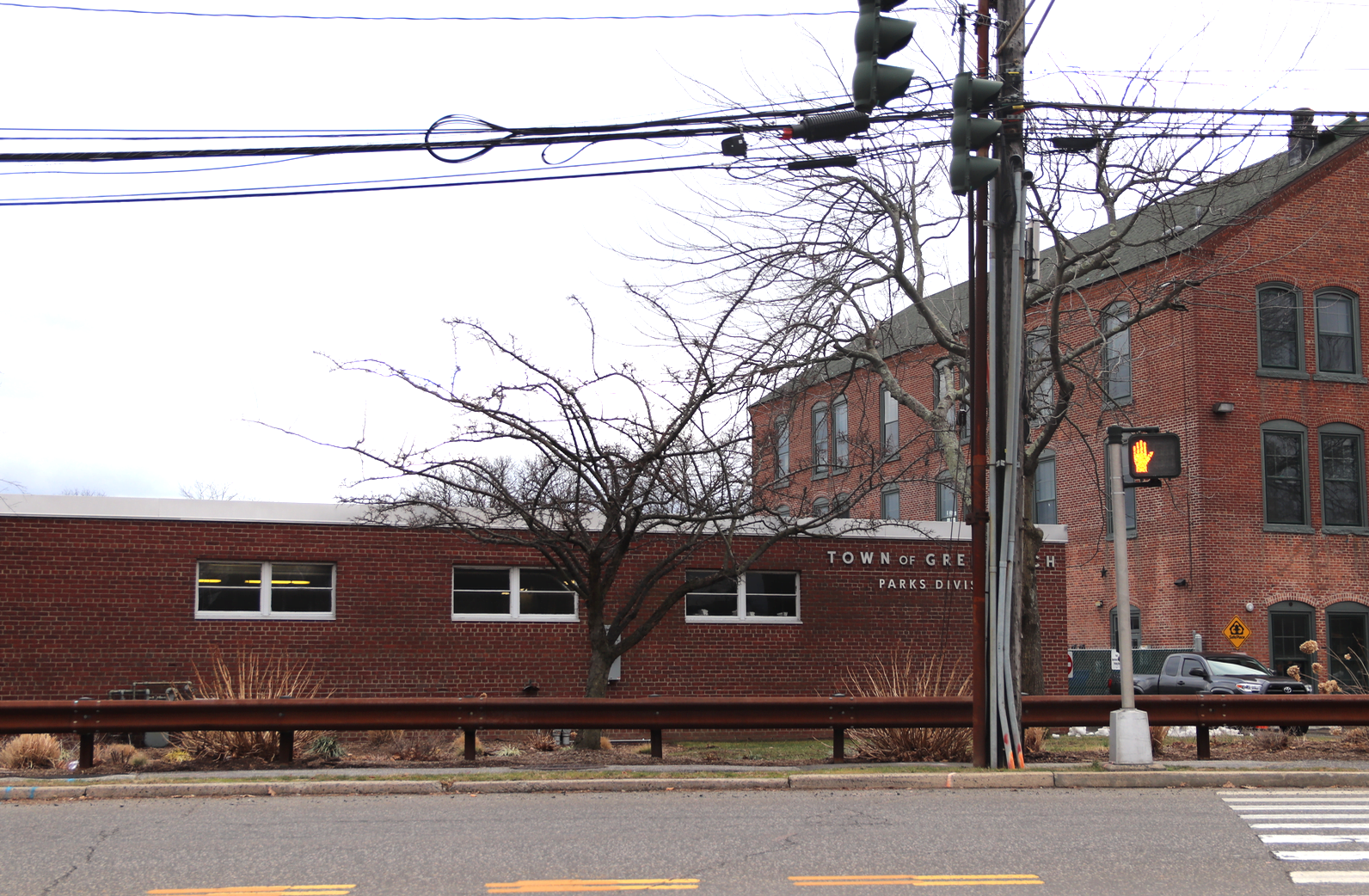
Parks building next to the former teen center building at 100 Arch Street. Photo: Leslie Yager
“Maybe you have a lot of new windows in the building that look out onto the park where there’s a concert. Maybe you build a deck outside – up high on the second or third floor,” Camillo said. “If you add on space on the ground we’d have to conform now to the new flood regs.”
Camillo recommended the task force look at the renderings of proposed changes to the park from a previous RFP.
“I don’t think it’s anything we would have to do in tandem,” he said. “Once those garages are gone – that’s its own project.”
Camillo said the holdup to removing the Parks Division buildings was related to the timing of that major project at Holly Hill.
“I think this BET understands we’ve been talking about (the Transfer Station) for 40 years,” Camillo said. “This BET is a little more proactive, which will be very helpful.”
Scott Frantz said it would be important to keep the use of paid consultants to a minimum.
Camillo said the two architects had offered to help without charging fees.
Election of Task force Officers
Ms Higdon offered to serve as secretary for the task force and was voted unanimously.
Steve Waters nominated Scott Frantz to chair the task force, but Mr. Frantz declined, citing time restraints.
Katherine Lobalbo nominated Mr. Waters, but he also declined, explaining he was more focused on the town budget, capital expenditures and public works.
Icy Frantz nominated Katherine Lobalbo, who also declined, noting her numerous other commitments, including service as Moderator Moderator Pro Tempore of the RTM.
Icy Frantz was asked if she was willing to be chair. She offered to serve as vice chair instead.
Sue Bodson was asked if she would chair the task force. She also declined and suggested Sabine Schoenberg.
“I feel with your real estate background, this would be in your wheelhouse,” Bodson said.
Ms Schoenberg said she would be “green” on guiding the process but was willing.
Ms Bodson nominated Icy Frantz as vice chair. That vote was unanimous.
Mr. Waters formally nominated Ms Schoenberg as chair. Ms. Frantz seconded. That vote was also unanimous.
The group agreed to meet on Fridays at 3pm via Zoom starting Feb 13.
Ms Buch noted that the task force meetings will be public and subject to FOI, but are not required to include public comments.
See also:
Camillo Appoints 9 Members of Arch Street Task Force
Jan 29, 2026