At their last meeting the Greenwich Planning & Zoning commission discussed an application from 22 Shoal Property LLC for a new house at 22 Shoal Point Lane in Riverside. The property is on a cul-de-sac with waterfront facing Greenwich Cove.
There was significant public comment prior to the meeting, as well as passionate testimony during the Zoom meeting.
The proposal is for a new single family dwelling with a driveway, garage, walks, patios, utilities, drainage and landscaping on a .5073 acre property in the R12 and Coastal Overlay zones.

The applicant’s attorney Chip Haslun said his clients, Marilyn Bastide Weissman and Alan Weissman, are 38-year Greenwich residents who want to build their dream house on the site and be part of the neighborhood.
According to the Assessors office, the property sold to the Weissmans for $4,000,000 in May 2025.
Haslun said a previous owner clear-cut the property and installed the golf green without town approvals – not the Weissmans.
He said the neighbors had misconceptions about the size of the house, and that was “an abomination,” from “developers looking to make a fast buck.”
He said the property would permit a 6,960 sq ft building, and the proposal is for 4,847 sq ft – or .219 FAR – which he said was comparable to neighboring homes.
A house that dated to 1969 was demolished in 2018. The vacant property includes an existing seawall, dock and pier.
Conservation noted the site had been substantially altered since 2018, including regrading and removal of mature trees and vegetation, affecting the tree canopy structure and habitat.
Conservation’s comments included: “Given the coastal location, it is important to confirm the absence of nesting protected species, including bats, eagles, ospreys, and other shorebirds.”
The applicant proposed to remove the one mature 24” Oak tree remaining from a grove that was clearcut.
Preliminary DEEP comments arrived the day of the meeting and more are anticipated. The property is located within the X and AE-15 flood zones.
Photos and videos of the site before vegetation and trees were removed were submitted to the application file by neighbors. They also submitted video of flooding A and flooding B and high tides.
“The point I got from a lot of these emails is people are looking for a higher degree of sustainability, P&Z commission chair Margarita Alban said.
Commissioner Peter Lowe said the remaining Oak tree stood out as a landmark and asked for further consideration about saving it.
Attorney for the applicant, Mr. Haslun replied, “They’re afraid that in a year or two, because of the disruption of the roots, it’ll need to be taken down anyway. It would appear from a project development aspect that it is not feasible.”

ZEO James Lunney signed off on side and rear lot lines for proposed house at 22 Shoal Point Lane.
There was a long discussion and disagreements about setbacks.
Peter Lowe asked the applicant’s perspective about side and rear setbacks, variances approved in 2018 that were never exercised, and a variance received in 2025 that was withdrawn.
Mr. Haslun said the ZEO deliberated with P&Z director Patrick LaRow before making a decision on the front and rear yard setbacks, as well as side yards being in accord with what was approved in 2018.
Mr. LaRow said the setbacks were “the most logical layout with least amount of non-conformities.”
“In this instance, we have prior decision-making when these houses either received ZBA decisions or building permits. It’s very clear from the history of those that the rear property line was the property that’s the farthest from the street. And, as the coastline turns north, that area, in part or in total, was considered an acceptable side yard. That was the finding,” LaRow said.
Mr. Haslun said neighbors had not wanted variances to move the garage closer to the street, and it wasn’t worth it having to go through the variance process anyway.
“We decided it was easier to build to the regulations,” he added.
Commissioner Mary Jenkins asked about earthwork volumes.
“It appears there is not any area other than the AE area that is not being disturbed during the course of construction.”
Jenkins also asked if the garage could be moved closer to the street and away from the water, noting the garage was proposed to be built on fill.
Landscape architect for the applicant Matthew Popp said with the intended removal of the large oak tree, there was a proposal to add three 3 native shade trees: 2 Oaks and a Black Gum – two on the street, one on the shoreline.
Also, he said proposed are eight evergreen trees grouped together for better wildlife value as well as under story trees in front of the house and native herbaceous plantings by the dock.
“We can propose more over by the putting green,” he added.
Architect William Kleinmann said he considered putting the garage in front of the house, but determined it would not create a very attractive house.
Kleinmann noted the garage is required to be detached and 5 ft away from the house because of the flood zone.
Mary Jenkins commented: “You already have walls all the way around the water side. You’re continuing to extend structural functions into that same area. It does seem to be a lot of visual volume.”
She noted DEEP commented on the retaining wall and fill proposed in the AE (Flood Zone AE is considered a high-risk flood zone).
“They’re looking for a feasible alternative,” Alban said.
Quoting DEEP, Alban said: “We recommend the commission require the applicant pursue an alternative design that either removes or locates the wall out of the special flood hazard area.”
Joel Green, an attorney representing Hannah and Christopher Peck of 21 Shoal Point Lane, said the application should be denied.
“It’s the position of our clients that the application has to be denied because the applicants have not met their burden of demonstrating consistency with the coastal management act, he said.
As for the rear yard setback, he said he was deeply troubled by the ZEO’s interpretation.
“While I recognize the commission has the authority to interpret the regs to some degree, the commission can’t change the word elephant to giraffe, he said. “The clear wording of the regulation – I have to respectfully disagree with the ZEO.”
“The key objection I see across the board is a concern about the proximity – and is that sufficient? We raised that question with DEEP, and were hoping for comments, but have not yet heard them,” Alban said.
As for the loss of views, Ms Alban said the commission did not have a statutory ability to mandate a scenic view protection.
“What we have done in the past is ask the applicant to consider accommodating neighbors comments about the vista,” she said.
George Logan, principal environmental scientist with Rema Ecological Services out of Vernon, CT, conducted an independent coastal and ecological review to see if the application complied with both the required by CAM and the Greenwich coastal site plan review.
“My conclusion is redevelopment is not foreclosed,” he said. “The current record is not complete.”
“The town record in my mind does not support CAM consistency findings regarding flood hazard mitigation, scenic and visual resource protection, the preservation of coastal landscape features and ecological evaluation of town resources. Additional analysis can address these gaps.”
Ms Alban reminded attorney Green that DEEP had not fully commented.
“They’re going to come back with more. They are the authority…You can build on what they say and that would be helpful to us…If you want to cite some case law, we’d be happy to hear that.”
David Rosenberg, attorney on behalf of Lucas and Elizabeth Durst of 18 Shoal Point Lane, talked about the use fill to raise the grade, and what the amount of fill would mean for the larger community.
He noted the applicant was were very close to maxing out their FAR – they are at 94%.
Ms Alban said the Town routinely double-checks any FAR over 90% of the maximum.
Mr. Rosenberg said, “The house is much, much larger because they are proposing to raise grade by six feet with fill, which allows that entire exemption of nearly 2,000 sq ft, with a wine cellar and rec room.”
“If there is a massive coastal storm, nobody will be able to do anything,” he said. “Is this house going to make things worse for everybody?”
“This is fill that is inconsistent with CAM standards where the goal is specifically to minimize the use of fill,” Rosenberg said. “Part of the FEMA standards here are to use fill only to shore up existing inhabited structures, not to enable new ones to come in.”
Rosenberg said the proposed design failed to comply with the yard setback regulations.
“Connecticut law is clear that if a variance isn’t built, there are no rights that are vested with it. That variance expired long ago under a previous owner,” he said.
Ms Alban asked Mr. Haslun to more deeply explore the issue of the side yard, though she said the commission would like to rely on the ZEO’s interpretation.
During public comment about the side yard non-conformity and a previous variance being abandoned, Alban noted that in 2017 the state statute changed as to what is deemed abandonment. (P&Z has not updated their regs to reflect that change).
“You basically have to blow up your property in order to lose your non-conformity nowadays,” Alban said.
Laura Kaehler said,” So much silt has come into this little inlet that is is not as deep as it use to be. And with this new construction – so much soil disturbance and much more impervious surface – it’s going to continue to destroy the quality of marine life, the bird life and the views.”
Kaehler added that flooding was a significant concern on the property. She referred to the video of a recent storm that showed water coming up and past the lone Oak tree and into what will be the footprint of the house.
“I think it’s not responsible for the resources. It’s going to flood. Whoever lives there is going to have serious problems.”
Val Rahmani urged the proposal be modified to make it more friendly to the environment and the neighborhood. Said it was inappropriate to have a two-story garage so close to the water.
“Even if it meets the requirements of the law,” she said. “Move it back a little from the water and preserve the tree.”
Christopher Peck from 21 Shoal Point Lane said the house should be shrunk to be commensurate with Riverside.
He referred to “gymnastics with FAR.”
“This this house will be 20 ft taller than my home. These basements and other exclusions to FAR are thousands and thousands of square feet.”
“Our intent was always – as residents of Shoal Point Lane – were always to leave this lot vacant. It’s been vacant for 10 years,” Mr. Peck said. “It was owned by multiple people on this street, and that was always our intention until our neighbor, off market, sold the lot to a developer without us knowing, and we were unable to manufacture the transaction that would allow us to leave it for all of Riverside in perpetuity.”
“We met the developers and they told us they were building a small retirement home up by the road – one commensurate with the size of home that was previously there, only to see a variance that was there that was accidentally published.”
Lucas Durst, a next door neighbor, said, “From what we’ve seen, this design depends on major grading and fill right at the shoreline, including using fill to create a large basement that effectively adds living space without counting towards the overall size of the house. While they might claim it’s 4,600 sq ft – you add 2,000, 3,000, 4,000 sq ft to get the actual livable size of the home.”
Hannah Peck urged the remaining Oak tree be spared.
“I know there’s a way to save the tree,” she said. “We’ve fine with variances to moving towards the street. Just protect the waterfront. The thing I have a problem with is this applicant seeks to enjoy the all of this open air because the neighborhood setbacks are all 35 ft from the water but they don’t have to participate in that same setback. It’s not really fair.”
Charles Fago, who grew up on Shoal Point Lane and owns a property there, recalled flooding in the basement of the house that was torn down.
He said even though it was higher and much smaller than the one proposed, the basement was “almost perpetually wet,” and during larger storms, the house was typically surrounded by water.
“Mr. Haslun, I think you have your work cut out for you: legal brief, talk to your client and talk about where we can get some movement and concession. Bear in mind the neighbor comments and key concerns,” Alban said.
“They’re talking a lot about this issue with the side and the rear. We can do our regulations as we see fit, as long as they’re consistent with state law. The real question is your setback from the resource – the fact that the garage structure has to use fill and grade change – all of these issues and this is without hearing fully from DEEP. Save the Oak tree, more robust planting.”
The application was left open.
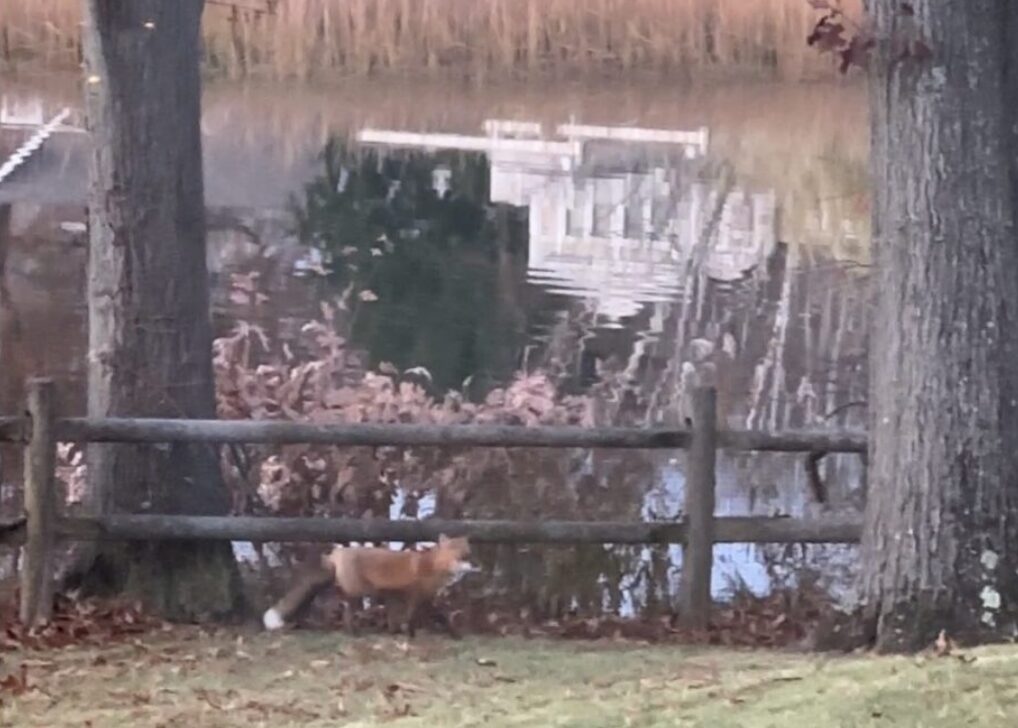
Screen shot of fox at 22 Shoal Point Lane prior to tree removal in video submitted as part of public comment.

Screen shot of 22 Shoal Point Lane prior to tree removal from drone video submitted as part of public comment.
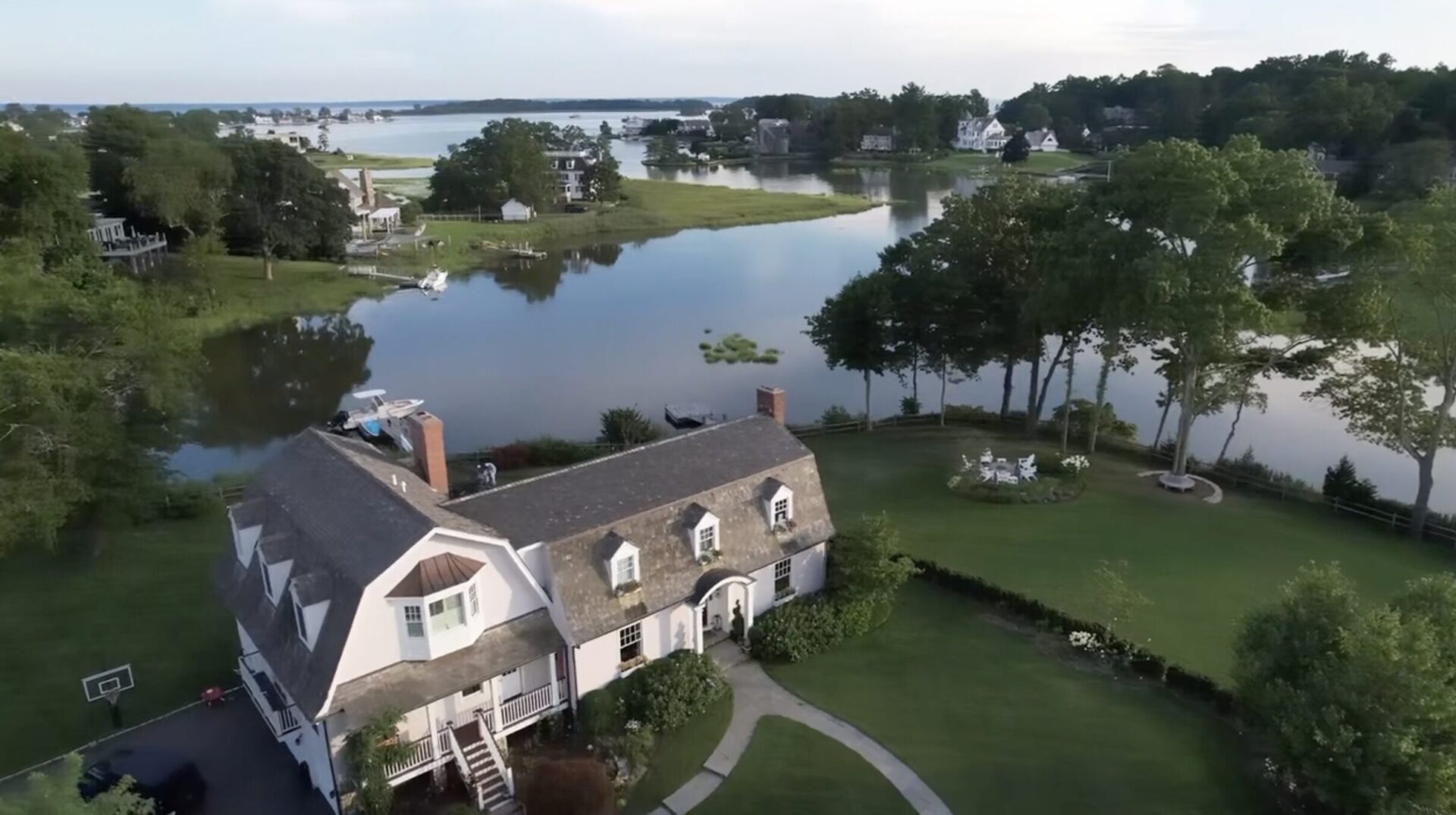
Screen shot of 22 Shoal Point Lane prior to tree removal from drone video submitted as part of public comment.

Screen shot of 22 Shoal Point Lane prior to tree removal from drone video submitted as part of public comment.
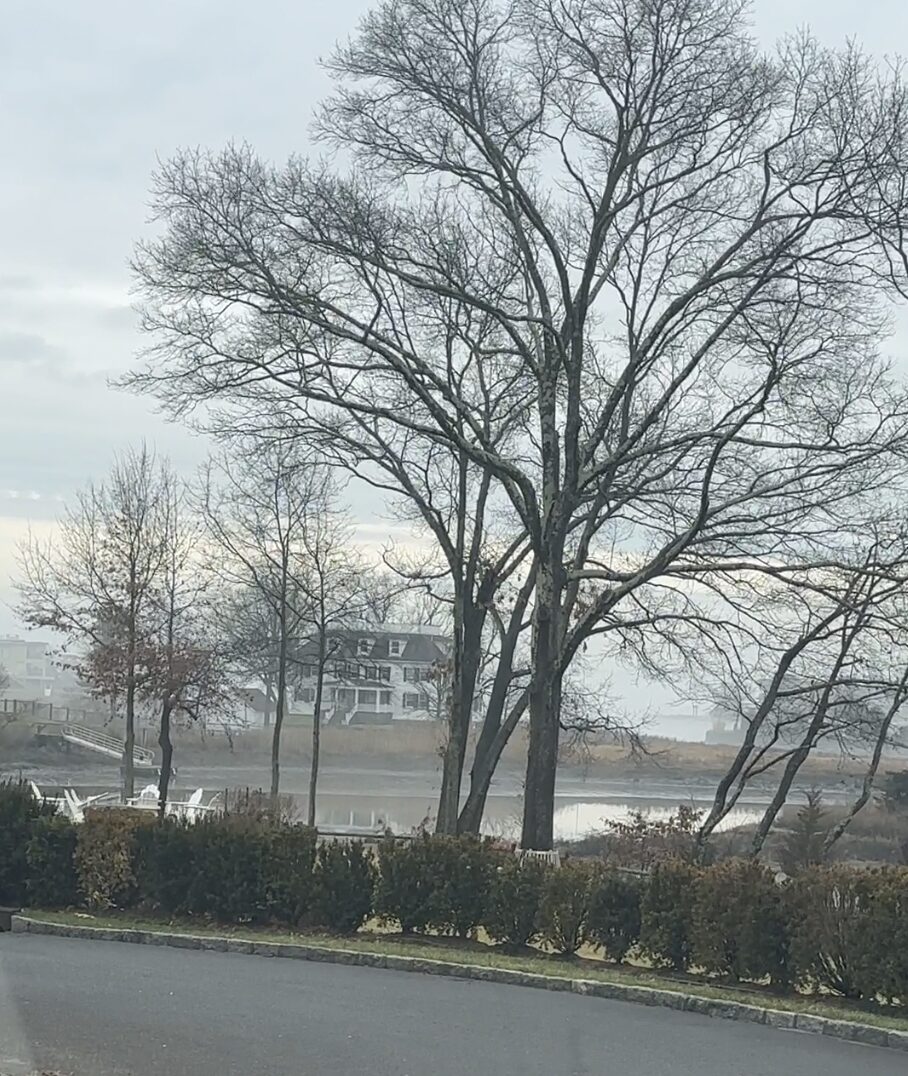
Screen shot of 22 Shoal Point Lane prior to tree removal from drone video submitted as part of public comment.