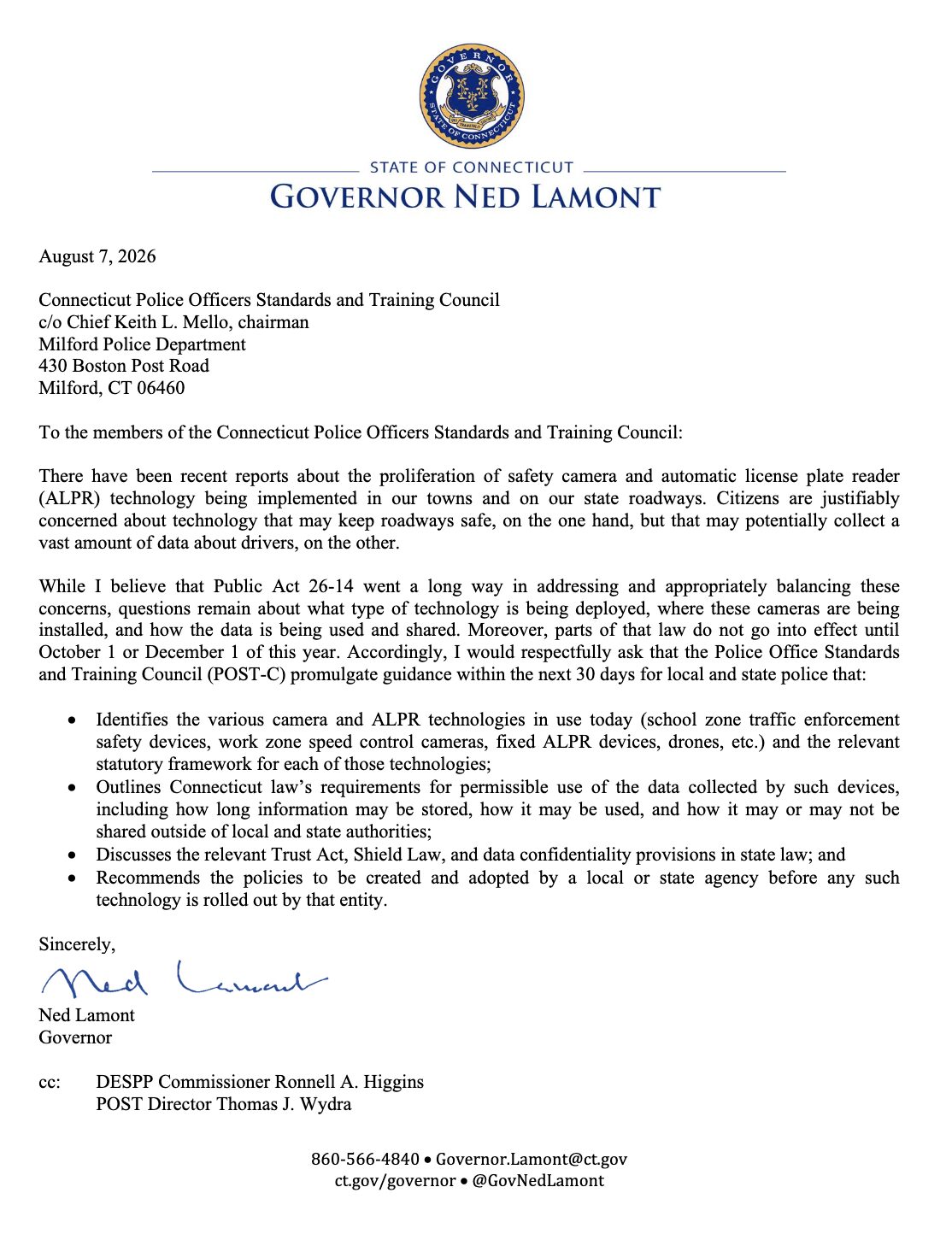
On Friday, Governor Ned Lamont announced that he was calling on the Connecticut Police Officers Standards and Training Council to conduct a review of the increased use of safety cameras and automated license plate reader (ALPR) technology by municipalities across the state, saying that many of the state’s residents are justifiably concerned about the privacy issues that can result from the use of this public safety technology.
In a letter delivered Friday, the governor requested that the council within the next 30 days develop guidance for local and state police departments that, among other things, outlines privacy provisions in existing Connecticut state statutes and recommends specific policies that should be adopted before any police departments implement such technology.
Governor Lamont urged all municipalities in Connecticut to immediately pause the installation of any new cameras and ALPRs until the council has finalized this guidance.
“I am in agreement with the many residents across Connecticut who are seeing this technology being implemented by their towns and are wondering what types of privacy protections are being implemented for ordinary people who are just going about their lives,” Governor Lamont said. “I understand that this equipment is intended to keep our towns and roads safe—and that’s a good thing—but we must have clear policies in place regarding what is happening with this data, who has access to it, and how it can be used.”
Specifically, the governor is requesting this guidance to:
- Identify the various camera and ALPR technologies in use today (school zone traffic enforcement safety devices, work zone speed control cameras, fixed ALPR devices, drones, etc.) and the relevant statutory framework for each of those technologies;
- Outline Connecticut law’s requirements for permissible use of the data collected by such devices, including how long information may be stored, how it may be used, and how it may or may not be shared outside of local and state authorities;
- Discuss the relevant Trust Act, Shield Law, and data confidentiality provisions in state law; and
- Recommend the policies to be created and adopted by a local or state agency before any such technology is rolled out by that entity.
In May, Governor Lamont signed legislation (Public Act 26-14) that included provisions intended to clarify some of these privacy concerns in state statutes.
However, he agreed that more needs to be done to strengthen these protections.