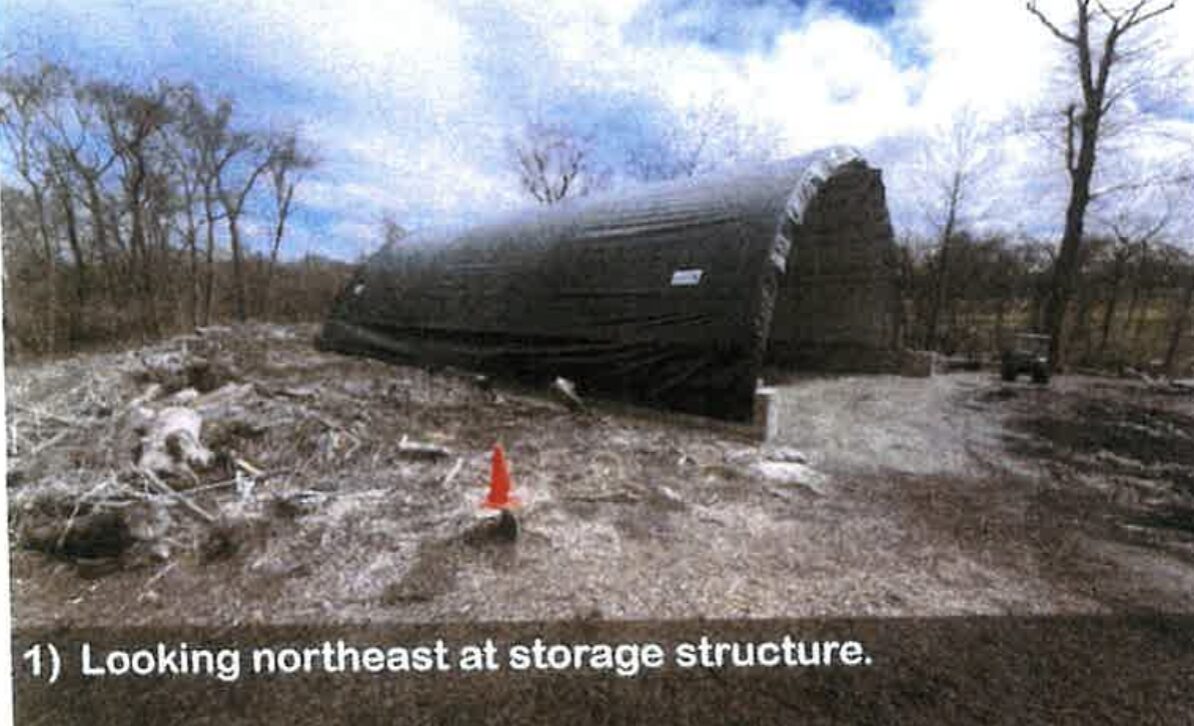
Burning Tree Country Club, represented by attorney John Tesei and engineer Tony D’Andrea, presented a pre-application to the Greenwich Planning & Zoning commission on Tuesday seeking comments on a permanent structure covered with fabric for storage of seasonal maintenance equipment.
The 45 x 62 ft fabric covered structure was already erected and a neighbor complained.
The club is on a 120 acre property on Perkins Road in the RA2 zone.
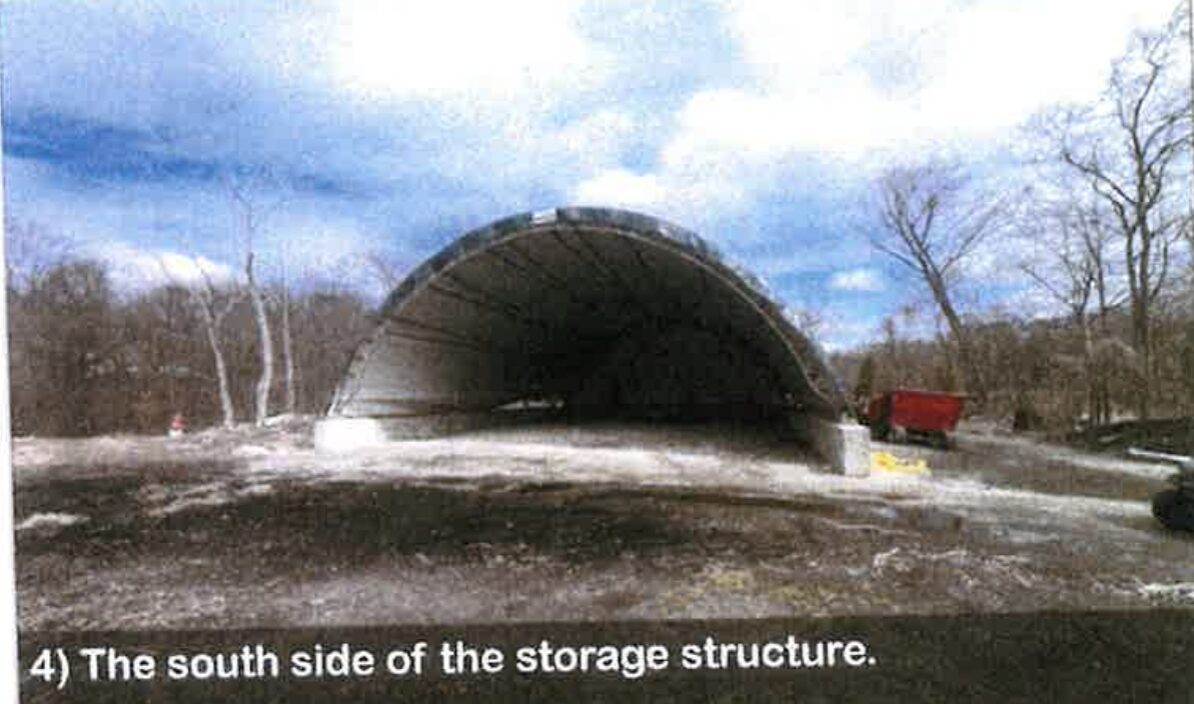
The structure is open at one end and the floor is maintained as earth.
At the outset, commissioner Nick Macri asked Mr. Tesei and Mr. D’Andrea if the structure had already been installed.
Tesei said the superintendent at the country club had installed what he viewed as a temporary structure not realizing a permit was required.
“I think there was a complaint. As a result of that, the fabric was removed from the skeleton,” Tesei said, adding that Mr. D’andrea was then hired to work with town departments.
Mr. Macri asked if the foundation, frame, and fabric cover had already been installed.
Tesei said he was not certain as to whether the structure had a foundation.
Mr. D’Andrea said, “John (Tesei) and I got a call with a complaint that there was a structure up there…At that time there was a foundation in the form of jumbo concrete blocks. On top is a metal framework made out of pipes. This is a manufactured structure – there is a fabric covering. At the time, the fabric was new and had a bit of a sheen to it. It was noticed, rightfully so, by a neighbor on Perkins Road.”
D’Andrea said the structure had been disassembled and only the concrete blocks remained.
He said an application to the Wetlands Agency had been the first step.
“For those of you who have played golf at Burning Tree as you leave the 11th hole you climb a hill toward the 12th tee, which is elevated. You probably wouldn’t have noticed it,” he continued, adding that the area has been used since the course was constructed in 1968 as a staging and stockpile area for piles of mulch. He said branches are put through wood chippers there.
He described the club’s main maintenance building is “constrained” and said the proposal was to take the winter machinery – plows, vehicles, shovels – and place them in the fabric covered structure in summer.
D’Andrea said no fuel would be stored in the structure. He said periodically an outside contractor is hired to bring in a wood chipper, though staff do some of that work themselves.
Asked about access D’Andrea said the storage area was accessible via a paved cart path that runs around the entire golf course.
“It is not sufficient to carry a 14-wheeler dump truck. These are small vehicles, golf carts and small machines, he said.
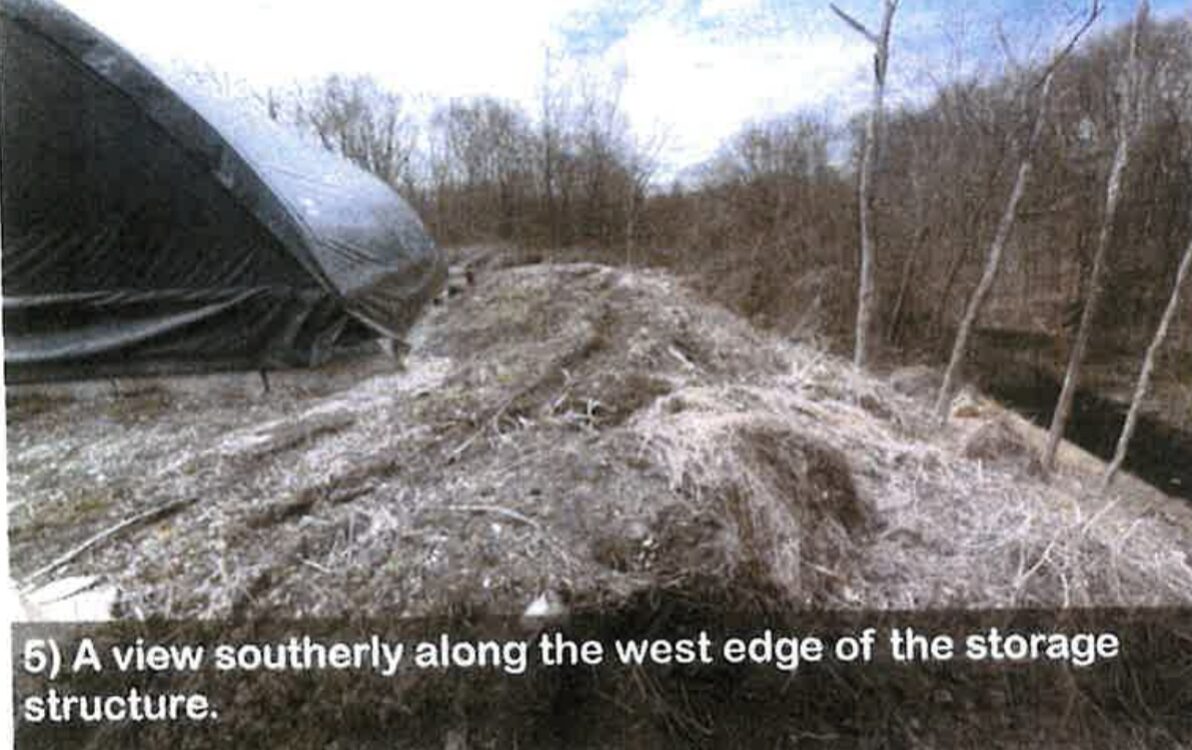
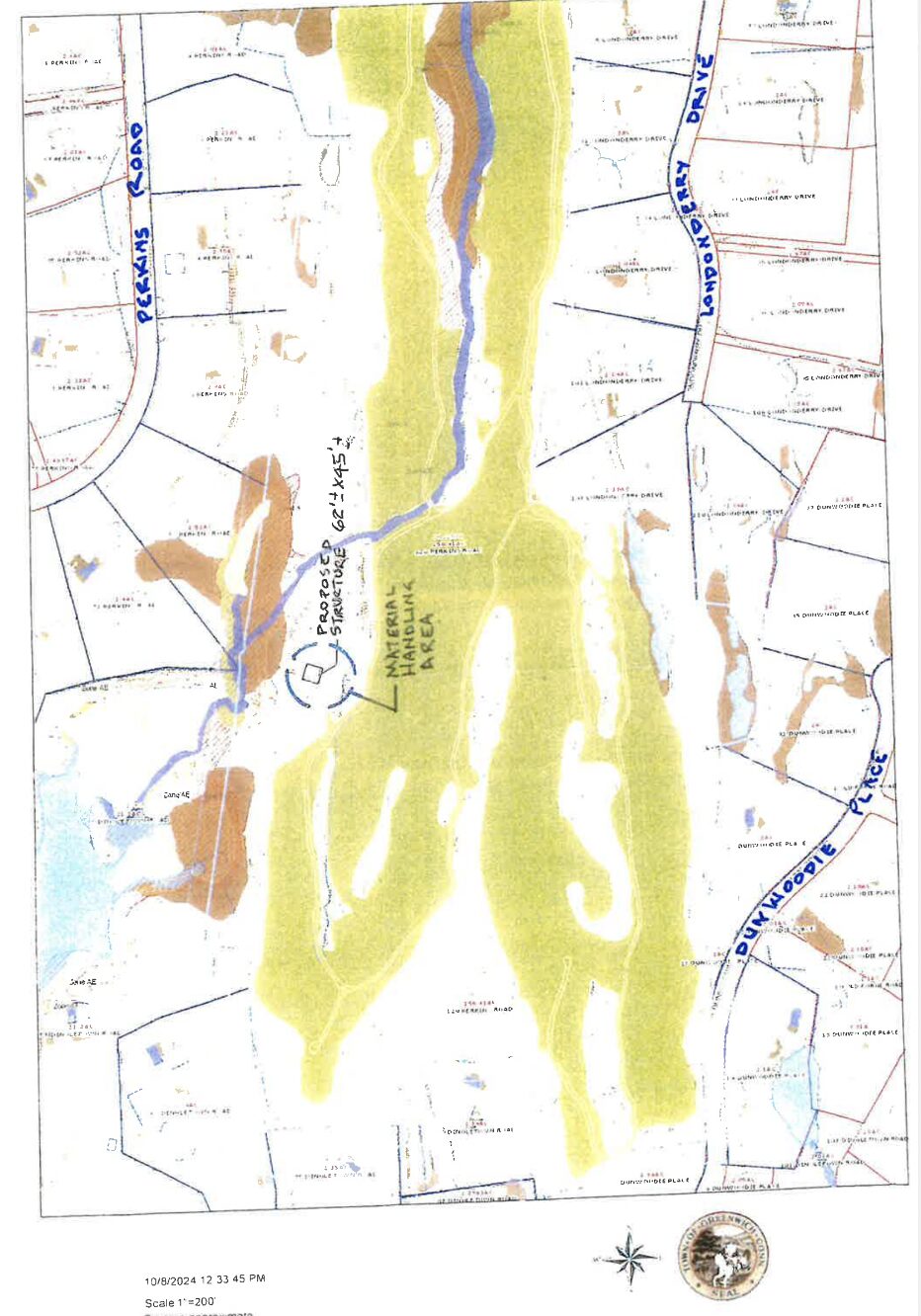
A condition of the Wetlands Agency approval was for the applicant to install a delineating border, including boulders along the northerly edge of the storage area that would also prevent expansion of the work area in that direction.
A staggered pattern of Green Giant arbor vitae would be planted at the top of the steep slope that descends to a watercourse at the west side of the storage area.
D’Andrea said arbor vitae were fast growing and would screen the view of the structure from properties to the west on Perkins Road.
Rain Garden to Treat the Runoff
A rain garden along the east would continue the delineating features.
“In order to address the water quality of the runoff from the area, we proposed a rain garden on the eastern side before it drops down over a significant ledge formation,” D’Andrea said.
“Volume is not an issue. Water quality is.”
Mr. D’Andrea said the applicant obtained a wetlands permit to construct the rain garden “to intercept, filter the water, and let it percolate down through the porous material, which is years of wood chips.”
Pickleball
Following up on comment made at the previous day’s staff briefing about a prohibition of pickleball at private clubs, P&Z commission chair Margarita Alban said she wanted all previous approvals checked because she recalled the issue of pickleball had come up in the past.
Mr. Tesei said there was no condition that would prohibit pickleball.
“That tennis court was used for pickleball before that application went in for the dome. When pickleball is in the dome, you don’t hear it. The outside use of the tennis court for pickleball was before that time.”
He said the club got permission for that court in 2016, which predated the demand for pickleball.
Tesei said the golf course superintendent Steve Wickstrom recommended the fabric covered structure because of limited capacity of the main maintenance building.
Tesei said it would not be heavily trafficked as will mainly be used for storage during the off season.
The main maintenance facility near the entrance at Interlaken Drive is in active use.
“The maintenance facility is fairly large but it is cumbersome during the season because there is more activity going on to maintain the course,” he said.
Commissioner Peter Lowe said all golf courses seem to be under pressure to upgrade their facilities.
“The golf course was built on a swamp, or former swamp,” commissioner Peter Lowe said. “Is it safe to say the use of this area does not represent an expansion of the maintenance and machinery?”
Tesei said the facility would not be for active use and that there are fewer employees in the winter and the fabric would come off in the winter.
Commissioner Dennis Yeskey asked if small trucks designed for winter maintenance would be stored in the fabric covered structure.
Mr. D’Andrea referred to “small John Deere type little dump trucks” that could be stored there.
“There is no water or power to this area. It’s just a former compost pile that is now flat…” he said.
Noise
Mr. Yeskey said the bigger issue was noise, and that construction at the club had gone on for years.
“First the golf course was totally redone. Then you put in an irrigation system that seemed to go for ever. Now you’re doing a pool.”
Yeskey addressed the pickleball issue.
A bubble was previously approved for seasonal use with the condition that the bubble is not to be used past 10:00pm.
“It’s a tennis bubble, right?” Yeskey asked.
“It’s a bubble. It covers the tennis court,” Tesei said.
“No, it’s a tennis court bubble. Tennis. There is no referring to pickleball…They are two radically different sports,” Yeskey said.
“Inside that bubble I doubt you can hear the pickleball players playing in that dome,” Tesei said.
Yeskey said at the time of the 2016 approval pickleball did not exist.
“This is an approval for a tennis court. That means a tennis sport and not pickleball. It’s radically different. We’ve had a series of these applications around town, and we’ve told clubs, no pickleball. …You’re changing the sport used in those. It isn’t just a bubble. There is a separate tennis court in the pool complex where pickleball is being played, and it’s outdoors.”
Yeskey said Burning Tree Club had always been a great neighbor. But, he said, “Over the last five years it just keeps imposing on the neighborhood noise levels and construction that I don’t think the management is sensitive to.”
“The storage, I get, and we can condition that, but pickleball I do not get. It doesn’t belong here in the neighborhood,” Yeskey said. “I don’t believe the tennis documents you show cover pickleball, period.”
Ms Alban said she wanted to review the timing of all the club’s decision letters.
Commissioner Anne Noel Jones asked if the fabric covered structure was only to be covered in the summer.
Mr. D’andrea said there was a cost to taking down the structure every year.
“Mr. Tesei represented it was coming down every year,” Alban said. “Mr. Tesei was very clear with us.”
“I did say that,” Tesei said.
Addressing Mr. D’Andrea, Alban said, “You are talking about a permanent structure that is going to be used seasonally, but it will be a hassle to take it down.”
Jones asked if lawn mowers would be stored in the winter and whether that might include gas and oil. Conversely, in the summer she asked if it would be used to store snow plows, salt and sand.
D’Andrea said he would come up with exactly what the club intended to store.
“We know now to provide a more detailed summary of what, when, and where,” D’Andrea said.
“Why don’t they just build something? Why build a tent that’s going to have a short life and have to be replaced. I’d think that would be nicer, but it’s your call,” Alban said.
“I assume that if wetlands is requiring screening and a neighbor complains about the structure, it is because they were able to see it. And if they were able to see it, you might want to consider additional screening before you come to us,” Alban added.
Alban requested Mr. LaRow provide a history of both Zoning Board of Appeals and Planning & Zoning approvals for the club because of the issue with pickleball.