Greenwich United Way recently held three comprehensive Deep Dive Reports following a sequence of roundtable discussions at Town Hall.
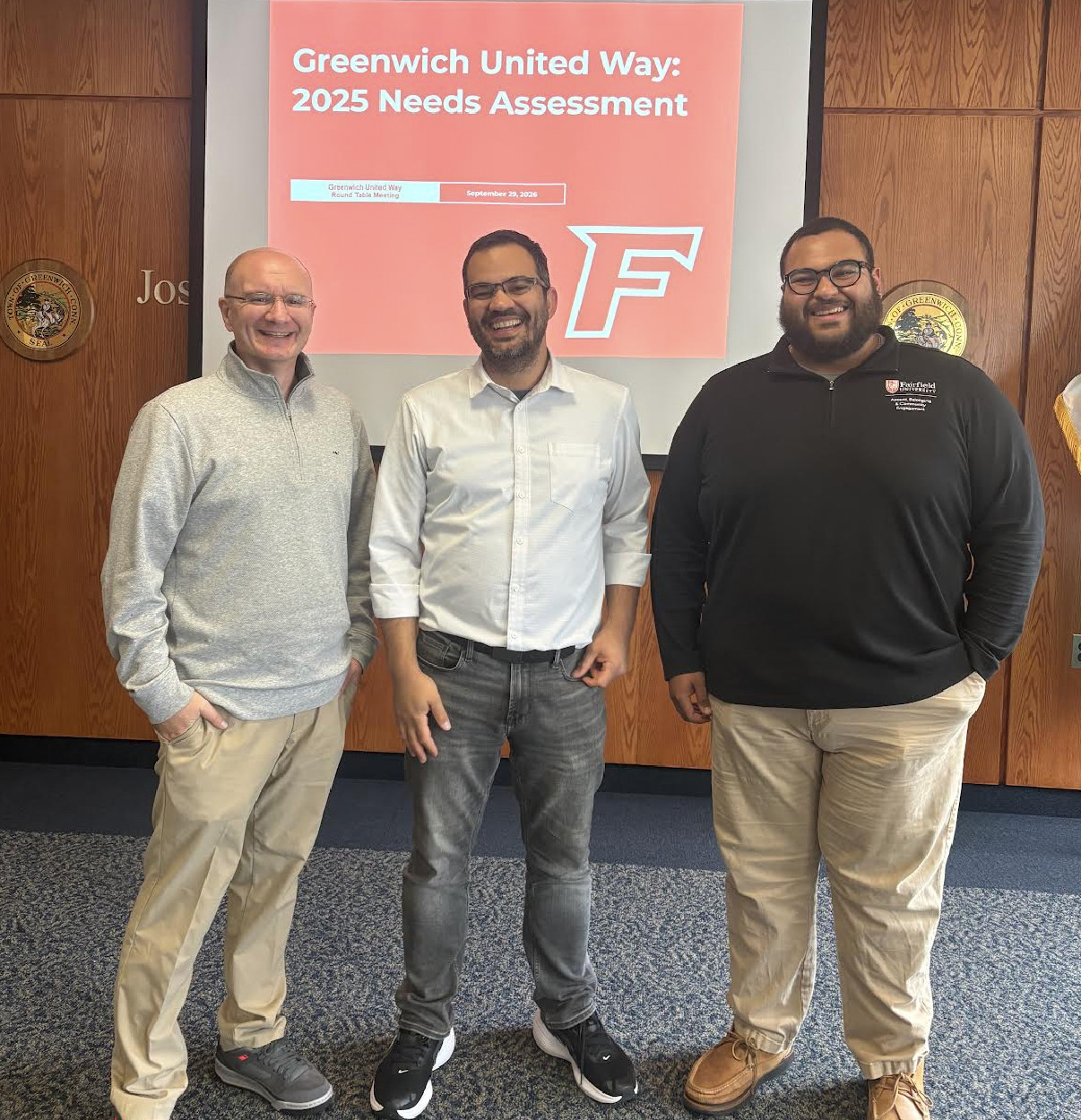
Jeremy Nappi (Senior VP of Advancement & Operations), Mehmet Cansoy (Associate Professor at Fairfield University), and Reinaldo Gonzalez (Associate Director at Fairfield University).
Conducted in conjunction with the 2025 Needs Assessment, these reports provide a data-driven look into the town’s most pressing human services challenges: housing affordability, mental health, and early childhood education.
These areas first emerged as critical needs in the 2020 Needs Assessment and have continued to be identified as important by stakeholders and residents through ongoing engagement.
“There is a common misconception that a community as affluent as Greenwich is immune to these kinds of hardships,” said David Rabin, CEO of Greenwich United Way in a release. “But these Deep Dive reports show that the escalating costs of housing and childcare, combined with a stark rise in mental health needs, are creating a real crisis for our neighbors. This data isn’t just numbers on a page—it’s a reflection of the daily financial and emotional strains that local families are navigating right now.”
Housing affordability remains one of the most persistent barriers in the community. Long-term residents noted that under current economic conditions, they would no longer be able to afford to move into Greenwich. Meanwhile, newer residents unanimously reported that housing costs are the largest and most burdensome strain on their household budgets.
Mental health and substance use rated exceptionally high as community priorities, with nearly one in six community members identifying substance use as a critical concern.
Participants emphasized an urgent shortage of autism spectrum-related services.
Interestingly, higher-income demographics were more likely to flag mental health as an unmet need, a trend researchers suggest may reflect higher mental health literacy and diagnostic awareness in those neighborhoods.
Across all socioeconomic strata, respondents universally agreed that the cost of early childhood programs is a primary strain on families.
While the quality of Greenwich’s early childhood education remains highly rated, parents and caregivers cited childcare as a staggering expense alongside housing, transportation, and groceries.
The Greenwich United Way Needs Assessment is an extensive, five-year community-wide evaluation of local human service demands and assets. By equipping non-profits and the public with this data, the organization aims to fuel measurable, impactful action for the public good.
The full 2025 Needs Assessment is available to read: https://greenwichunitedway.