Part 1 in a series by James Bonney about the Greenwich High School music program
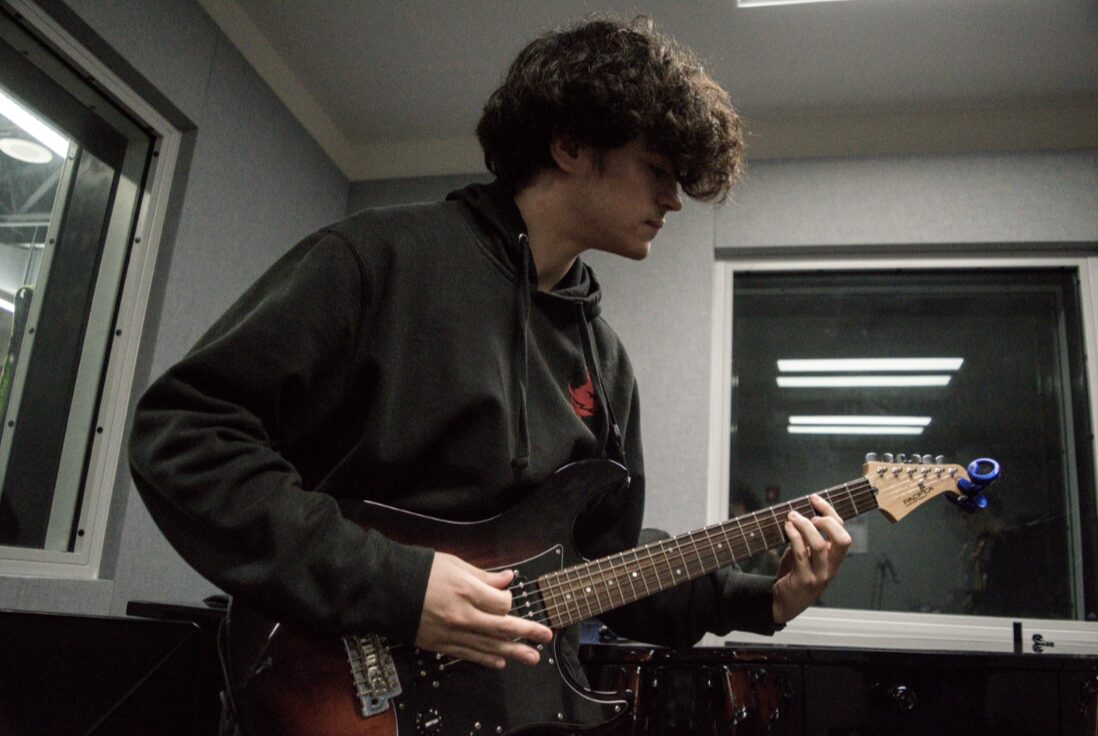
Students rehearse together during a music class, practicing their instruments as part of the modern band program. Jan 4, 2026. Photo: James Bonney
In Greenwich High School’s music classrooms, teachers say the work extends beyond learning notes, rhythms, and repertoire. Across band, orchestra, choir, and music production, students are expected to prepare independently, listen to one another closely, and take responsibility for outcomes that depend on the entire group.
Those expectations are built into the structure of ensemble-based classes, where progress happens collectively and mistakes are shared. Teachers interviewed described a consistent emphasis on accountability, preparation, and ownership — habits they say are reinforced daily through rehearsal routines rather than taught as abstract lessons.
Last spring, those habits appeared outside the classroom.
When band director Michael Breaux learned his position at Greenwich High School would not continue, students organized independently to advocate for the program and for him to remain.
Mr. Breaux said he did not direct or participate in the effort. Students coordinated through peer networks, gathered written statements about the program’s impact, and attended a Board of Education meeting together.
The response, teachers said, reflected behaviors they routinely ask students to practice in class.
Teaching responsibility through ensemble work
In large ensembles, teachers explained, individual accountability is inseparable from group success. A missed entrance or unprepared part affects everyone.
“It’s one of the few classes where everybody has to do the right thing at the right time at the same time,” said Jason Polise, who teaches modern band, electronic music, jazz ensemble, band, and guitar. “If one person changes the way they play, everybody else has to adapt.”
That structure, Polise said, creates a setting where students quickly learn that preparation is not optional. In rehearsal, students are expected to arrive ready, listen actively, and adjust in real time.
Bethany Fuscaldo, the orchestra director, described orchestra classes as environments where responsibility to the group is central.
“We’re only as good as we are as our weakest link,” Fuscaldo said. “So how do we get everybody to feel comfortable and perform at their best?”
Fuscaldo said that means teaching students to meet deadlines, submit work they are proud of, and pay attention to small details, because in ensemble playing, small decisions affect the overall sound.
Michael Breaux, who directs band, described similar expectations. He said rehearsal is not only about reading music correctly, but about listening, evaluating, and responding.
“What are we hearing?” Breaux said. “Is it in tune? Is it in balance? Is it blended?”
Breaux said students are taught to compare their sound to recordings and to identify what needs adjustment. Over time, he said, that process encourages students to take ownership of their role within the group rather than waiting for instructions.
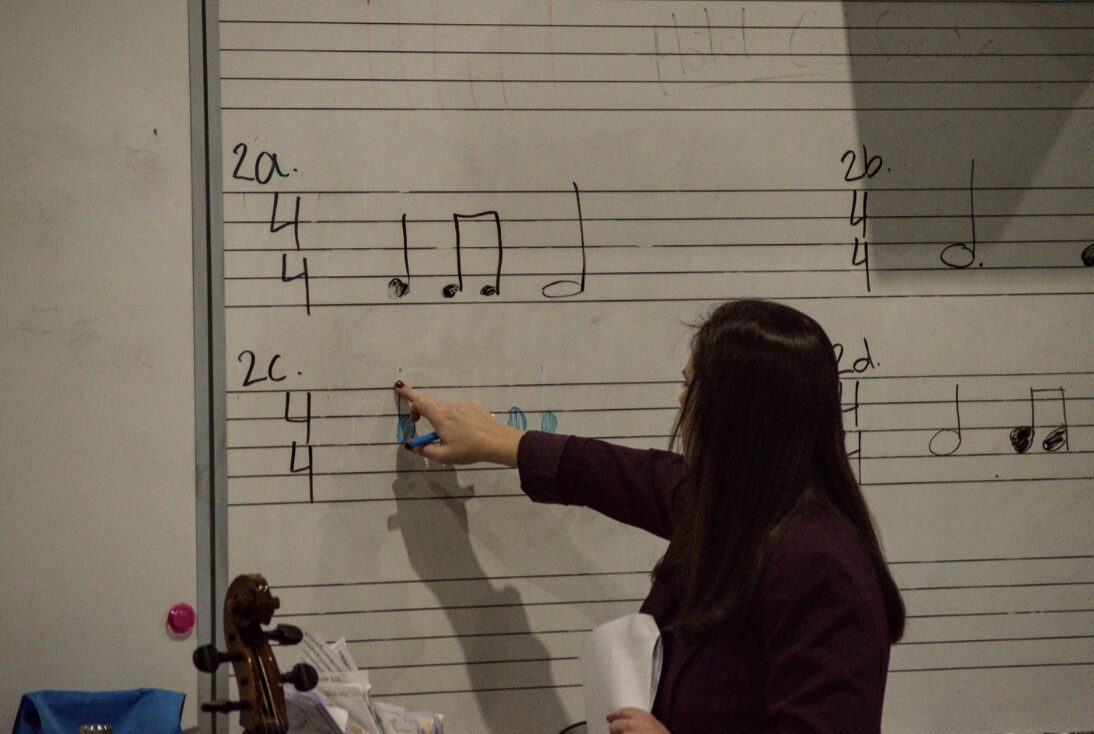
A lesson on Music Theory to deepen the students understanding of the song they are learning. Jan 4, 2026. Photo: James Bonney
Building intrinsic motivation
Several teachers emphasized that while expectations are clearly defined, motivation ultimately must come from students themselves.
Breaux said his approach is shaped by the idea that teachers can create conditions for growth, but students must decide to engage.
“I try to be honest, motivating, and demanding,” he said. “But ultimately, students have to find intrinsic motivation.”
Luke Rosenberg, director of choral music, said choir rehearsals require students to balance individual expression with collective responsibility. He said students are taught to modify their sound to blend while still valuing their own voices.
“The way you sing in an ensemble is not the way you sing as a soloist,” Rosenberg said. “But I’m never trying to change your individual sound.”
Rosenberg also said he emphasizes understanding the cultural and historical context of the music students perform, describing that awareness as part of respecting the work and the people who created it.
“There are a lot of programs where students are just singing the notes,” he said. “We try to make sure they understand where the music comes from.”
Barbara Freedman, who teaches music production, said responsibility in her classes looks different but follows the same principle. Students create original work using digital tools, starting from nothing and building complete compositions.
“Creating something from nothing is daunting,” Freedman said. “But it’s also empowering.”
She said students are expected to manage their own projects, meet technical requirements, and refine their work overtime. The goal, she said, is for students to understand that effort and revision are part of producing something meaningful.
Michael Donovan, a senior who has been in band for four years, said the structure of music classes shaped how he approaches responsibility more broadly.
“We each have our own responsibilities as a musician to learn our parts,” Donovan said. “That sort of self-discipline carries into other parts of your life as well.”
Donovan described band as an hour in the day that operates differently from most academic classes, with an emphasis on shared goals and collaboration.
“It’s the hour you get to come in here and make music,” he said. “You get to do something as a community.”
When students learned Breaux’s position would not continue, Donovan said classmates organized on their own. He credited fellow students with coordinating the response, collecting written statements through a shared form, and organizing attendance at the Board of Education meeting.
“They really spent so much time to get everyone organized,” Donovan said. “We all sent in messages about how the program impacted us.”
Students attended the meeting together in concert attire and presented their message collectively.
Donovan said the decision to act came from a sense of responsibility rather than instruction.
“We couldn’t let it go,” he said.
Breaux said the experience stood out because students acted independently.
“To motivate young men and women to protect one of the educators they’ve spent four years with, that speaks volumes,” he said.
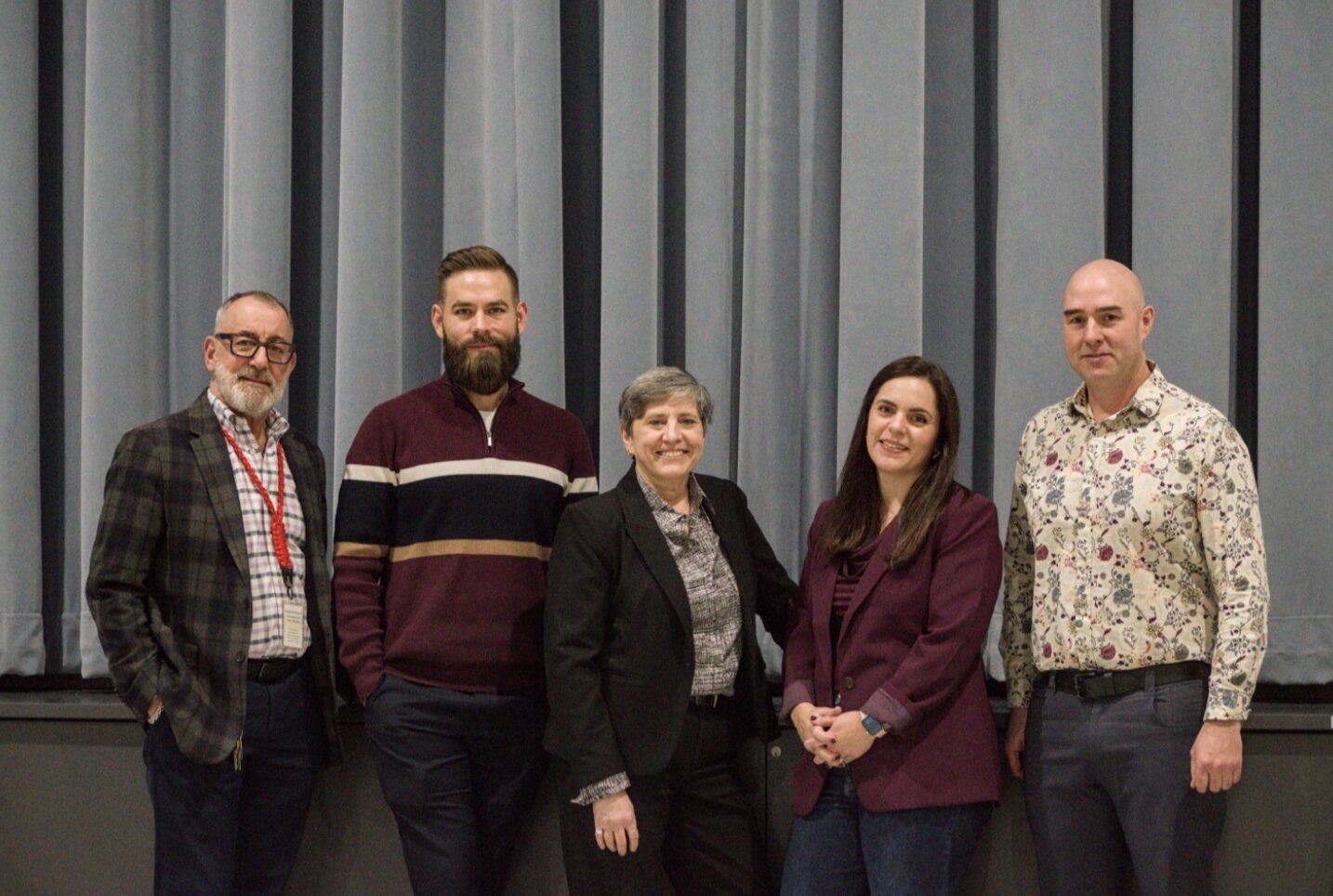
The Music Department teachers: Michael Breaux, Luke Rosenberg, Dr. Barbara Freedman, Bethany Fuscaldo, Jason Polise. Jan 8, 2026 Photo: James Bonney
Leadership as a learned practice
Teachers said leadership in music classes is often informal and shared. In ensembles, students lead by example, model preparation, and support peers during rehearsal.
Polise said in modern band settings, students regularly take turns leading rehearsals for specific songs.
“We’ll say, ‘You’re in charge of this one,’” Polise said. “And they guide the group.”
That structure, he said, allows students to practice leadership without formal titles.
Rosenberg said older students often serve as role models for younger singers, shaping rehearsal culture through attitude and consistency.
“Younger students are watching,” Rosenberg said. “They see what’s expected.”
Fuscaldo said the mix of grade levels in upper ensembles creates opportunities for peer learning, with students helping one another navigate technical and musical challenges.
“It’s not tracked by grade,” she said. “You get all walks of life in one room.”
Teachers across the department described the music program as a setting where students from different grades, backgrounds, and academic tracks work toward a common goal. They said the consistency of expectations across disciplines helps reinforce habits over time.
Freedman said the department’s shared emphasis on creativity and responsibility gives students room to take ownership.
“If you’re in my class, it’s my job to help you succeed,” she said. “But you also have to show up and do the work.”
Polise described the program as one that encourages students to find a place where they feel invested.
“They make friends, they collaborate, and they learn from each other,” he said.
For teachers, the student response last spring was not framed as an outcome they expected or directed. Instead, they described it as an example of students applying familiar practices – preparation, coordination, and collective responsibility – in a different context.
“It’s the same skills,” Breaux said. “Just used somewhere else.”
See also:
Bring Back Breaux: A Plea from GHS Students
Jun 10, 2025
June 13, 2025