The League of Women Voters of Greenwich recently hosted a debate between town clerk candidates in the Nov 4, 2025 municipal election.
Incumbent Republican Town Clerk Jackie Budkins faced off against her Democratic challenger, Meghan McCreary. The debate was moderated by Hena Doba.
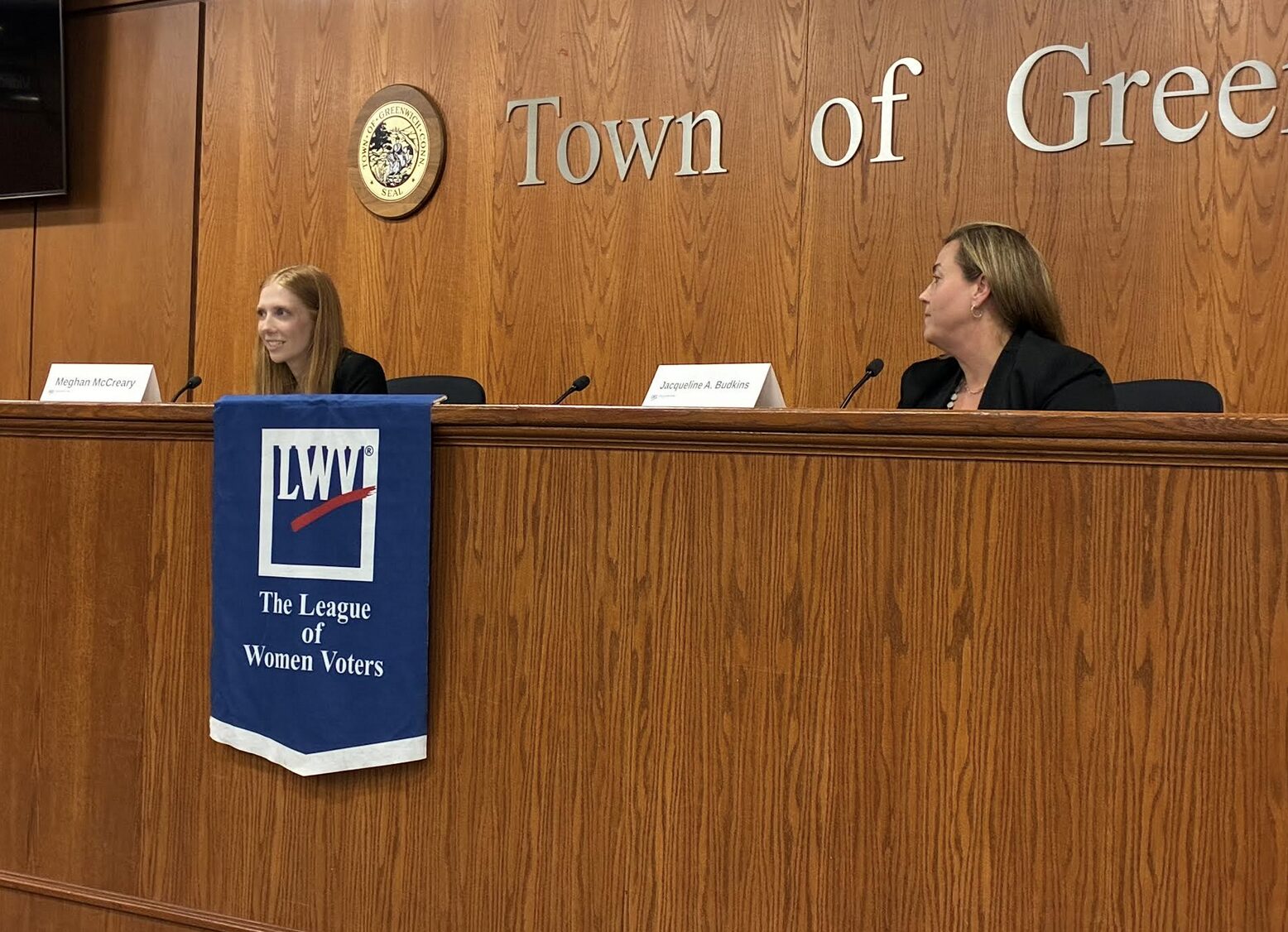
Democratic challenger Meghan McCreary and incumbent Republican Jackie Budkins debated at Greenwich Town Hall on Oct 7, 2025 Photo: Leslie Yager
Ms McCreary, originally from a small town in Missouri, has a bachelors degree in computer science and a decade of experience in software engineering.
Many know her for the website she built called 203.Vote to help increase transparency of RTM voting records.
Ms Budkins said she has 20 years of experience in real estate sales and has been a lifelong Greenwich resident.
“Over the past 3-1/2 years we have modernized the office while keeping service at center, launching online dog licensing, digitizing land records, creating a free property alert system and implementing mobile voting technology for the RTM,” Budkins said, adding that she had earned certification as a Connecticut Town Clerk.
Asked about preserving the town’s legal, historical and electoral records for, McCreary said, “I find when I’m working on 203 Vote, sometimes the records are incorrect. Many of the district pages ballots have misprinted names. Even the date of the write-in deadline for RTM does not take into account early voting this year, which is not correct,” she said. “Being detail oriented is important.”
Budkins said Greenwich’s deadline for write-in candidates is the day before election day, while the state deadline was October 6.
“We take great pride in digitizing all our records. We get a state grant every year, which we use to go back in time and preserve our land records,” Budkins said, adding that RTM web pages were managed by individual districts and committee members.
McCreary replied, “The districts do manage the top part, but they don’t manage the iframe that has the members listed.”
(Inline Frame or iframe, is an HTML element used to embed content from one website or source within another web page.)
“I also have section 9-373a here from CT General Statutes, and I understand there’s that carve out for for the RTM, but it was changed for early voting last year, which has not been accounted for. I’m not talking about Oct 6, I’m talking about Oct 17,” McCreary said.
Asked about use of artificial intelligence, Budkins said it offered some advantages, but was unable to comprehend certain things.
“If we can use it to help manage our messaging and perhaps get our minutes together, that would be helpful,” she said.
McCreary said screenreaders can’t read PDFs, but neither can AI scraping bots.
“So we need to get a lot of things off of siloed platforms that are under a Greenwich banner but are actually a third party website. We need to integrate our data so we can innovate in the future with AI, but so we are ADA accessible with our data and our information so that all resident can find information easily.”
Ms Budkins said third party vendors are required to be approved for certain items, per state statute.
“This would be something in conjunction with the state that every town clerk would have to work with and be the same across the board,” Budkins said.
Budkins said last year her office rolled out an electronic recording system whereby documents come from a trusted third party. They also rolled out online dog licensing.
“Next year we’ll be rolling out shellfish permits,” Budkins said, adding there were about 300 people in Greenwich who shellfish, and 3200 licensed dogs. “We are looking to put in credit card systems in our office.”
Budkins said land records were digitized going back to 1920, but the task is a challenge because original records are difficult to read and include maps.
McCreary said with state grants cut from $7500 to $7000 a year, it was important to “do more with less.”
“We definitely need to automate and focus on smart systems to make clearer workflows for everyone in town – not just automating for internal processes, and not just for staff, but for how we are providing services to residents,” McCreary said.
“I think minutes and agendas could be streamlined to make sure data isn’t replicated poorly across different minutes and agendas. We should use automation to streamline all of that so that volunteers don’t have to spend time on any of that.”
Budkins agreed the state grant had declined and the town only gets about 25¢ back for each dog license.
“I’ve worked well with the BET they have increased our budget for remote voting, cloud service and everything that comes with an RTM meetings – the tech crew, the TVs, microphones – it’s a full set up.”
Budkins said Historic Preservation Commission provides about $20,000 annually. “The large maps are what were focusing on.”
Ways the town clerk Might help the public make informed decisions about RTM races
“They can check out 203.vote,” McCreary said. “I’ve been told by the RTC leadership that they use 203.vote. I was told recently by a 93-year-old member that she uses 203.vote.”
“I’ve done it,” she said.
“We can be proactive about being transparent, and not reactive to putting things on the website, but how can people actually visualize the data and see the information about how people voted,” McCreary said.
Budkins said that task was not in her office’s purview.
“It doesn’t come under our command in our office to notify people of how (RTM members) have voted,” Budkins said. “It would be hard for us to do something like that.”
RTM Attendance Records
The moderator asked whether the town clerk should post the attendance records of RTM members and whether they attend in person or online.
McCreary said that information was public record and it was included on her 203.vote website.
She said while there were people who oppose online voting at RTM, it was an important option for people with young children at home and people do struggle to get to an 8:00pm RTM meeting in person.
“That doesn’t mean they are a less active member of the RTM,” she added. “I think (attendance) should be posted online, and they are.”
Budkins said members do vote using the app when they are at RTM meetings in person.
“That’s why we started to take attendance,” she said.
Customer Service
McCreary said the town clerk’s office was referred to as the gateway to town hall and the staff were always friendly.
She added a suggestion. “One thing is making them not come in. If you don’t have to drive over here, you’ll be a lot happier dealing with us.”
She said the town clerk should take as much as possible off her staff’s plates so they’re not trying to do 10 things at once.
Budkins said her office was efficient, welcoming and responsible.
“This year I became a certified town clerk as did two of my staff,” she said. “It’s a three-year vigorous process with an examination at the end.”
“It keeps them professional and we learn new tools to manage for our customers. People love going online, but there are people who like to come in…They want to talk. They want a friendly face,” Budkins said. “That’s how I spend a good portion of my day.”
What services can be shifted online?
Budkins said many tasks had already migrated online, but some business including birth certificates and marriage licenses must to be conducted in person.
Still, she said the e-recording service had reduced trips to town hall by title searchers, title companies and mortgage companies, and had cut back on reliance on US mail.
McCreary said while some tasks can be done online, there are many that could be made more user friendly, like adding a scheduling tool to make an appointment time for a marriage license.
She said many town clerk responsibilities that went online were in required to do so by the state.
“The fishing license went online by the state. The absentee ballot request was required by the state,” McCreary said.
She talked about being proactive and testifying in Hartford to ask them to fix some of the processes in order to make it possible to automate more processes.
Budkins said there were times the state had failed after intending to take over and automate a process.
“The state wanted to handle dog licensing, but for us to solve the problems when someone loses their tag,” she said.
“The state wanted to take over localized land recordings. That went to the wayside because town clerks fought against the legislation. We have a lobbyist who goes for us.”
Budkins said other processes might potentially be handled by the state, but there were examples where it’s preferable to maintain control.
Opportunity for change
McCreary said it was important to be more proactive than reactive.
“I understand that when things pile up it’s hard to anticipate what problems will be and you don’t want to prematurely optimize a process but I think we’ve seen a few FOIA issues not go the town’s way. We’ve seen records not being published,” McCreary said. “Some of it can just be put online and you could find it and it can be easier to navigate so that residents can know how town hall works, know what’s going on, restore trust – even if they don’t have a friend in town hall or someone they can ask.”
She said when people start to involved in Greenwich, they find people to ask questions.
“When you’ve just moved here, it’s hard to find that first person to ask questions. Making sure everything is simple, online and with good visualizations so that it’s understandable and cohesive and concise.”
Budkins said she wished McCreary had come to her when she first moved to town.
“We have a great staff. They roll with the punches,” Budkins said. “You have to choose platforms that are easier not just for residents, but also for staff – and is it going to make their job easier, faster and more efficient.”
“We work with our IT department on a lot of those things. To put something new online is a whole process – it’s not just our office. It’s our office, it’s our research, it’s our cyber security team, it’s our IT dept, it’s the law dept, it’s the purchasing dept. It’s not a quick process.”
McCreary said with her background as a software engineer, there were creative ways to use existing platforms without having to necessarily go through a full cyber security review for an entirely new system.
“We can use free existing tools that we have. Excel can do a lot. You can do a lot in open public Excel that is locked,” McCreary said. “We can figure out ways to do it without having to involve purchasing.”
Budkins said the IT department oversees everything website-related.
“Everything you put up, you almost have to run by them for the most part,” she said. “If you want to use Excel spreadsheets, that’s good but you’re limited to what you can do with that.”
“Excel is what’s called Turing-complete,” McCreary said.”You can do any program in Excel. It’s widely powerful.”
McCreary said the IT director was seeking efficiencies and told the BET budget committee he was getting more requests than he could handle.
“Doing what I can do – absolutely secure and private –you have to make sure everything is done well and I’m an expert in that and I look forward to working with IT.”
Modernizing the town website
Budkins said she had made changes to the tow clerk web page. “That’s something were working on and I think there will be some nice changes to come.”
McCreary said there was a web version of ADA, and will be required when it becomes law in April.
“Even if it doesn’t necessarily look more modern on face value, making sure everything is compliant with those standards,” McCreary said.
She said the RTM districts and committees managing their web pages will require training once the ADA regulations go into effect.
“That could become a liability. They are not trained. Nor should they be. That’s just too much of a time commitment for our RTM members to be trained in what makes a website ADA accessible.”
Budkins said the IT department is responsible for the town clerk’s web page.
“The staff is not a web-based staff. They’re not IT. We’re the town clerk’s office.”
McCreary said many residents were volunteers and platforms should be created to make their time more meaningful.
Budkins said her office made life easier for residents by answering the phone, being present in person and being empathetic and having a well trained staff in customer service, as well as putting process online, such as dog licenses, property alerts and plan to do for shellfish permits and e-filing.
In closing McCreary said she loved Greenwich but believed that aspects of town government were “stagnating.”
“I want to bring us into a new era,” she said.
After someone in the audience laughed out loud, McCreary said, “I want more debate to happen and members of the other party who are their elected representative and here in District 1 not to laugh at them. I want that for Greenwich because I love this place and I can help.”
Budkins said her guiding principal as “ambassador of our town” was that every resident deserves responsive, respectful and respectful service.
“Under my leadership we have modernized the office while keeping it deeply people-focused. We’ve digitized land records, launched online dog licensing, introduced a free property alert system and brought mobile app based voting technology to the RTM. We work closely with state officials to stay ahead of changing election laws, ensuring every election is executed with integrity, accuracy and transparency.”
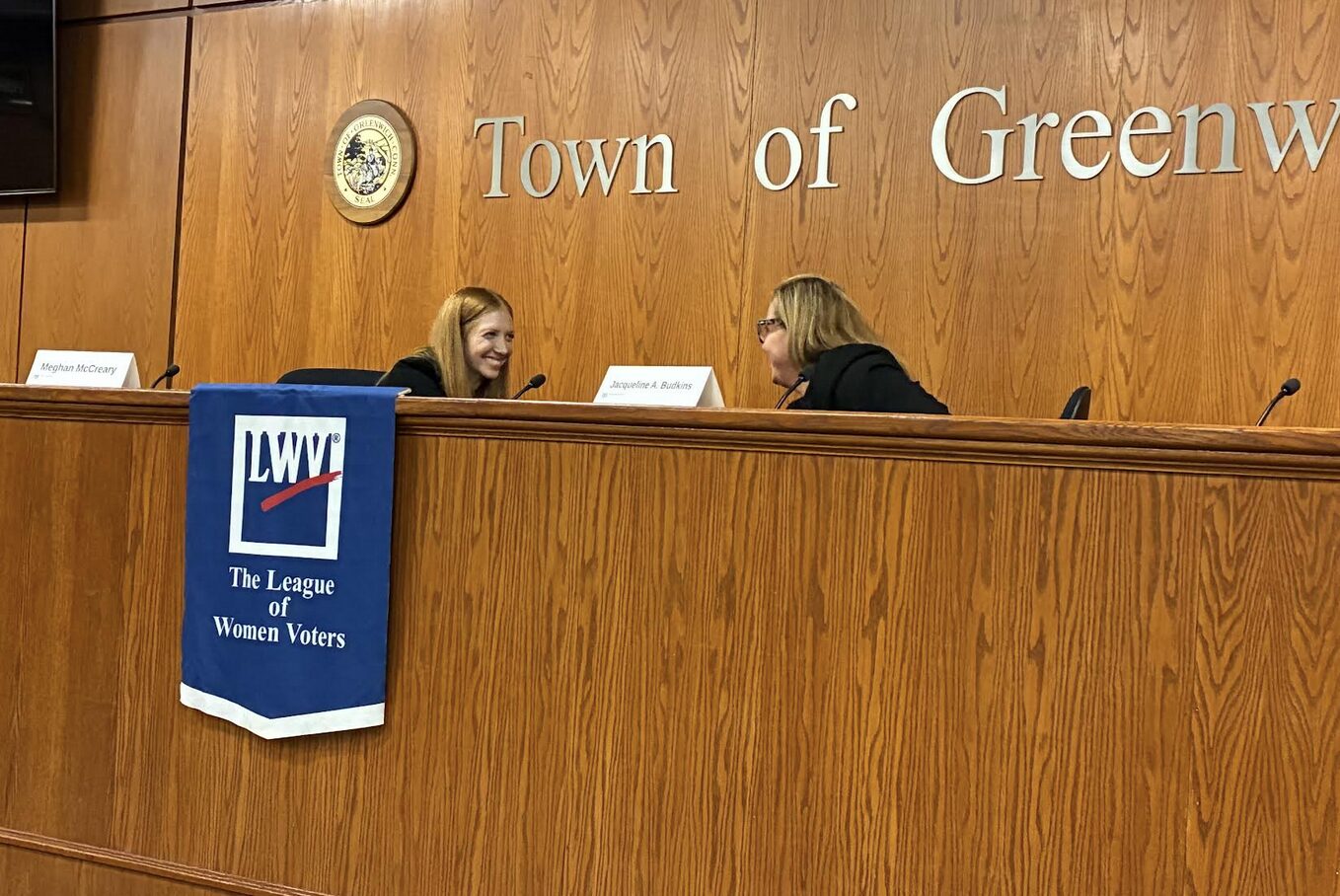
Democratic challenger Meghan McCreary and incumbent Republican Jackie Budkins debated at Greenwich Town Hall on Oct 7, 2025 Photo: Leslie Yager
See also:
Historic Greenwich Finance Board Debate: It’s Up to the People Now
Oct 11, 2025
Oct 9, 2025
Board of Education Debate Heats up Over Public Schools Budget
Oct 7, 2025
Selectmen Debate, Not So Contentious; More Like a Slow Boil
Sept 30, 2025