“I’ve often heard it stated that Connecticut’s coastal access is great if you already own a boat.”
– State Rep Roland Lemar (D-96) representing New Haven and East Haven“Officials from our Finance Department and Parks & Rec Dept got together and figured out a day pass and car pass (fee) that was in line with other communities,” Camillo added. “Since then we’ve been conforming with the decree. Lots of people come to Greenwich Point from out of town and no one seems to complain about the price.”
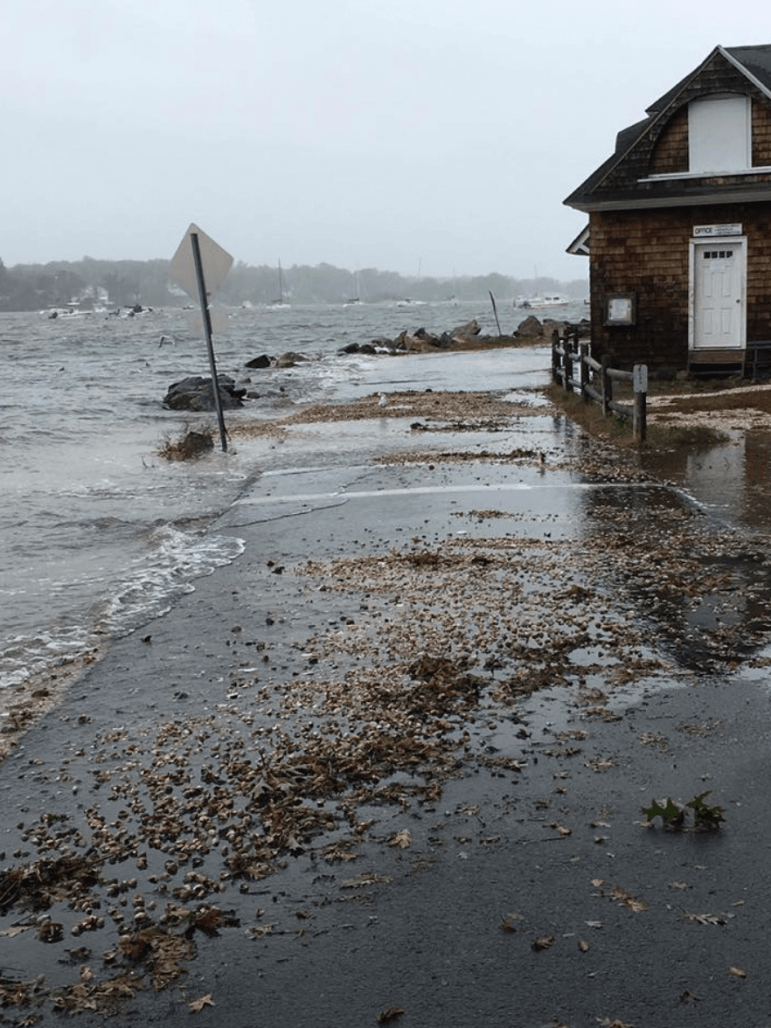
Lastly, Camillo said the town maintains its beaches, including paying for major work after natural disasters.
“I know a lot of my former colleagues (in the legislature) talk about ‘pay your fair share,’ and I agree. We want to make sure people who use our beaches pay their fair share too,” he continued, adding that paying 50% more than a resident wouldn’t come close to representing a fair share.
Like Camillo, Carl Fortuna, who has been First Selectman in Old Saybrook since 2011, said storms had damaged beaches in his coastal community, and his town funded capital projects entirely from capital reserves, taking no state or federal grants.
“The ability to charge a little more for non residents over residents, I think is an important factor in allowing towns to properly maintain their beaches for all residents,” Fortuna said.
In Old Saybrook a non-resident season pass good at Harveys Beach for one car is $150, and must be purchased at town hall, not at the beach.

State Rep Roland Lemar (D-96) who serves New Haven and East Haven, was a strong advocate for the bill. In fact, he championed a similar bill in 2021.
Lemar said he had the sense that Connecticut was “a distinct outlier” in how it provided for coastal access.
Mr. Kozak said many land use decisions along the Connecticut coast land were made 300 years ago.
“We’ve built things in places they shouldn’t be, and exclude people from accessing the coast for the types of uses only the coast can support,” he said. “Over the past two years I’ve observed some coastal municipalities employing practices that effectively raise the drawbridge to make access to town beaches increasingly difficult.”

Connecticut is a High Water State; Massachusetts and Maine are Low Water States
“I’ve often heard it stated that Connecticut’s coastal access is great if you already own a boat,” Rep Lemar said.
Kozak explained that Connecticut is a ‘high water state,’ which means the lands at or below the elevation of mean high water are held in trust by the state for all the people of Connecticut.
“So, property ownership only extends as far forward as mean high water, but the waters and lands below mean high water are owned by the state of Connecticut and held in public trust. And the state has an obligation to protect those lands and provide access to them.”
Kozak said states including Massachusetts and Maine were “low water” states.
“The private owner owns their property down further shore-ward to the low water mark,” he said. “In that respect, we’re winners. However, many other states have done a much better job in providing access to the water from the uplands.”
“You can walk along the shore up to mean high water in Connecticut, whereas if you’re traveling along the beach in Massachusetts you only have a legal right to go up to mean low water….How you get to the water in the first place is often the question.”
– David Kozak, formerly of DEEP’s Coastal Resource Management Program
Lemar said the state and federal government had invested hundreds of millions of dollars into improving water quaity in Long Island Sound, and into water treatment facilities, shoreline restorations, shoreline stabilizations, and repairing roads after hurricanes and other natural events.
“And then, often times communities will turn around and restrict parking access in and around that public access to just their community members, despite that we were all invested in it. Are there provisions in the state of Connecticut or under federal law that require communities, after receiving state and federal funding to provide access? Are these communities potentially in violation of some of those stipulations by not allowing the public to access?” he asked.
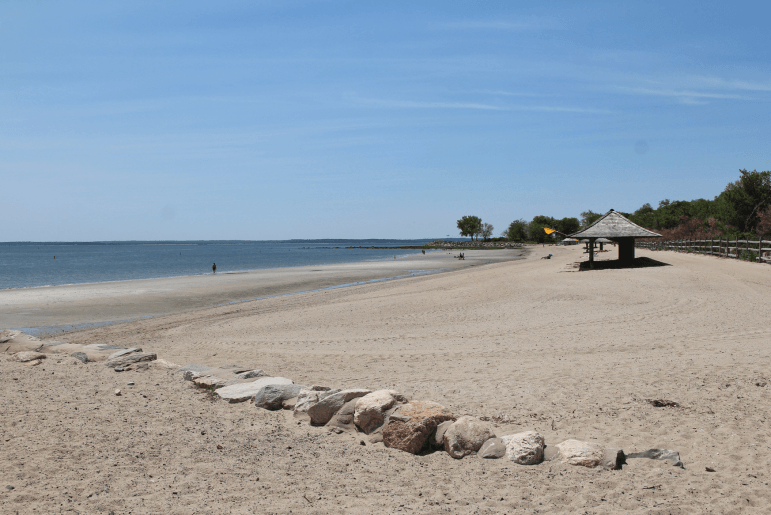
Kozak said grant recipients had contractual requirements that they make access to areas improved using public dollars on an equal footing, but some contracts were decades old.
“Sometimes municipalities are unaware of all the details in the contracts,” he continued. “It takes a lot of legwork to access those records and follow up and be in contact with towns to remind them of their obligations. I think it’s only going to get worse.”
Kozak said if models were correct, the amount of flooding experienced on coastal roads will be an order of magnitude greater in the next 10-20 years.
He doubted whether towns could afford to flood-proof their roads by themselves.
“They’re going to be coming to the state of Connecticut with their hands out for financing for help to flood proof these roads,” he said. “If the general public is paying for flood proofing municipal roads, and other members of the public outside those communities cannot use those roads to access the shoreline, there’s a real equity issue.”
Rep Michael Winkler (D-56) representing Vernon, asked, “No private landlord or town will have the right to tell me to get off their beach?”
“That’s correct,” Kozak said adding that there were some very minor exceptions, such as King’s land grants made back in colonial times, which are not subject to the public trust doctrine.
“We’ve heard earlier, ‘We dumped sand on our beach using our own money, so we’re not using state money,’ but your testimony is there is a lot of state money that goes into these beaches, for example water treatment plants.”
“Why would I, as an inland owner, want to support water quality in Long Island Sound if I can’t get there?” Kozak asked.
“We’re all paying to keep the Sound clean, yet it’s not equal access for all?” Lemar asked.
Kozak said he recalled at public hearings residents in the private beach association of Chalker Beach in Old Saybrook asking the town to put up a berm to prevent flooding on their roads.
“People in other parts of town said, ‘Why should I pay to reconstruct your roads and berms if I can’t come to your beach?’ Those issues I think will be coming to a head more and more,” Kozak said.
Brian Farnen, a Republican who was formerly the State Rep in District 132, said in Fairfield beach fees were the same for residents and non residents: $50 for weekends and $40 for weekdays, and non residents can buy season passes.
“Everyone is welcome to use the beach facilities. No one would ever be turned around,” Farnen said.
Lemar asked Farnen about his comment from an earlier hearing where he said it was only fair that the taxpayers contribute to the upkeep of beach pay a reduced rate.
“Tens of millions of tax payer dollars from Connecticut residents has gone into the upkeep of Fairfield beaches,” Lemar said. “The daily fee for a non Fairfield resident to go on a Sat or Sunday is $50. It’s $25 for the entire season for a Fairfield resident.”
“We had a First Selectman say their town never received any federal funding, but a quick Google search shows that town receiving state bonds, Clean Water Act funding, wastewater facility management upkeep, new pavilions – all paid for by state and federal dollars. I think sometimes it’s confused what the generosity of the state of Connecticut is and the upkeep of our beaches.”
“You said Fairfield was a model of equity,” Lemar said to Mr. Farnen. “But a Fairfield resident pays $25 for the entire season and a non resident pays $50 a day.”
Farnen said he’d prefer to discuss the issue from “an equity perspective.”
“At the end of the day, your typical Fairfield resident is getting a very small portion of the amount of money they send to Hartford – only a small portion is coming back. Our typical resident who is paying so much money in property takes to upkeep these beaches, then, yes they should get that benefit.”
Farnen added that anyone can come to the beaches without paying a dime. “They can Uber or taxi. People can carpool…And they do. There’s a great amount of diversity, and if you come to our beaches, you’ll see it.”
Lemar asked whether someone is paying propety taxes before they are considered a Fairfield resident, right?
“We have a lot of people we consider ‘six months and a day,’ right, who live in Florida or other places where there’s no income tax, but then will live here for those 5-1/2 months,” Farnen said. “Those individuals who are paying propety taxes do have to pay the non resident rate also.”
Renters, Farnen said, were considered residents.
“We all pay high property taxes in our local communities,” Lemar said. “What is it I’m allowed to bar you from in New Haven because I pay higher property taxes here? …Should I say you can’t walk on our sidewalks?”
“How do we determine what our property taxes pay for when the state is also kicking in so much toward the upkeep and development of those assets?” Lemar asked. “That’s where my frustration in this conversation stems from. And this idea that Fairfield is doing it right.”
“The reality is that a Fairfield resident can attend a beach that has received substantial state investment for half of what it would cost a non-resident to go for one day,” Lemar continued. “I don’t think that’s a definition of equity under any circumstance, even if you guys feel you’re not getting your fair share because of your high income taxes.”
“That’s a challenge I’m going to face when I look to craft legislation moving forward – is we have very different terms of what equity means,” Lemar said. “You express a desire to do things equitably. I’d hope we could have that conversation in a more constructive way than defensiveness, so for a rate that I don’t think anyone other than Fairfield residents – or maybe Greenwich and Westport residents too – think of as equitable. Particularly given the substantial state and federal dollars used for the upkeep of those beaches.”
On another note, Kozak said there was another part of the bill that would amend the Connecticut Coastal Management Act to make it easier for state and town regulators to require developers along the coast to provide public access in general, not just in municipal beaches. “Perhaps to public boat launches or bird observation areas, and varieties of other places where people want to access the coast but may be cut off from it, because development was not designed in a way to require developers to provide public access.”
“This amendment to the act would help the CT Coastal Management Act strengthen the tool that municipalities have to require developers to require that access,” he said, urging the legislature to include that part of the bill.
If the bill passes it would take effect July 1, 2022.
See also:
Dire Warnings Issued on Impact of “Transit Oriented Development” Bill 5429 in Fairfield County March 15, 2022
Bill Would Prohibit Greenwich from Charging More to Non Residents for Beach Access Feb 8, 2021