By Kaevel Sandhu, Greenwich High School class of 2028
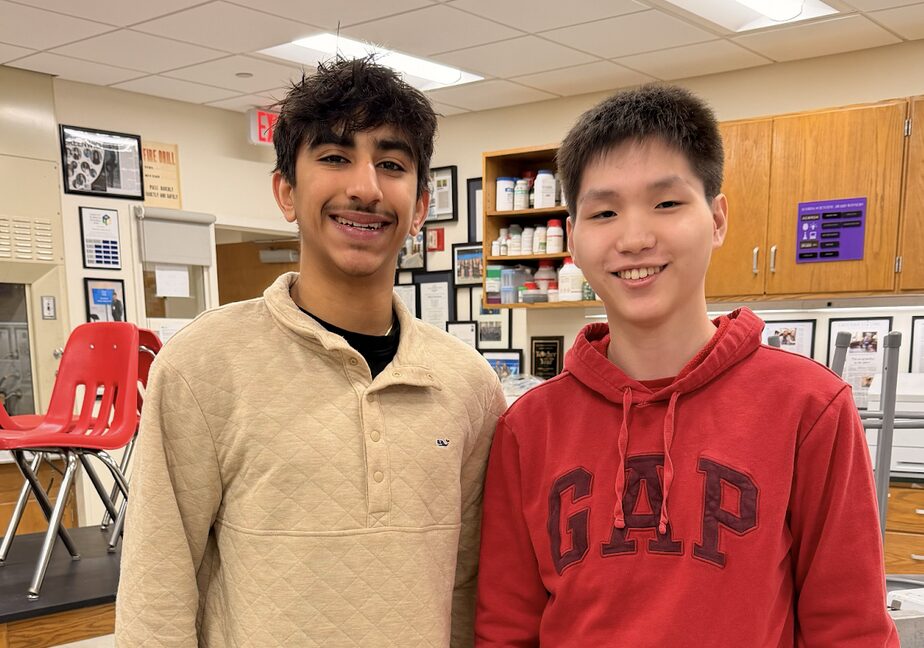
Greenwich High sophomore Kaevel Sandhu interviews Regeneron Scholar Henry Jin about his research on artificial intelligence and autonomous drones. Photo: Kaevel Sandhu
While most Greenwich High School students were asleep, Henry Jin was already hours into his workday.
At 3:00am, the GHS senior would wake up quietly, open his laptop, and begin testing lines of code of an artificial intelligence system which is designed to control autonomous drones. For the next few hours, before school even began, he would run simulations again and again, aiming to teach his AI machine how to navigate through the unpredictable physics of the real world.
That relentless routine helped Henry Jin earn recognition as a Top 300 Scholar in the Regeneron Science Talent Search. This being the nation’s most prestigious science competition for high school seniors.
But behind all recognition was months of persistence, experimentation, and failures.
Teaching AI to Navigate the Real World
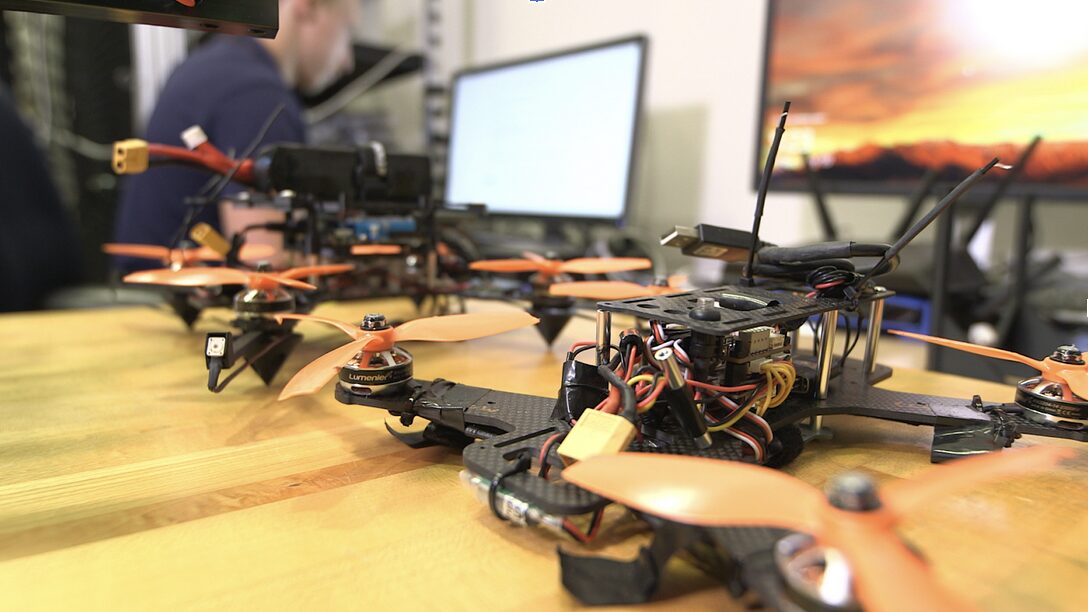
At its core, Jin’s project tackled a deceptively simple challenge: teach a drone to travel from point A to point B completely on its own.
No pilot. No remote control. Just artificial intelligence making decisions in real time while avoiding obstacles and adapting to its environment.
To train the system, Jin used a branch of artificial intelligence called reinforcement learning, where Jin explains how machines improve by learning from their mistakes.
“It’s basically like training a system to play a game,” Jin explained.
Inside a simulation, the drone’s AI attempts the task over and over again. If it successfully reaches its destination, it earns a reward. If it crashes, it receives a penalty.
“You gain points if you win, lose points if you crash,” Jin said.
Over thousands of attempts, the system gradually learns what works and what doesn’t.
But Jin quickly discovered a major obstacle known in robotics as the “sim-to-real gap.”
This being the fact that artificial intelligence can perform well inside simulations, where everything follows predictable rules and set patterns. But when this same system is placed in the real world, things completely change.
Wind shifts unexpectedly. Air pressure varies. Even these minor physical differences that seem insignificant can fully affect how a drone moves through the air.
“It’s like a chess engine memorizing the rules of chess,” Jin said. “If you suddenly change the rules, the engine becomes very bad because it’s never seen that situation before.”
Those small differences can cause AI systems to fail entirely.
Jin’s solution was not to make the simulation more perfect. It was to make the AI more adaptable.
During training, he intentionally changed the environment over and over again. Wind speeds increased. Conditions shifted. The drone had to constantly adjust.
“It starts easy and then it progressively gets harder,” Jin said.
By the end of Jin’s training, his simulated drone was able to navigate itself through winds of 60 mile-per-hour gusts.
The aim was simple: if the AI could handle these kinds of unpredictable simulations, it would be ready to be implemented in the real world.
That idea of training machines to handle uncertainty instead of the protection of a simulation had become the heart of Jin’s research and one of the reasons it stood out among thousands of submissions.
Learning from Failure
Ironically, this breakthrough came from a setback of frustration.
During his junior year, Jin attempted to move a simulation-trained drone model into the real world.
“It failed quite horribly,” he said.
The drone struggled to perform the same way it had inside the simulation.
Although, instead of abandoning the project, Jin used his failure as a starting point.
If the real world couldn’t match the simulation, he reasoned, then the AI needed to learn and adapt with the unexpected changes of the real world.
That one failure sparked insight and came back revamping the entire project. Eventually leading to the results that earned him recognition in the Regeneron competition.
The Schedule Behind the Science
Behind the research was a schedule that required serious discipline.
Jin began working on the project two weeks before the school year even started, maintaining the routine through the fall until his Regeneron submission in early November.
Most days began long before sunrise.
“I would wake up around 3:00am and work on research for about three hours,” Jin said.
After arriving at Greenwich High, he helped mentor middle school students in the school’s Junior Innovators program, guiding younger students through their own early research projects.
Next his seven-hour school day at GHS would begin, Jin’s schedule including tons of rigorous courses that he had to tackle through his day.
Whenever he had a free period during the school day, he returned to debugging code or refining simulations.
Then after school, the cycle repeated as Jin would first quickly complete his homework and then continue his research until 9:00 or 10:00pm.
“A lot of hours,” Jin said.
The Role of Greenwich High School
Jin credits how the Greenwich High School science research program played a vital role in his journey. Providing him all the support he needed.
He joined the Science Research Program as a freshman and began conducting independent research in his sophomore and junior years with the mentorship of science teacher Andy Bramante.
“Senior year was really the compound of everything I learned,” Jin said.
The program encourages experienced students to mentor younger researchers — something Jin now does through the Junior Innovators program.
In many ways, the environment at GHS helped turn curiosity into serious scientific exploration.
Looking Ahead
While the project began as a high school research experiment, its potential is limitless.
Autonomous drones could one day assist with tasks such as search and rescue missions, disaster response, environmental monitoring, or delivering supplies to difficult terrain.
Jin is already thinking about those possibilities.
He is currently collaborating with one student researcher on a startup focused on AI-controlled drone systems, expanding on the ideas developed in his project.
“This project is already shaping my future,” Jin said.
For Jin, the Regeneron recognition is not just an award — it’s one milestone in a much longer journey of exploring how intelligent machines can interact with the real world.
And for a student who began many mornings at 3:00am, that journey is only getting started.