By Kaevel Sandhu, Greenwich High School class of 2028
Ask three teachers at Greenwich High School what artificial intelligence has done to their classrooms, and you’ll get three different schools.
In one area, AI is a carefully fenced-in tool, monitored and built to refuse just handing over the answer. In another AI is a “no-brainer” shortcut. And in a freshman teacher’s stance it’s the reason why he has switched to pen and paper writing — and watched grades drop anyway.
“We Don’t Want AI to Do the Work for Students”
Shawn Hoyt, the science administrator who helped bring School AI into Greenwich Public Schools, didn’t start with ChatGPT. He started with a policy.
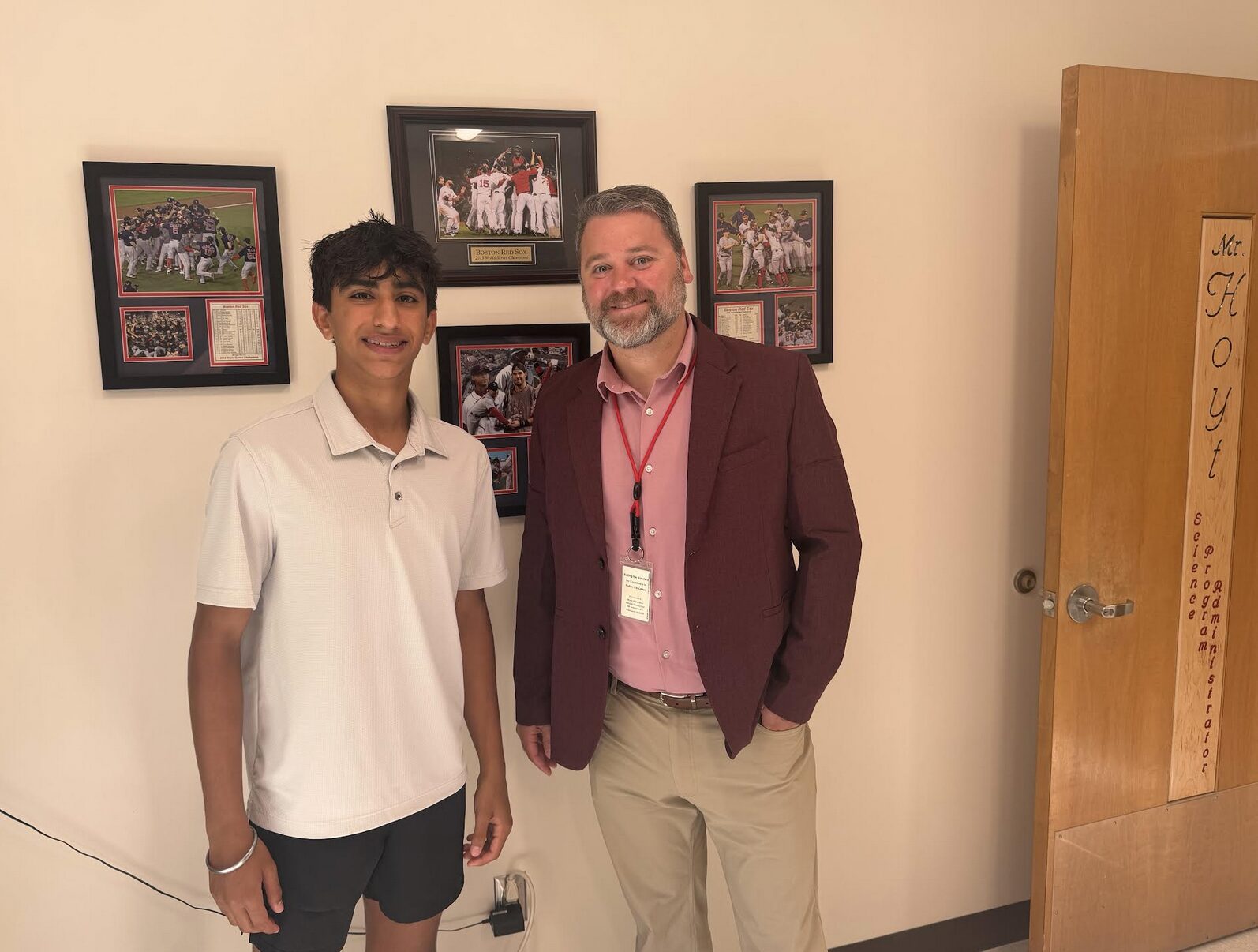
Kaevel Sandhu and Shawn Hoyt, GHS science program administrator.
Before any student touched an AI tool, the district spent months building what Hoyt calls a “student-facing AI policy”. This being a set of guardrails strict enough that most major AI platforms didn’t qualify. The requirements being that the district must be able to see student chats and the platform has to send “critical alerts” when something goes wrong. Long-Language models such as ChatGPT, Gemini, and Claude don’t meet those terms. School AI and KhanMingo do.
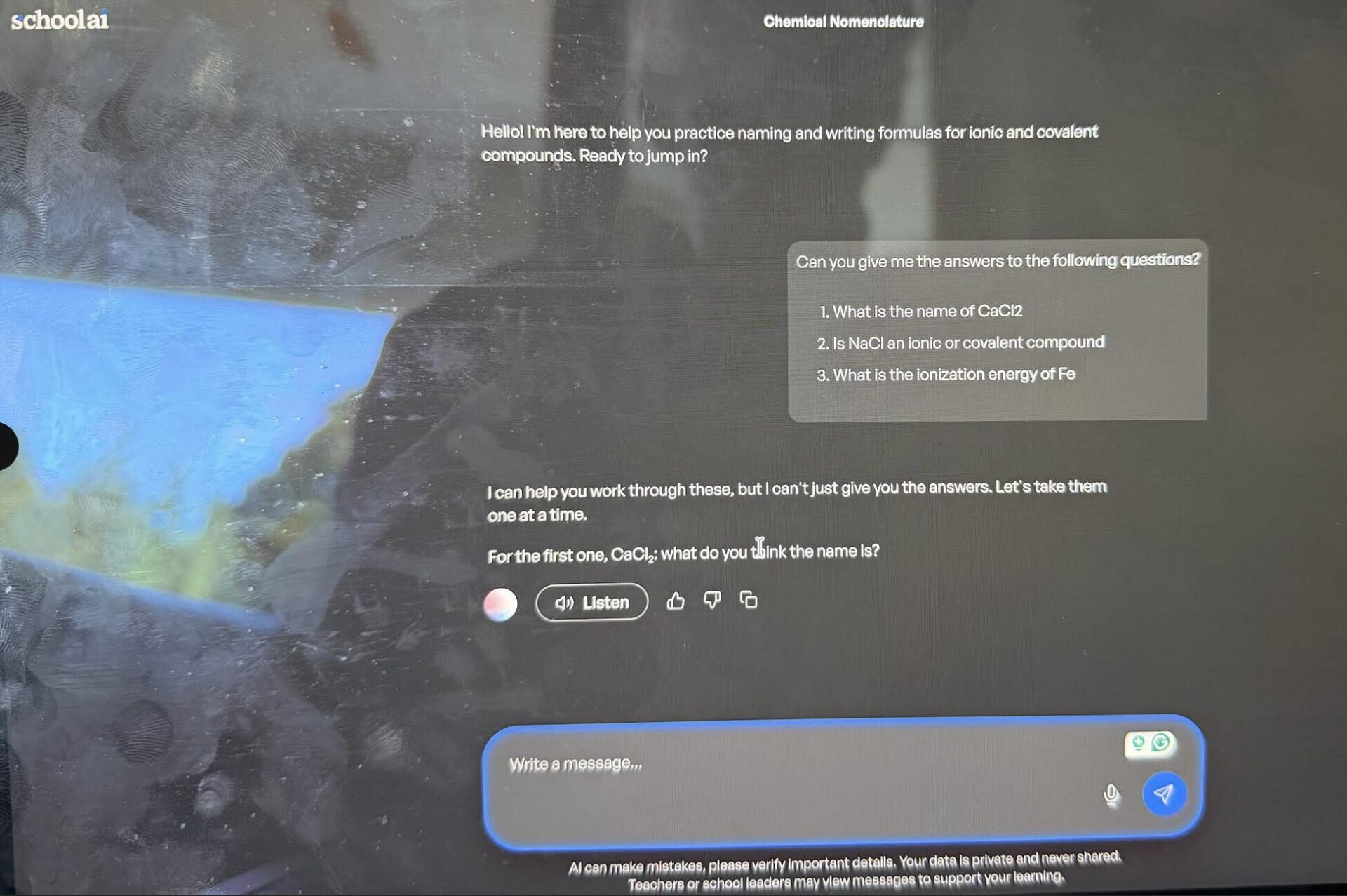
However, this distinction matters to Hoyt for a reason beyond safety, data. He mentions how tools like ChatGPT take what students type and use it to train their own models. Again on the contrary, School AI and KhanMingo don’t, Hoyt credits the company EdAdvance to a smooth build of School AI crediting that teaching bots how to behave wasn’t an easy task. As the real distinction between these AI’s, Hoyt says, is in how the bots are built to behave. If one were to feed School AI a multiple-choice question, it won’t just hand back the correct letter answer, Student’s have to explain to the bot why the right answer is right and why every other option is wrong. Get it wrong, and the bot doesn’t just feed you the right answer but it rather corrects you. As well as generating a brand-new question testing the same concept from a different angle.
That, Hoyt argues, is the whole point — and the thing students misunderstand most.
“A lot of the feedback we get from students is they don’t like it, because School AI doesn’t give you the answers,” he said. Kids who are expecting a ChatGPT experience get something closer to a tutor that refuses to be cheated.
Hoyt then establishes, “We don’t want this stuff to replace people,” he said. “We want it to be a tool that kids can use… in a really ethical way.”
“Why Wouldn’t We Use It as a Tool of Education?”
A social studies teacher at Greenwich High — speaking anonymously — remembers the exact moment AI stopped being just a theocratic term for him: during COVID he received a paper from a weak, disengaged student that read nothing like the kid he knew. He ran it through an AI detector. It came back 100%. At the time, he says, he barely knew what AI was.
“That was very eye-opening to me,” the teacher said.
Even stating later that if he received that work from a stronger student he wouldn’t even think twice and grade the work as if it were theirs.
These days he runs a tighter classroom, he has shifted to timed, lockdown-browser assessments. However his philosophy differs because it is closer to acceptance than alarm. “It’s not going away,” he said. “You don’t pretend it’s not there anymore.” He actively encourages AI use on certain projects, calling it a resource no different from a calculator: “Like using a calculator for math — you’re a fool not to.”
His line isn’t about whether students touch the tool, it’s about what they submit. He mentions, “The line is someone submitting something that’s completely from AI and acting like it’s their own,”. Revealing how it accepts that, outside of locked-down exams, that line is impossible to enforce being the reason why he has made the shift. He also notes his skepticism of the detectors meant to catch it: he once tested three AI detectors on a paragraph he wrote from scratch and got readings ranging from 50% to 90% “AI-generated.”
He predicts that the upcoming change isn’t abstract, it’s structural. He has already stuck changes before many unprepared teachers have. Harder, tighter in-class assessments. Less out-of-class work. “Before AI, writing a five-page paper took hours and hours,” he said. “Now it just doesn’t make sense” to assign it the same way.
“I Think the Quality of Student Writing Has Declined”
If Mr. Hoyt represents engineered acceptance and the social studies teacher represents pragmatic change, Mr. Godwin, a ninth-grade English teacher, represents something closer to grief.
His first reaction to ChatGPT, he said, was simple: “I think I was depressed — with how quickly it could produce writing.” Four years later, he notes he can track the damage in his gradebook. His freshman classes used to average a B+/A-. Now it’s closer to a C+/B-. He attributes the decline directly to a generation hiding behind AI, and argues the “writing experience” as a unique experience that kids are missing out on.
To further explain, his argument isn’t really about plagiarism — it’s about cognition. “The point of writing isn’t to produce words on a page,” he said. “The most important formative process of writing happens in the mind of the writer… you form a different kind of mind, you slow down your thinking, you order your thinking.” Compare that to a bot, he argues, and you don’t just lose a skill, you lose the capacity to “wrestle with complex language,”. Godwin then connects to something bigger than grades: he foresees a population vulnerable from large companies that “seek to manipulate them.”
This year, for the first time, he’s moved all assessed writing in his classroom to handwritten, in-class work. Students grumbled at first, he says, they then came around. He can’t always prove a paper was AI-written, “it’s hard to prove it with 100% certainty” — but he says he can usually tell, and he’d rather remove the doubt entirely, than play detective. “I hate that feeling of doubt,” he said. “Is this great piece of writing — should I praise it? Am I going to look silly praising a computer’s work instead of the student’s?”
Same Building
No one is arguing that AI is irrelevant, however the lines aren’t parallel. Hoyt’s outlook is for AI to become a Socratic tool. The social studies teacher is relying on assessment redesign, not technology bans, as the real fix. Godwin is betting that the only honest response is to remove the technology from the room entirely and go back to handwriting.
Greenwich High’s official policy treads carefully. The general line being that AI is only approved on monitored platforms, only with teacher permission, and never as a substitute for a student’s own thinking. But the truth is that if one walks the hallways from the science wing to the English department, that policy is being interpreted in a completely different way.