On Friday, the ACLU of CT announced that the Connecticut State Police agreed to stop breaking up highway overpass demonstrations protected by the First Amendment.
The agreement comes after a federal judge presiding over a hearing in the case denied the state police’s bid to dismiss the case and observed that parties’ positions were not that far apart. Judge Stefan Underhill directed both sides to work together to finalize an agreement. The parties successfully negotiated a settlement that provides important safeguards* for the public’s First Amendment right to peacefully protest on public sidewalks and clarifies that Connecticut State Police may not disperse lawful demonstrations.
In the First Amendment lawsuit – Quinn v. Eucalitto et al., the defendants were Garrett Eucalitto, commissioner of the state’s Department of Transportation and Ronnell Higgins, the head of the state’s Department of Emergency Services and Public Protection, which includes the Division of State Police.
The ACLU brought the lawsuit on behalf of Erin Quinn, 46, and Robert Marra, 71, both part of a local group called Visibility Brigade who have been protesting on highway overpasses.
Visibility Brigade signs – either letters on black Posterboard spelling out messages, or vinyl banners they have printed— contained messages like: “Due process is the law,” “These voices melt ICE,” “No kings,” “Love Liberty? Resist Tyranny,” and “Hands Off Our Judges.”
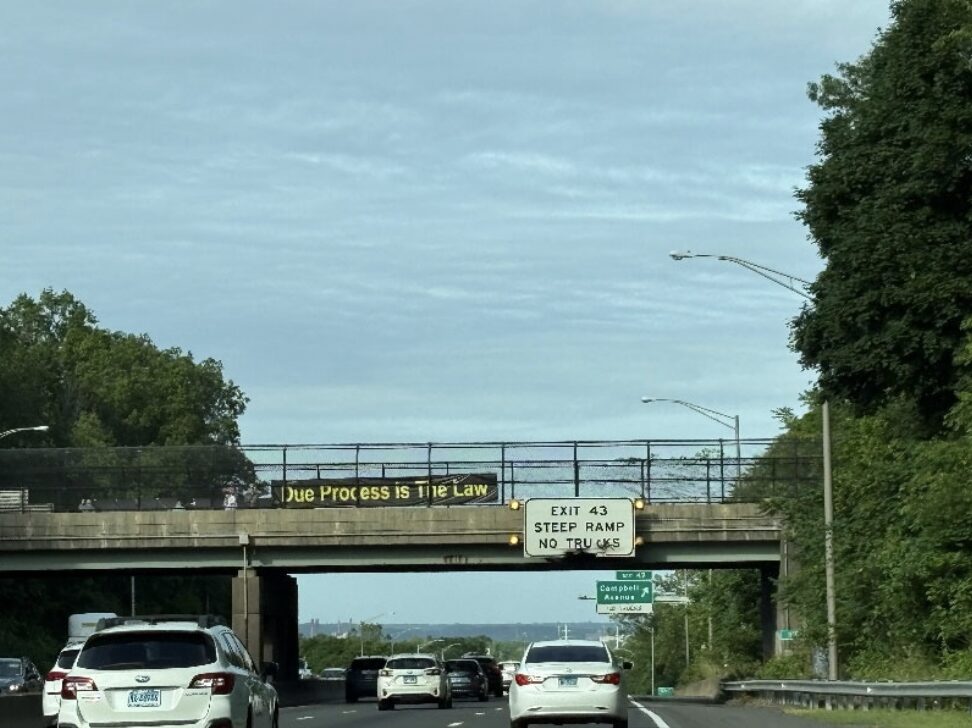
From the complaint, a banner held at one of the Visibility Brigade demonstrations.
Though Quinn and Marra, both of the New Haven area, were never arrested or cited, they stopped going out to protest out of fear of criminal prosecution. Indeed, a year ago state troopers started detaining, citing, and arresting sign-holders.
According to their complaint, “By threatening them with interruption of, arrest or citation for, and/or prosecution for their overpass sidewalk speech, the defendants violate the Speech Clause of the First Amendment to the United States Constitution.”
Their complaint explained Ms Quinn and Mr. Marra became distressed at the direction of the country,
and decided to do the most American of things about it: tell people in their part of Connecticut about their views.
“They chose southern Connecticut’s de facto main street, I-95. Standing on local roads where they pass over the interstate, Ms. Quinn and Mr. Marra have held signs imploring their fellow Nutmeggers to think about the rule of law, reject fascism, and take action to save democracy. The defendant state officials have responded by prosecuting some of Mr. Marra and Ms. Quinn’s fellow protesters, claiming variously that no signs may ever be shown to interstate traffic, or that sign-holders are criminally liable for drivers’ reactions to the signs.”
On Thursday CT State Police released a statement about the settlement reached with the ACLU of CT in the pending litigation over protests occurring over Connecticut’s highways.
“Last summer, several state legislators had reached out to us concerning protests, and we are glad that the ACLU has joined the conversation about how to best protect citizens’ First Amendment rights while ensuring that all citizens are safe on our roads and highways,” State Police said in their statement.
State Police added they plan to issue additional guidance to State Troopers and thanked the ACLU for working with them on the important issue.
“We would like to ask the public, as the Court did today, to please stay safe and limit peaceful protests to sidewalk areas.”
In their release on Friday the CT ACLU said they were glad about the settlement and that Connecticut State Police agreed to stop breaking up highway overpass demonstrations protected by the First Amendment.
The ACLU of Connecticut noted, “The case comes at a time when such demonstrations nationwide have faced heightened scrutiny and increased attempts to restrict protest activity. The resolution of Quinn v. Eucalitto helps ensure that Connecticut residents can engage in civic discourse without fear of legal retaliation.”
David McGuire, Executive Director of the ACLU of Connecticut, said, “This settlement is an important win for the right to protest at a time when we have witnessed that freedom comes under attack across the country, said Our legal team moved swiftly to defend core First Amendment rights and make clear that people in Connecticut can speak out without fear of retaliation.”
*The safeguards are as follows:
The request for preliminary injunction is resolved on the following terms:
State Troopers shall not use Conn. Gen. Stat. §§ 53a-107 (First-Degree Criminal Trespass), 53a-108 (Second-Degree Criminal Trespass), 53a-109 (Third-Degree Criminal Trespass), 53a-181 (Second-Degree Breach of the Peace), 53a-182a (Obstructing Free Passage), 53a-182 (Disorderly Conduct), 13a-123 (Restriction of Outdoor Advertising Signs), or 13a-124 (Unauthorized Signs) to detain, identify, threaten, fine, disperse, or arrest individuals for peacefully assembling or for holding up signs conveying non-commercial, political messages when those individuals are on a sidewalk of an overpass that is not a limited-access highway
In addition, State Troopers shall not detain, identify, threaten, fine, disperse, or arrest individuals for peacefully assembling or for holding up signs conveying non-commercial, political messages when those individuals are on a sidewalk of an overpass that is not a limited-access highway based on the pace, conduct, or reaction of traffic on the highway below. Nothing in this Special Order shall prevent a trooper from responding to a call for service.
This directive does not prevent State Troopers from arresting, fining, or dispersing any individual who incites imminent unlawful action, engages in fighting words, affixes a sign to an overpass fence, drops an item from an overpass onto a highway below, or who stands in a roadway.