A lengthy and momentous BET meeting on Monday was notable for the absence of discussion on possible interim appropriation for the public schools operating budget.
This came after a letter from 3 BET Republicans supporting an interim appropriation got the hopes up of many public school families that bus funding might be restored to keep the GHS 8:30am start time.
The BET voted on party lines to uphold First Selectman Camillo’s decision to channel funds from three other approved safety projects to the housing authority for a painting project despite the recommendation of the block grant advisory committee.
The BET also appointed Joan Lynch as the town’s new comptroller replacing Pete Mynarski who is retiring this summer, and approved a mill rate for the town of 12.041.
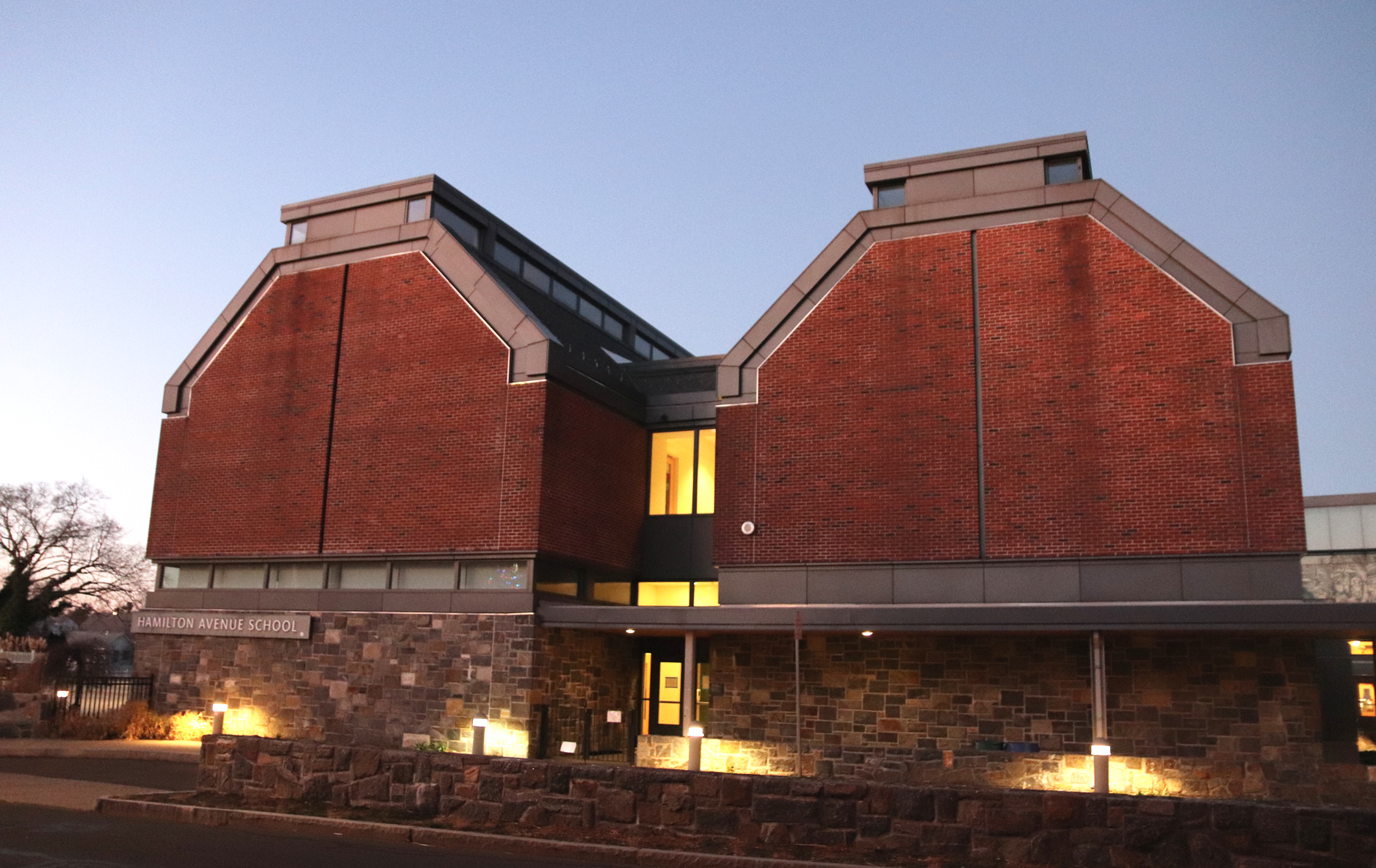
Hamilton Avenue School at dusk. Photo: Leslie Yager
Hamilton Avenue School Geothermal HVAC
Monday’s meeting also featured a contentious discussion about $325,000 of funding for architectural and engineering work on the Hamilton Ave School HVAC system.
The work is the next step in pursuing the renovation of the existing geothermal system.
It has not been operational for about two years.
An temporary system was approved on an emergency basis, costing the town $1,000 a day, $30,000 a month and $360,000 annually.
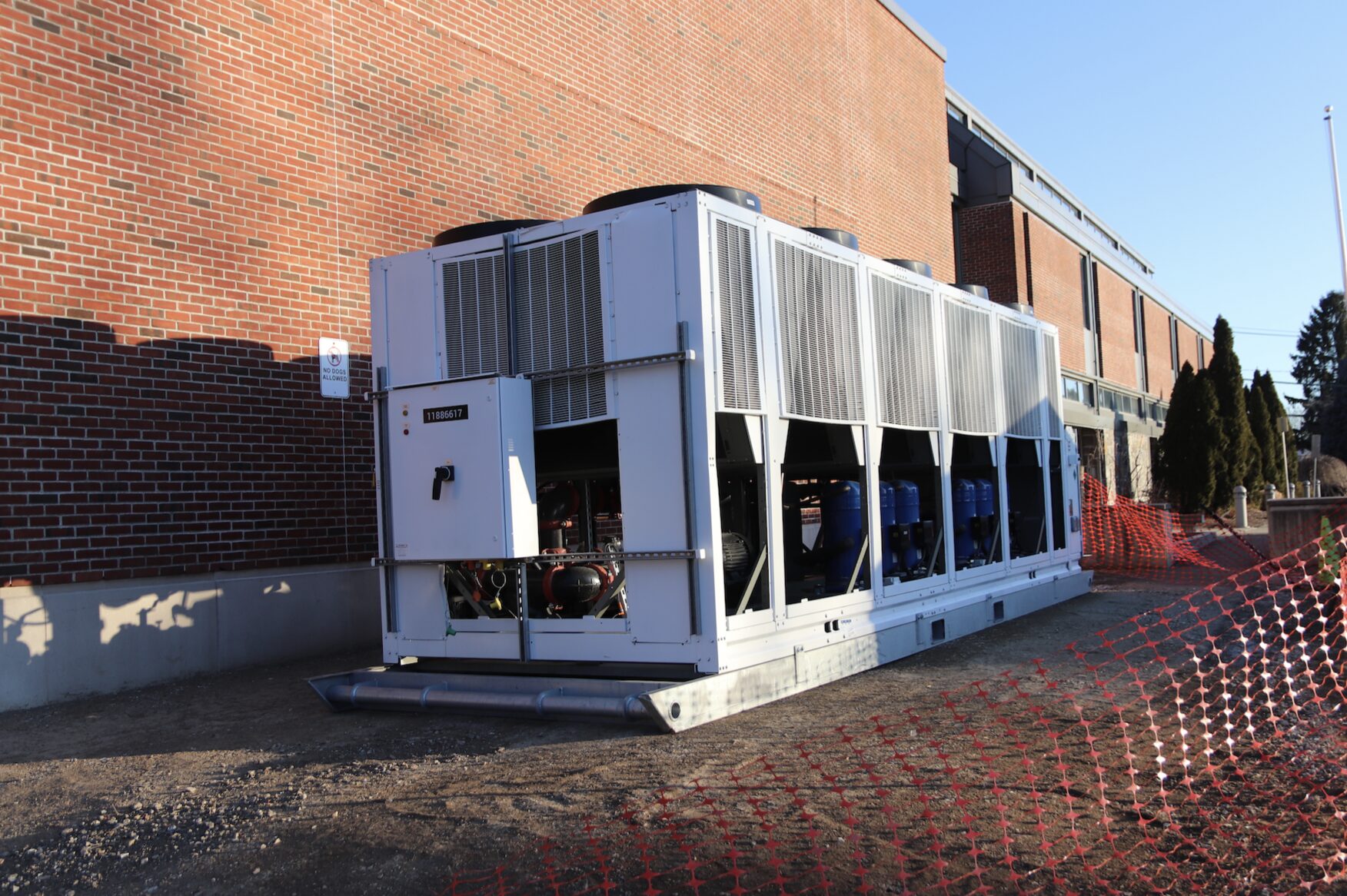
Temporary rental HVAC outside Hamilton Ave School. March 2, 2025 Photo: Leslie Yager
Leslie Moriarty, a Democratic member of the BET, noted the request for $325,000 is on the RTM June 9 call.
“In theory the project could get started as soon as this summer,” she said, warning against further delay.
Greenwich Schools COO Ben Branyan previously said work could take 2 years because it can only be done when school is not in session.
He also noted the equipment alone could take months to arrive due to ongoing supply chain shortages.
“Perhaps the design funds are something we are willing to fund ourselves, and then go after (grants for) the construction funds,” Moriarty suggested.
She noted the $325,000 amount came directly from the CIP sheet from the First Selectman’s budget.
“I’m troubled that you’re willing to give away $325,00 of taxpayer’s money,” said Republican Karen Fassuliotis.
Moriarty said a five-month delay meant longer use of the temporary system, resulting in a higher cost than the amount of a possible 10% or 20% state reimbursement.
Ms Fassuliotis nevertheless proposed a condition on the approval of funds that the Board of Education look into the possibility of forming a building committee or exploring a possible state grant and report back to the BET in June.
Republican Leslie Tarkington seconded the motion.
The board’s representative to the Energy Management Advisory Committee – EMAC – Democrat Matt DesChamps, said the question about grants had been raised numerous times, as well as ITC (investment tax credit).
He said the condition was unnecessary.
“As a result of delay for this project and others, we are no longer likely take advantage of ITC,” DesChamps said. “There is nothing that would preclude getting state reimbursement or any other grant reimbursement, including from Eversource.”
“It’s very clear the public wants this. The RTM voted overwhelmingly in favor,” he added.
DesChamps said he worried about “over-engineering the project with conditions.”
Democrat David Weisbrod agreed.
“I’m okay with idea of ‘looking into,’ but there has to be a minimum level of trust here,” Weisbrod said. “Let’s not put another hurdle on this.”
“They could write a memo that they looked into it. We can’t micro-manage every nickel that is spent,” he added.
Republican Nisha Arora explained the lack of trust.
“Two years ago the BOE said they could not do the geothermal. Mr. Watson (BOE facilities director Dan Watson) said we can not support the geothermal, so we supported the traditional …One year later when the RTM had flipped to be more progressive, the BOE suddenly said now we can do geothermal. It came to the BET and we saw the politics at play, and we said no.”
“We’ve obviously been thwarted by the RTM,” BET chair Harry Fisher said.
“Why wouldn’t we do a study on both (systems) just to get information,” Arora asked.
Ms Moriarty said both studies had been done.
“Every member of this board has received the AECOM analysis…,” she said. “The analysis showed that the capital costs are relatively the same, but there are operating cost savings (with geothermal).”
Moriarty read from the CIP sheet:
“‘After extensive consultation with AECOM and the town’s EMAC, the evaluation of the building’s heating, ventilation and air conditioning system has been completed. The 25-year life cycle shows that geothermal costs of $158,443 savings compared to a conventional system.
The proposed scope of work repurposes the two pipe changeover system and is using it as a chilled water system, replacing the water-to-water heat pumps with six heat pipe chillers connected to the geothermal fields and adding reheat coils downstream from the 8 head units for heating and reheat.
The new configuration allows the heat pumps to simultaneously produce heating hot water and chilled water for space conditioning and when the heating and cooling loads are not balanced, the geothermal field can be used as a sink or source. The current system only provides for either heating or cooling.'”
Moriarty again warned about delays.
“If this board is still dabbling with, ‘Gee, we need to spend money to design a conventional system,’ we’re wasting time and resources,” she said.
Mr. DesChamps said Mr. Watson had endorsed geothermal after the AECOM report addressed his concerns.
He said the AECOM’s report had been available for quite some time and both Mr. Watson and schools COO Ben Branyan had been assured that the school system could maintain a geothermal system.
“The new system they’re putting in is markedly different. It’s simpler to use than anything that was used in the past,” DesChamps said.
“It’s cost effective,” he added. “And it deals with the noise mitigation issue which is presented in the traditional system, which has not been priced in and would increase the cost of a traditional system.”
“To delay this more is unfair to the pubic who have been dealing with this temporary system – and it’s not cost effective to keep that in place any longer than need be.”
Ms Arora disagreed, questioning why geothermal was not being implemented in other municipal projects.
“We should not be throwing more good money after bad,” she said.
“I understand the RTM flipped this, but nothing happened in that one year other than the fact that the RTM body changed. It is a little bit more progressive now,” she added.
“If you were to poll the Greenwich community, I don’t think the majority would say we should start doing geothermal in municipal projects,” she said.
David Weisbrod disagreed.
“You don’t have the competence, background, or skill to override a study done by a world renowned engineering company, that I doubt that you read, because if you read it, the conclusions are clear and self-evident,” Weisbrod said. “There is a $158,443 savings here. I’ll go with the study and qualified engineer over anybody’s personal opinion.”
Arora said she holds a degree in chemical engineering and owns electric cars.
“I did read the report and I probably have a more background and understanding of evaluating the report than you do. When I speak about what my personal opinion is, it’s not based upon me denying climate.”
“When it’s good enough for the private sector, that’s when the public sector starts adopting it,” Arora said.
Elliot Alchek, who installed a geothermal system when he constructed his house, said two national based firms had recommended geothermal to him.
“There isn’t a lot of adoption because there is a higher up front cost,” he said. “We already have sunk costs here. We’ve already drilled these (geothermal well) holes…This is a well known technology.”
“It is completely false to say geothermal is not being used in our state,” Alchek added. “If you like, we can provide you with a list of schools across the state that have already installed geothermal.”
“What the board is really saying is I don’t care what the RTM says. I don’t care what the school says,” Stephen Selbst said. I reject that as a matter of democracy.”
“We need to make sure to respect each part of our town government,” Leslie Tarkington said.
“We’re micromanaging and conditioning things I think are superfluous and unnecessary, but if it makes you comfortable, I see no reason not to,” DesChamps said.
The board voted to add the condition to the release of $325,000 that the BOE look into state or federal grants or forming a building committee, if appropriate, to take advantage of state reimbursement and report back to the BET at their June meeting.
Mr. DesChamps joined the six Republicans to approve the condition. The vote was 7-5-0.
Motion on the $325,000 appropriation for Hamilton Avenue school geothermal A&E was passed 10-2-0, with Fassuliotis and Arora voting against.
On Tuesday morning in his WGCH 1490am radio de-brief, Mr. Fisher said the BET had wanted to go back to a conventional system.
“That is what a lot of people in the community that is served by Hamilton Avenue School wanted, but the RTM balked,” he said.
See also:
Hamilton Ave School Anti-Geothermal HVAC “Bots” Target BET & BOE Feb 26, 2025
SOMR to Encourage Net-Zero Energy Passes at RTM April 9, 2024
BOE Considers HVAC at Hamilton Ave School: “Morally Wrong to Throw Away a Geothermal System?” Sept 30, 2024
Patience Wears Thin over Noise from Temporary HVAC at Hamilton Ave School August 21, 2024