From Greenwich Police Dept Chief Jim Heavey
As Chief of Police for the Town of Greenwich, I am proud to report that our school zone speed camera program is working exactly as intended, and I want to take this opportunity to address some of the concerns that have been raised by members of our community.
Since the cameras were activated, we have seen a meaningful reduction in speeding within our school zones during school hours. This is not a coincidence. These cameras serve as a consistent, visible deterrent, and the data bears that out. The safety of our roadways is paramount, and this program is delivering results.
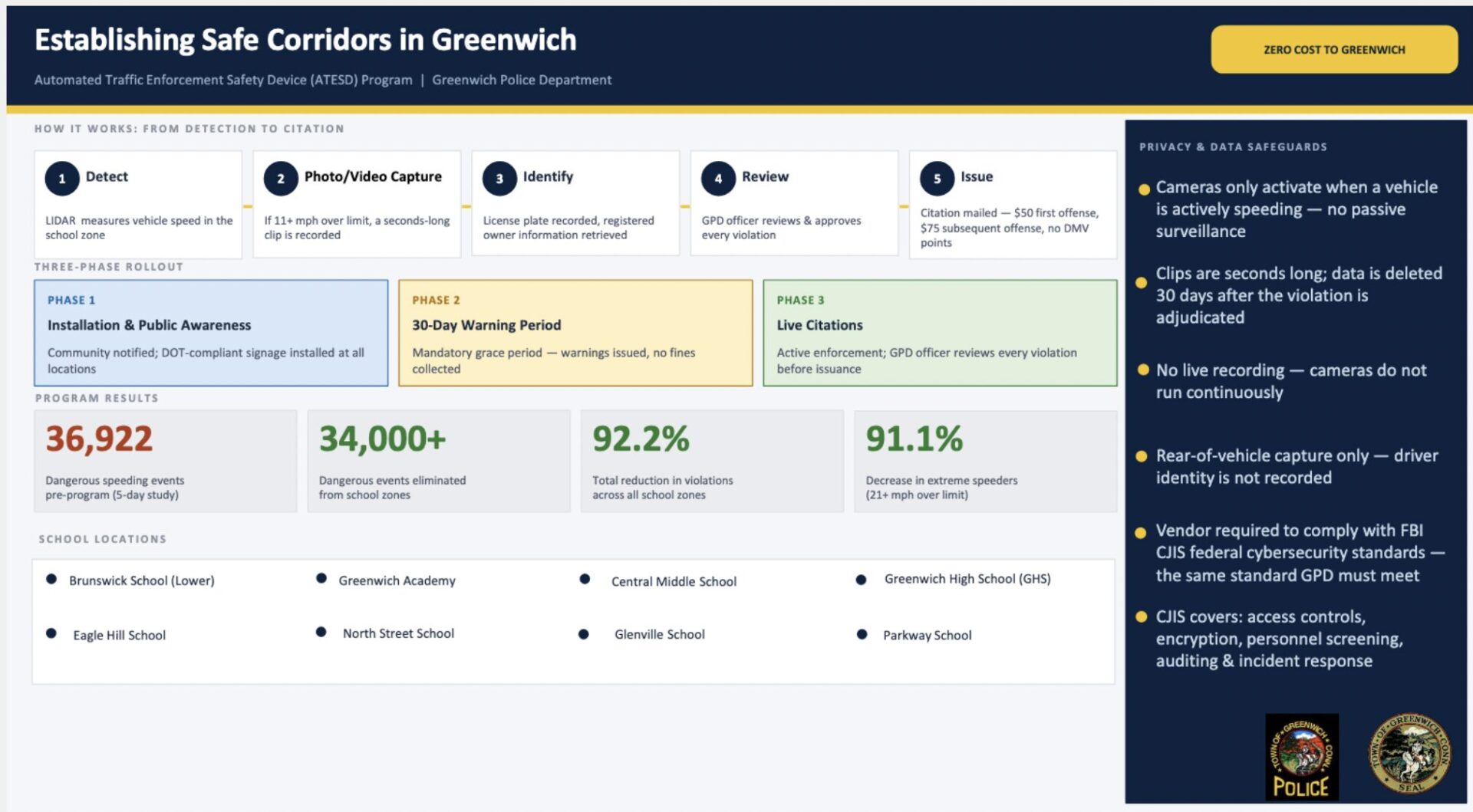
Prior to the cameras being installed, a one-week traffic study was conducted, and 36,922 violations were noted across eight school zones. During the public education phase of the program, speeding incidents were reduced to 15,319 per week (41%). Once tickets went out in the mail, weekly violations were reduced to 2,863 (a 92% reduction from the original rate). The program reduced the most extreme threat (speeders exceeding 21MPH over the limit) by 91%.
We are also committed to conducting annual traffic studies to determine where the cameras can make the most impact. Greenwich is one of over 15 Connecticut towns that have implemented this program, and one of three that is in the process of amending it. For example, we will need to adjust the plan once the new Central Middle School opens.
I also want to directly address the concerns that have been raised about privacy. I understand why residents ask these questions, and they deserve a clear, honest answer. These cameras do not conduct surveillance. They do not record live, continuous footage of our streets or our residents. A recording is only triggered when a vehicle is detected traveling above the posted speed limit within a school zone. At that point, a clip of only a few seconds in length is captured, nothing more. There is no passive monitoring, no logging of vehicles that are obeying the law, and no tracking of the movements of law-abiding drivers.
Furthermore, the images and footage that are captured are retained only until the associated violation has been fully adjudicated. Once that process is complete, the data is deleted. There is no long-term storage of resident data, and there is no database being built of who drives where and when. On the matter of data security, I want to be especially clear: The vendor operating these cameras is required to comply with the Federal Bureau of Investigation’s Criminal Justice Information Services (CJIS) Security Policy, the same stringent federal standard that governs how the Greenwich Police Department handles sensitive criminal justice information. CJIS compliance is not a suggestion or a best practice; it is one of the most demanding data security frameworks in the country, covering areas such as access controls, encryption, personnel screening, auditing, and incident response. Any company that handles data on behalf of a law enforcement agency must meet these requirements or they do not work with us. The bar is high, it is federally mandated, and it is actively enforced. Residents can be confident that the data captured by these cameras is protected to the same degree as any sensitive information held within our department.
This program was not undertaken lightly. It was designed with both safety and civil liberties in mind. I am confident that it strikes the right balance, and I remain committed to transparency as we continue to evaluate its results.
The Greenwich Police Department for many years has utilized a strategic traffic enforcement plan (STEP) to have the greatest impact on traffic safety. We look at traffic collision data, traffic surveys, and citizen complaints to determine where to assign officers to do traffic enforcement. Last year (2025), we conducted 9,091 motor vehicle stops, and this effort to enforce traffic safety resulted in a 19% reduction in injury accidents over the previous year.
Another often-presented concern is that the program is a “money grab.” When an officer issues you a traffic summons, nearly all revenue from the fine goes to the state. Yes, the vendors do receive money to cover their cost of installing the cameras and the processing, and yes, they do make a profit as a private company, but the town will now receive money that will be used for traffic safety. Under Connecticut Public Act 25-116, the monies the town receives can only be used for traffic safety improvements in the areas of education, engineering, and enforcement. Additionally, release of the funds must be approved by the town Board of Estimate and Taxation before they can be used.
While the original plan was approved unanimously by the Board of Selectmen in 2025, it should have had a public hearing like the one that was recently conducted on May 14. (Video is available on Greenwich Channel 79 website.) Once it was determined that the presentation to the Board of Selectman had not met the public act’s requirement, we suspended the program, amended our safety plan to include a public hearing, and made changes based on the state department of transportation suggestions and recommendations from the public. These changes include better signage.
Thank you for the opportunity to speak directly to our community on this important matter.
Respectfully,
Jim Heavey
Chief of Police
FAQ’s: /DocumentCenter/View/56657
Infographic: /DocumentCenter/View/56655
Public Hearing Power Point Presentation: /DocumentCenter/View/56656