At Thursday’s BOE special meeting with the main agenda item being the budget, other topics were also discussed, starting with an update on the speed cameras in school zones.
Greenwich Police Chief Heavey said the program was off to a good start.
One of our distressing observations was that there were these big yellow buses that were the violating the speed limits. We’re going to make sure you are aware of that as well. Even at schools where they were delivering kids to that school. – Greenwich Police Chief James Heavey
He noted that the speed cameras were possible because of a change in state statute enabled CT municipalities to deploy speed cameras and red light cameras if they desired.
He noted that after the town passed an ordinance, and an extensive survey were conducted of both public and private schools to identify locations where speeding is a problem, Greenwich Police selected a vendor called Blue Line.
He said as part of the vendor model, there was no cost to the town to install this system.
Heavey said a portion of fines go to the vendor and a portion goes into a special account for the town he called the 3 E’s: Education, Engineering and Enforcement, to keep the schools safe.
The speed camera system started in November with the first 4 speed cameras. Then five more zones were added more recently.
During the first 30 days the vendor issued warnings by mail.
Subsequently, the vendor sent violations with fines of $50, plus a service fee.
The second fine is $75, plus a service fee.
Heavey said people can appeal a ticket to the civilian police advisory board, appointed by the Board of Selectmen, who will review tickets that are challenged.
“A fourth way it can be challenged is up to the courts in Stamford,” Heavey said. “We’re still working with the relationship there because we are one of the first towns in Fairfield County to do the system.”
As for red light cameras, Heavey said only 2 intersections in town – at exits 3 and 5 – might be appropriate.
However, he said, “Our option is not to put cameras there right now because but the solutions might cause more accidents than it might (prevent).”
Heavey shared data provided the previous day from the speed camera vendor: When warning tickets were issued at Eagle Hill School on Glenville Rd there were about 1,230 violators who received warnings.
“After the 30 day warning, it was down to 116 summonses being issued,” he said. “I think the word has gotten out.”
Another place where there were a lot of violators was North Street School, with 4,341 violations during the school day during the 30-day warning phase, which dropped to 107 violators for summonses including a fine in the next month.
“In both cases, you look at almost a 90% reduction in speeders. And the company initially from their research said it would be about 70%,” Heavey said.
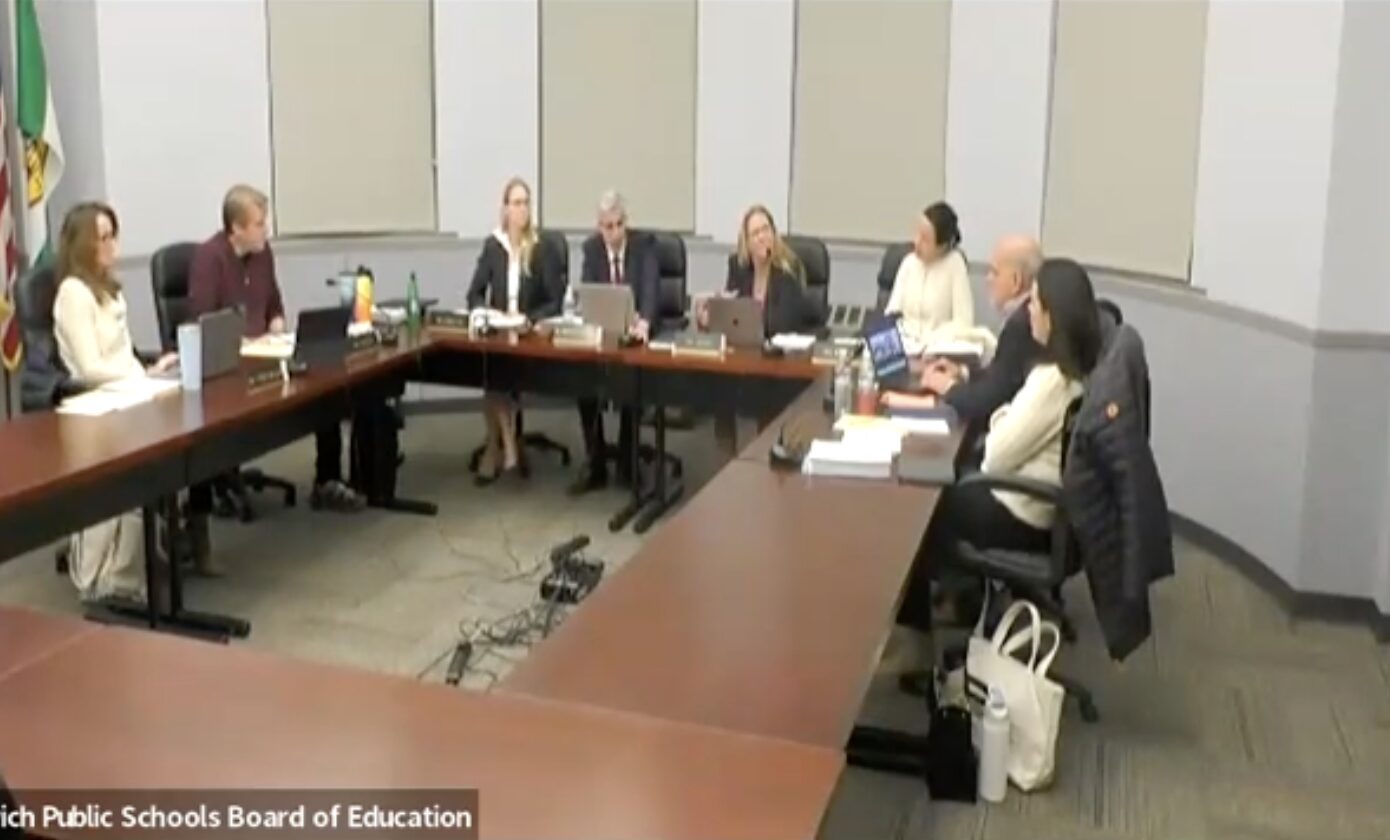
Heavey said he consulted the police traffic expert, Sgt Smith, a GHS graduate and longtime police officer who today runs the Traffic Section, and noted, “One of our distressing observations was that there were these big yellow buses that were the violating the speed limits. We’re going to make sure you are aware of that as well. Even at schools where they were delivering kids to that school. We’re hoping now that is something made public, that will work out better.”
“If we were to collect the fines for all the tickets that were issued so far – and it’s only been about six weeks – it would be about $30,000.”
He said it was not a “money grab,” but rather a portion of the fines will go back into the account for programs to make school zones safe.
Heavey said the zones were a mix of Greenwich public and private schools, but police applied to the state for permits to use the speed cameras at all schools, but the eight zones were selected based on the highest rates of speeding.
Lastly he said there will be an opportunity to adjust the locations of the cameras at Central Middle School when traffic patterns change there.
Asked about privacy, he said, as with License Plate Readers, the cameras were a critical component of making the recent arrest of a suspect for grabbing a student.
Similarly he said there will likely also be a limitation on how long the information is stored. He said generally after 90 days the LPR data is cleared.
Karen Hirsh, who Zoomed into the meeting remotely, asked about the hours the speed cameras are activated.
Heavey said the cameras are active 1/2 hour before first bell and a 1/2 after last bell, when lights are flashing.
“We enforce the speed the flashing lights indicate to 20 or 25mph, and during the school day, it would enforce the normal speed, which is either 25 or 30mph.”
“Speaking for myself, if you’re realized a 90% reduction in some of these places where you’ve installed these cameras, that says it all right there,” BOE chair, Dr. Michael-Joseph Mercanti-Anthony said. “I’d love to seem them all across town. I think this is vitally important for the safety of our kids.”
Sophie Koven asked if GHS administration would communicate about the speed camera program. Heavey said the SROs had put out the information, as well as information about e-bike safety and importance of wearing helmets.
Wendy Vizzo Walsh asked if the speed cameras were initiated by Chief Heavey or the Governor.
Heavey said the town has had LPRs for several years. Initially they were on the police cars, but now they are in fixed locations and have been critical in solving a number of crimes. He said the LPRs have been used in coordination with other states and towns, and had been critical in solving auto thefts, burglaries and missing persons.
Heavey said there are over 600 cameras throughout BOE properties.
Ms Kraus asked about the retention policy of the BOE camera data.
Heavey said data was retained for 90 days unless there is a criminal matter or investigation open, in which case data is kept for two years.