YWCA Greenwich hosted the 2026 Coretta Scott King and Dr. Martin Luther King Jr event on Thursday with a focus on the value of “third spaces” – places where organic social connections are made, including for example, playgrounds, basketball courts, parks, swimming pools, community gardens, libraries and places like the YWCA where programming brings the community together.
The idea of the event, held each January, is to select a theme that would have resonated with Dr. King.
The keynote speaker was Eric Klinenberg, author of the best-selling book, Palaces for the People: How Social Infrastructure Can Help Fight Inequity, Polarization, and the Decline of Civic Life.

US Senator Richard Blumenthal spoke at the YWCA Greenwich’s Coretta Scott King and Dr. Martin Luther King Jr. Annual Conversation. Jan 22, 2026 Photo: Leslie Yager
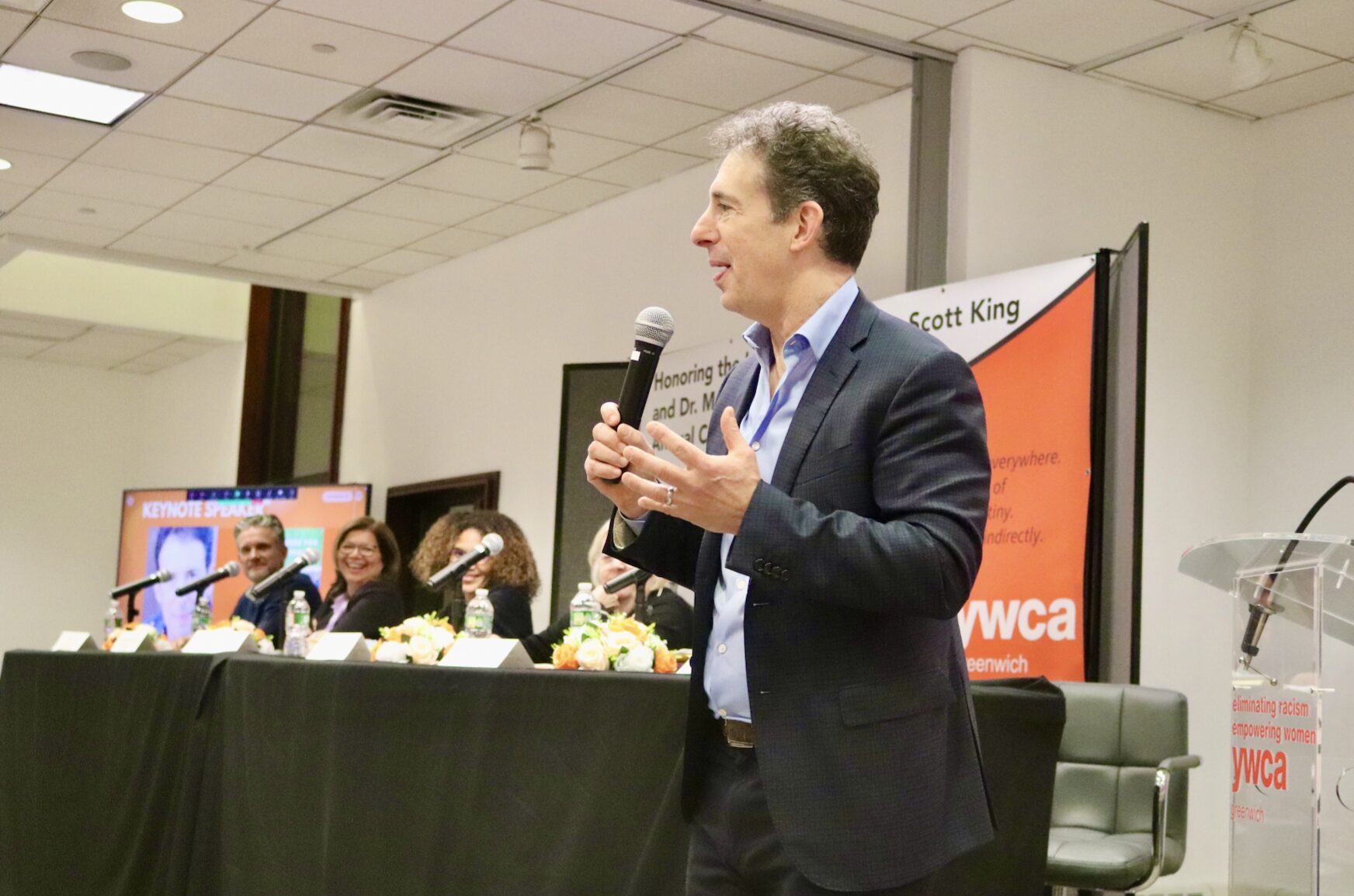
Keynote speaker Eric Klinenberg at the YWCA Greenwich’s Coretta Scott King and Dr. Martin Luther King Jr. Annual Conversation. Jan 22, 2026 Photo: Leslie Yager

Greenwich Board of Estimate and Taxation chair David Weisbrod, State Rep Tina Courpas (R-149) and State Rep Hector Arzeno (D-151) at the Coretta Scott King and Dr. Martin Luther King Jr. Annual Conversation. Jan 22, 2026 Photo: Leslie Yager

Greenwich Board of Estimate and Taxation chair David Weisbrod, State Rep Hector Arzeno (D-151) Greenwich Planning & Zoning Commission chair Margarita Alban and Margaret Simon at the Coretta Scott King and Dr. Martin Luther King Jr. Annual Conversation. Jan 22, 2026 Photo: Leslie Yager
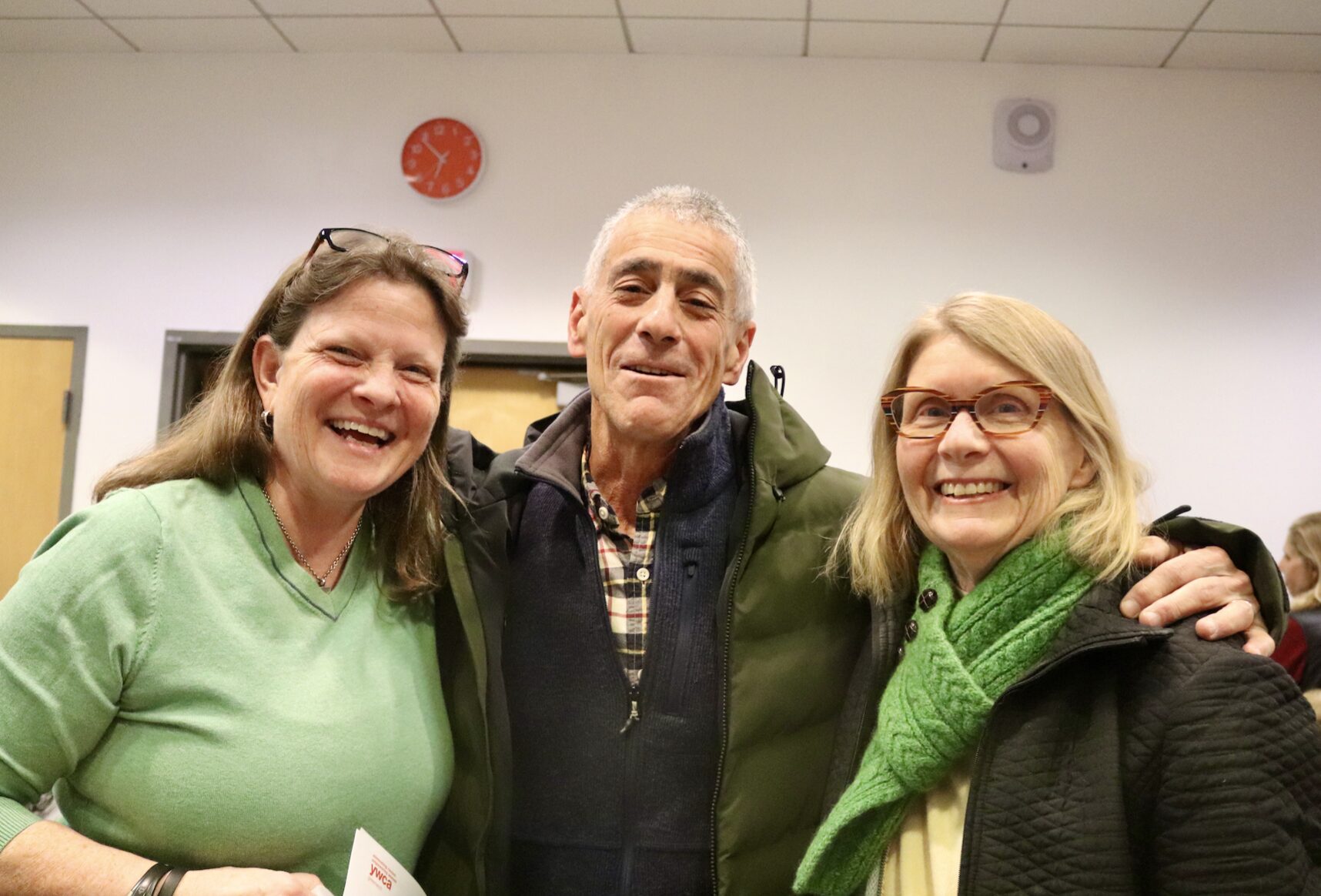
Connie Blunden with Bob and Jan DeAngelo at the Coretta Scott King and Dr. Martin Luther King Jr. Annual Conversation. Jan 22, 2026 Photo: Leslie Yager

Keynote speaker Eric Klinenberg at the YWCA Greenwich’s Coretta Scott King and Dr. Martin Luther King Jr. Annual Conversation. Jan 22, 2026 Photo: Leslie Yager
Klinenberg said social infrastructure was vital to a democracy and critical today given America’s ideological polarization.
He noted that Dr. King’s message was not to wait for a charismatic leader to unify people.
“I don’t think we’re going to solve this thing on Twitter either,” he said, going on to talk about how organic connections are made on playgrounds where parents talk to each other.
“You learn about that development project down road, of a site that’s polluted, or an eviction that’s happened. Information gets moved from one family to another and the playground becomes like a mini civic hub. When you have a good playground, you also start to meet people.”
Klinenberg said the urge to convene was as important as having a place to gather.

Eric Klinenberg was the keynote speaker at the Coretta Scott King and Dr. Martin Luther King Jr. Annual Conversation. Jan 22, 2026 Photo: Leslie Yager
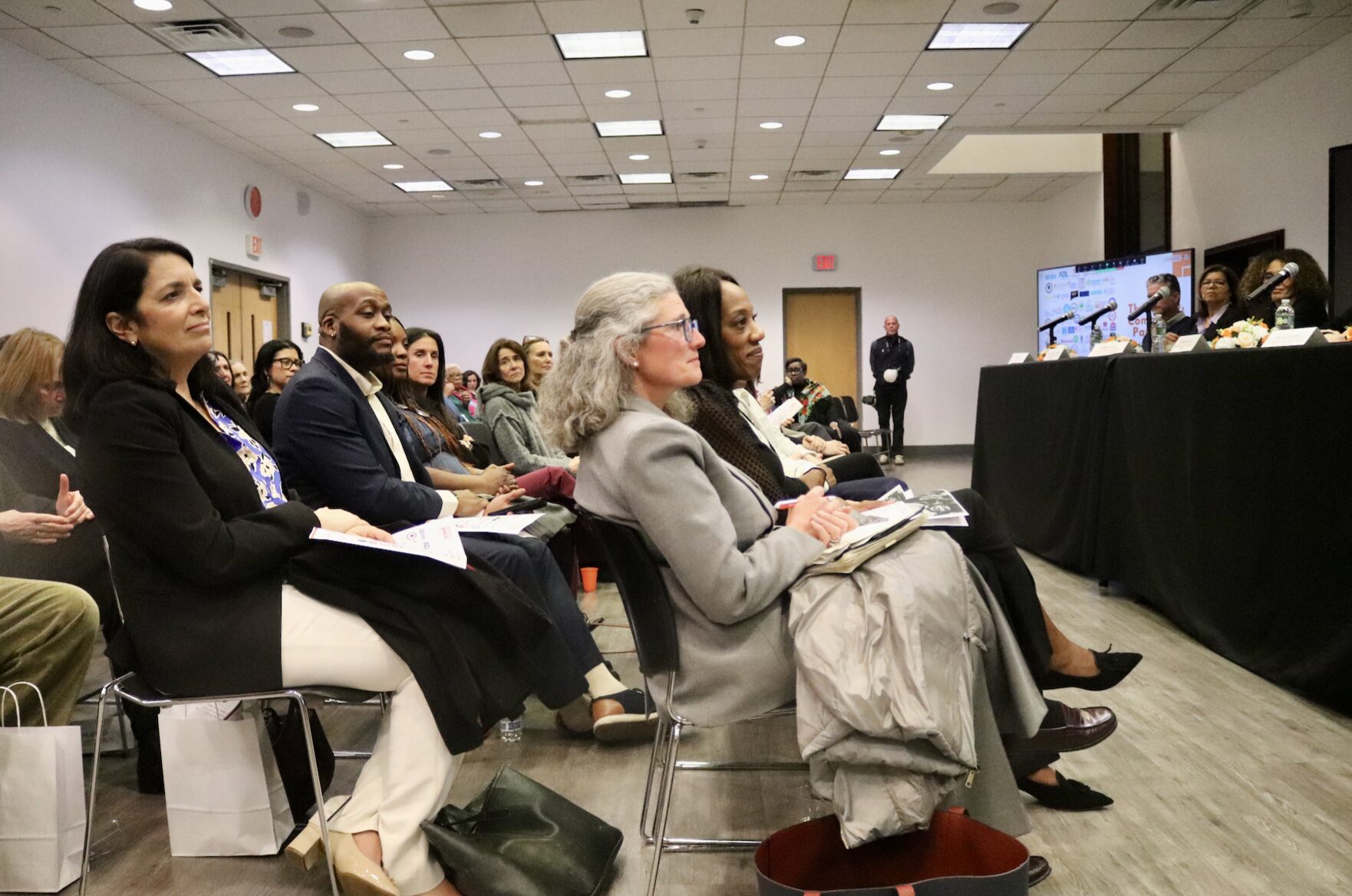
Audience for the Coretta Scott King and Dr. Martin Luther King Jr. Annual Conversation included State Rep Tina Courpas (R-149) (left) and Selectwoman Rachel Khanna (right) at the Coretta Scott King and Dr. Martin Luther King Jr. Annual Conversation. Jan 22, 2026 Photo: Leslie Yager

Maggie Young; Danielle Jean-Guillaume Sittol, LMSW Youth Services Bureau Administrator Town of Greenwich – Department of Human Services; , Heila and Demetria Nelson at the at the YWCA Greenwich’s Coretta Scott King and Dr. Martin Luther King Jr. Annual Conversation. Jan 22, 2026 Photo: Leslie Yager
“The fear I have today is we’re letting that slip away. We’re hearing about polarization, division and inequality. We have a sense that the idea of a shared purpose is slipping away.”
“We spend a lot of time thinking about our cultural values,” he added. “But if we don’t have a place where we can actually come together and work together, it doesn’t matter what your values are because you’re sitting at home on your screen.”
Klinenberg argued that good social infrastructure should not be perceived as a luxury, but rather as vital, essential community infrastructure.
“We spend a lot of time thinking about our cultural values, but if we don’t have a place where we can actually come together and work together, it doesn’t matter what your values are because you’re sitting at home on your screen.”

Mary Lee Kiernan, who is the YWCA Greenwich’s President and CEO, welcomed the audience to the annual Coretta Scott King and Dr. Martin Luther King Jr. event. January 22, 2026 Photo: Leslie Yager
Mary Lee Kiernan, who is the YWCA Greenwich’s President and CEO, noted that 72 partners co-sponsored the event including schools, houses of worship, Greenwich Police Dept, non-profits, Fairfield County Community Foundation, funders and others, including YWCA’s elsewhere in Connecticut.

US Senator from Connecticut Richard Blumenthal greets keynote speaker Eric Klinenberg at the Coretta Scott King and Dr. Martin Luther King Jr. Annual Conversation. Jan 22, 2026 Photo: Leslie Yager
United States senator from Connecticut Richard Blumenthal, who has supported the YWCA’s work toward diversity, equity and inclusion, and efforts against domestic violence, invoked remarks from Robert F Kennedy who said in a 1968 speech at University of Kansas that economic metrics failed to measure the nation’s well being.
Paraphrasing RFK’s remarks, he said, “We measure our gross domestic product – we have numbers and metrics – that tell us everything about America except what’s important, which is the education of our children, the quality of their play, the excellence of our open space and the beauty of our surroundings.”
Blumenthal said he often attended immigration naturalization ceremonies in courthouses where immigrants become citizens.
“Very often immigrants will say to me, ‘I love America. We have libraries here. Nobody asks me any questions. I pick up and read books and it’s free,'” he said.
“The health of our communities should be measured by how much we invest in and whether we support our public spaces that bring us together as the Y is doing right now,” Blumenthal added.

He noted that while today there is an assault on DEI, “the moral ark of the universe is long but it bends toward justice.”
He characterized social infrastructure as “the glue that binds us.’
The Senator said he included the places where ballots are cast as part of social infrastructure.
“I hope people will realize the stakes we have in maintaining our rights, our elections, our fourth amendment rights against people battering down our homes, and our fifth amendment rights including the right to equitable treatment,” he added.
Congressman Jim Himes shared remarks remotely, saying the solution to the current polarization was for people to work together.
“We are social creatures. We are happiest and most fulfilled when we are with other people. While that often means family, families sometimes can’t absorb the pressure of the expectations put on it,” he said. “So these third spaces – churches, taverns and social clubs are essential to the social connections that we literally need for our health and longevity.”
Himes noted Dr. King led a movement that was nurtured in the churches of the south – third spaces – where people gathered to think about the greater good.
“Democracy owes a good chunk of its existence to people gathering in bars and coffee shops, and talking about how they feel and becoming united around ideas. This is one of the many reasons that kings, despots and dictators are suspicious of third spaces – of labor unions and churches – because those are the places that we become most active,” Himes said.
“What is happening in this country is not consistent with the gospel of the Christian religion, nor is it consistent with our laws,” he added.

Director of the Center of Equity and Justice at YWCA Greenwich, Simone Quartey, posed a question to Eric Klinenberg at the Coretta Scott King and Dr. Martin Luther King Jr. Annual Conversation. Jan 22, 2026 Photo: Leslie Yager
The panel discussion was moderated by Simone Quartey, Director of the YWCA Greenwich’s Center for Equity & Justice.
Panelists including Carmen Hughes, Director of Diversity, Equity and Inclusion for the City of Stamford; Seila Mosquera-Bruno, Commissioner of Housing for the Sate of Connecticut; Denise Savageau, Environmental Activist; and Andrew Clark, Director of the Institute for Municipal and Regional Policy (MRP) University of Connecticut.

Panelists offered insights and anecdotes about third spaces connecting people who might not otherwise have a chance to meet.
Denise Savageau described the intersection of environmental justice, housing policy and social infrastructure.
“The idea that we were putting houses in places that were polluted or had a lot of noise or for whatever reason was where nobody else wanted to live. We were putting people in flood plains and places housing shouldn’t be,” she said, recalling a conversation with a State Representative who said it was alright to build housing in a flood plain because it was better than no housing at all.
“No!” she said. “From down in New Orleans, did we learned nothing about putting the most vulnerable people in flood planes?”
“Part of environmental justice is not just making sure…we’re building in the right places, but that we have open space, pocket parks, and access to green spaces. I think during Covid, if we did learn anything, it how valuable it is to be outside and in these green spaces.”
Here in Greenwich the topic of environmental justice and green space has emerged as skyrocketing land values have paralleled the increased need for housing of all types.
Over and over, with 8-30g affordable housing applications to Greenwich Planning & Zoning, the commission has urged developers to include outdoor space, playgrounds, and trees.
In 2023, former Architectural Review Commission member Kate LoBalbo was skeptical of a housing authority project for affordable housing in Cos Cob proposed tucked into the slope along I95 called Ferris Landing. “What we try to do when we build these new housing communities is not build them in environmental injustice zones – not between loud train stations and loud highways with a large amount of air pollution,” LoBalbo said.
Other developments the P&Z commission struggled with include the 8-30g proposed for the site of the former Honda dealership on Mason Street with issues including contamination, lack of setbacks and the questions about equity between the affordable and market rate.
“We’ve got to be very careful from an environmental justice point of view,” said P&Z chair Margarita Alban said in 2024. “We have to be very careful that this site is not so contaminated that it would not be usable for residential.”
Neighbor Andrew Collins testified during public comment, “Setbacks are for introducing light and air, and creating high quality housing.”
Though the commission approved the application with conditions, and the state recently announced a grant of $8 Million via a state DECD program for remediation of the site, the development is still the subject of litigation.

Denise Savageau, environmental activist and former director of Greenwich’s Conservation Department, was a panelist at the Coretta Scott King and Dr. Martin Luther King Jr. Annual Conversation. Jan 22, 2026 Photo: Leslie Yager
Former conservation director for the Greenwich, Denise Savageau said Greenwich Community Gardens fostered connections and community.
She recalled how her contacts from the gardens at a housing authority property were invaluable during SuperStorm Sandy when she was working the town emergency operations center.
Though the housing was not in danger of flooding, after a week without electricity residents were growing desperate.
“I started getting emails from people who were saying I have no lights. The emergency lights went out in the hallways. They had no food because their refrigerators weren’t working and they wouldn’t go out because they were afraid of looting,” she recalled. “That’s the power of a sense of place and the idea of the community gardens, and the idea that people who work in those gardens were able to open up the public housing complex to first responders.”

CT Housing Commissioner Seila Mosquera-Bruno was a panelist at the Coretta Scott King and Dr. Martin Luther King Jr. Annual Conversation. Jan 22, 2026 Photo: Leslie Yager
CT Housing Commissioner Seila Mosquera-Bruno, who was originally from Ecuador and came to the US without speaking English, said her neighborhood provided social infrastructure.
“We took care of each other,” she said of her neighbors. “And through food – a sense of community, we trusted each other.”
She said she learned from her grandmother to cook and to this day invites her friends and neighbors over to eat, dance to a Salsa band and share Latin culture.
Mosquera-Bruno said an affordable housing development called The Monarch recently opened in New Haven featuring a computer room for children and space for socializing.
“Because when you’re in an apartment building, you don’t have that much space,” she said. “It is very welcoming and they have a space where they can meet with friends.

Andrew Clark, Director of the Institute for Municipal and Regional Policy (MRP) University of Connecticut, at the Coretta Scott King and Dr. Martin Luther King Jr. Annual Conversation. Jan 22, 2026 Photo: Leslie Yager
Andrew Clark who is the director of UConn’s Institute for Municipal and Regional Policy previously served as clerk of the Connecticut General Assembly’s Appropriations Committee and as an aide to House Chair William Dyson for 5 years, where he assisted in the development and passage of significant criminal justice system reform legislation.
He described living in one of the poorest neighborhoods in Hartford for 30 years, and is interaction with local kids in a community garden.
“They were curious and wanted they wanted to learn about gardening and taste things. There were wonderful people from all different backgrounds and ways of life – from the Caribbean, from Asia, and growing different things,” he recalled. “And then the tragedy of watching some of those kids get older and then fall into the justice system was profound.”
He lamented the amount of money spent on prison beds in Connecticut and the disparities in rats of imprisonment for whites, blacks and Latinos.

Carmen Hughes, Stamford’s director of DEI at the Coretta Scott King and Dr. Martin Luther King Jr. Annual Conversation. Jan 22, 2026 Photo: Leslie Yager
Carmen Hughes, Stamford’s director of DEI, talked about intentionally designing public spaces to accommodate neighborhood needs and her work to make sure places like city parks the libraries are inclusive.
She talked about the value of public swimming pools to combat high drowning rates, fear of water and promote the value of swim lessons.
She emphasized that countless relationships blossom from parks, and spoke of the importance of cleaning up litter, having safety patrols and adding trees and greenery.
Upcoming YWCA events include the annual Stand Against Racism on April 29th at noon in Greenwich Town hall.
See also:
Milestone Reached: YWCA Greenwich Breaks Ground on Renovation and Addition Sept 22, 2025

Eric Klinenberg was the keynote speaker at the Coretta Scott King and Dr. Martin Luther King Jr. Annual Conversation. Jan 22, 2026 Photo: Leslie Yager