By Jim Cameron
 When you think of P.T. Barnum your first thought is probably about his circus, or maybe his museum of oddities in 1840’s New York City.
What you may not know was that Barnum lived in Bridgeport and was once a State Representative in Hartford and, in 1875, Bridgeport’s mayor. His real genius wasn’t just in filling circus tents. It was understanding logistics…how to move goods, people and opportunity efficiently.
Barnum was truly a city builder, especially because he understood that Bridgeport’s future depended on its railroads.
When the New York and New Haven Railroad reached Bridgeport in 1849, most people saw a passenger line. Barnum saw the foundation of an industrial empire. He invested accordingly, donating land for Seaside Park, backing Bridgeport Hospital and subdividing his 30-acre Waldemere estate into neighborhoods that attracted Bridgeport’s industrial elite. But most importantly he knew those civic amenities couldn’t survive without an economic engine.
That “engine” was the New Haven and Housatonic Railroads.
The railroads gave Bridgeport something neither Hartford nor New Haven could match: direct coastal access plus rail connectivity to New York, Massachusetts, and the entire Northeast. Manufacturers could ship south to New York markets, north to New England, and worldwide via Long Island Sound.
Bridgeport manufactured everything: sewing machines, buggies, machine tools, munitions, every product imaginable. But by the 1880s, there was a problem.
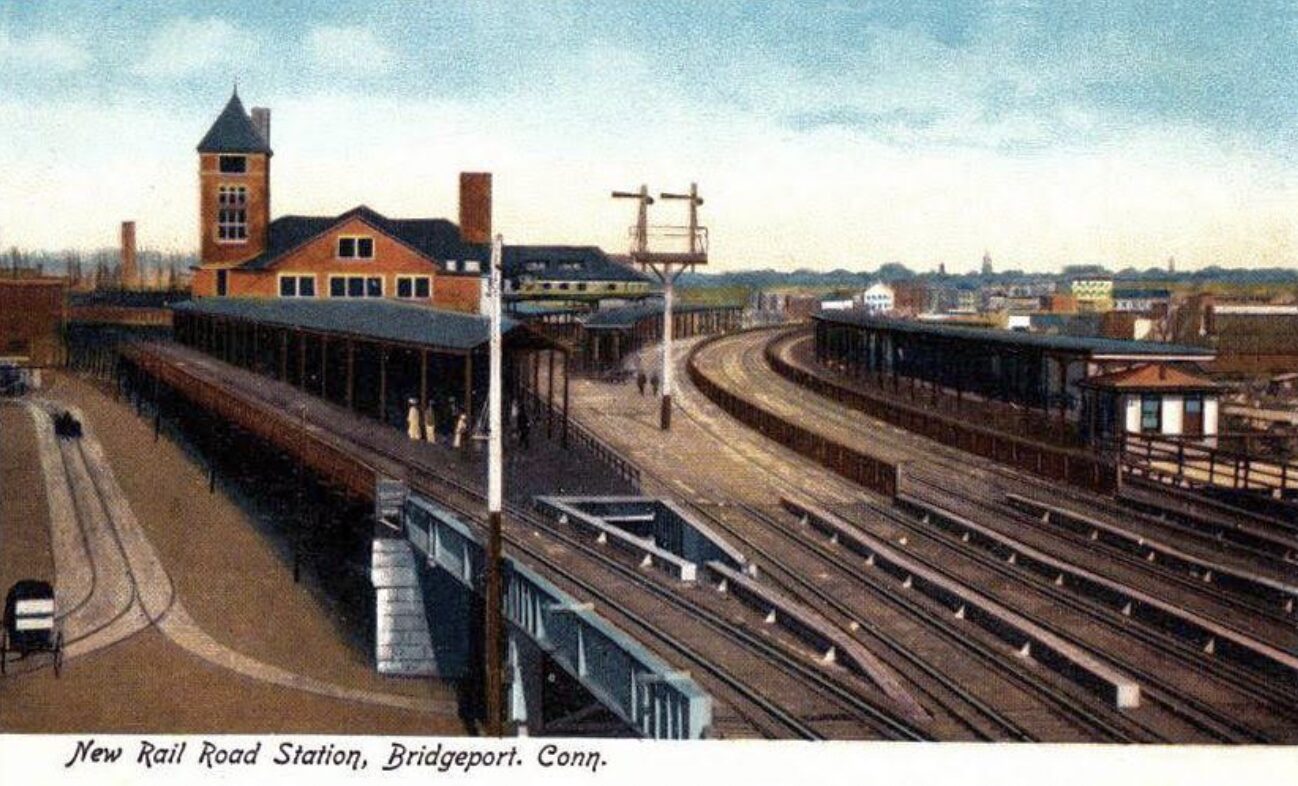
Bridgeport’s railroad tracks used to run at street level right through downtown…trains competing with pedestrians, horses, carriages. It was constant gridlock. For local factories trying to move freight 24/7, those grade crossings were a productivity killer.
As mayor in 1875-1876, Barnum pushed hard for grade separation, elevating the tracks above street level. Though he didn’t live to see it completed, the New Haven Railroad spent $5 million in the 1890s ($183 million in today’s inflated dollars) to build that viaduct.
Think a kind thought of Barnum the next time you ride Metro-North through Bridgeport, high above the streets.
Once those tracks were elevated, something remarkable happened. The Railroad Avenue industrial district exploded. No more street-level bottlenecks. Freight trains moved around the clock. Factories adjacent to the viaduct could load and unload directly onto rail cars. Bridgeport boomed, eventually becoming one of Connecticut’s largest cities, filled with skilled immigrants making good money.
What Barnum understood better than most modern planners was that you can’t build a thriving city on civic projects alone. Parks and hospitals matter. But they’re all built on an economic foundation.
Today we’ve got it backwards. We debate roundabouts and bike lanes while underinvesting in regional rail connectivity. The New Haven Line still runs through Bridgeport. It still carries passengers and could still be an economic engine… carrying freight.
Why no freight trains today along the coast? Stay tuned.